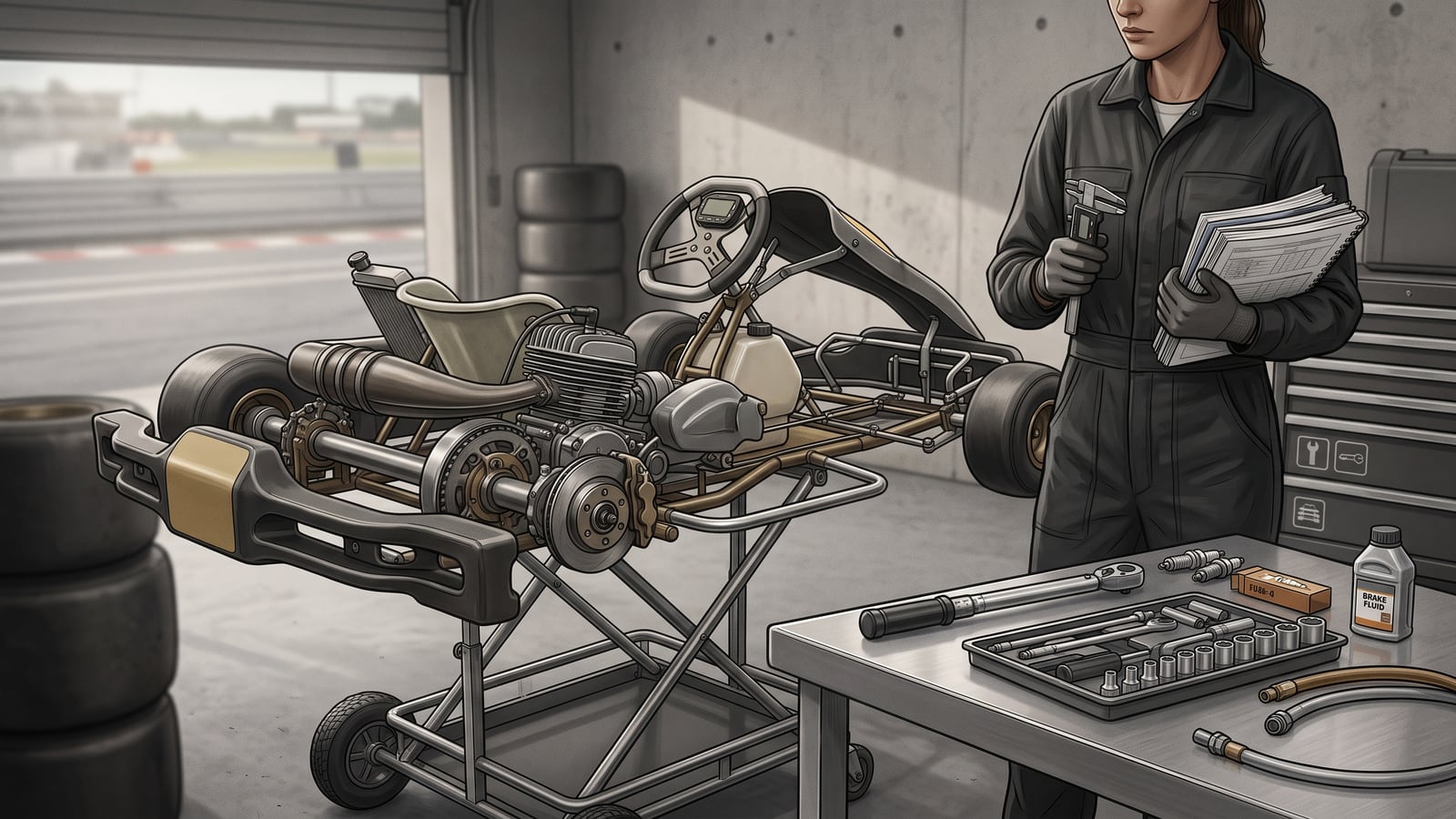
A maintenance schedule built from memory, a friend's number, or whatever interval sounded reasonable at the time can look tidy — right up until it turns out to be wrong for your engine, your chassis, or the event you're entering.
The fix isn't more discipline. It's a different starting point: build the schedule from the documents that control your equipment, then keep it honest as you go.
Document-led starting point
Before you write down a single interval, figure out exactly what you're maintaining: the chassis model, the engine family, any hydraulic or electrical extras bolted to it, and the club or governing body whose rules apply to your events. Each of those has its own paperwork — an owner's manual, a service bulletin, a class regulation — and that's what sets your intervals, not a general sense of what karts usually need.
That holds even for guidance that looks universal. FIA Karting's Version 4 private-testing guidelines are non-regulatory minimum-safety guidance, and applicable law and national ASN requirements take precedence over it whenever they set a different standard, so following the guidance alone does not guarantee safety. Treat it as one input, not a substitute for checking your own rulebook.
No interval in this article is universal: the CRG and Rotax figures used as examples later come from their own manuals and apply only within the product and document scope named alongside them, while the worked calculation further on uses openly invented, fictional numbers for illustration only. Before you write anything into your own log, confirm the number against your current manufacturer manual and the applicable governing authority for your class and event. That single check — right document, right edition, right authority — is what separates a schedule that protects you from one that just looks organized.
Four trigger sorting labels
Once you've got the right documents, you'll notice their instructions don't all work the same way. Sorting them into four types keeps the log usable instead of a wall of text:
- Pre/post-session checks — things you look at before or after every run, no matter the hours: fluid leaks, loose fasteners, visible cracks.
- Elapsed operating exposure — tasks triggered by hours, laps, or distance run, which only tick forward while the engine or chassis is in use.
- Calendar thresholds — tasks triggered by time passing regardless of use, like a shelf-life limit your document sets for a fluid or component.
- Condition or incident overrides — anything triggered by what you find or what just happened, which jumps the queue ahead of any scheduled date.
These labels are just a way to file what your manuals already say — they're not a claim that every kart needs one task from each bucket. A given manual might lean hard on hours and barely mention calendar limits, or the other way round. The sorting is yours to apply; the intervals inside each bucket come from your documents.
Copyable schedule template
Here's a record structure with the fields a working schedule needs — not just what was done, but what it's measured against and what happens next. Copy it as-is into a spreadsheet or notebook.
| Field | What goes here |
|---|---|
| Document Source & Scope | Which manual, bulletin, or rulebook, its version/date, and what it covers (chassis, engine, class) |
| Task Description | The maintenance action in plain words |
| Trigger Type & Threshold | One of the four labels above, plus the exact number or condition from the document |
| Responsible Role | Who does this — owner, team mechanic, or a named authorized service provider |
| Status | Open — not yet due / Due soon / Overdue / Completed / Escalated |
| Last-Completed Exposure Baseline | Date and hours/laps/sessions at the last completion |
| Current Usage Reference | Today's date and current hours/laps/sessions on the kart |
| Next Due Point | Recalculated hours, laps, or date at which the task is next due |
| Completion Evidence Reference | Log entry ID, photo, invoice, or work order number |
| Unresolved Conditions / Hold Notes | Anything found but not yet resolved, and what it's blocking |
That structure does two things a simpler log can't: it lets you work out how much exposure is left before a task is due, and it makes clear whether a line is a fresh entry or an update to something already open.
Recurrence-history convention
Recurring tasks raise one practical question: when the drive chain comes up for inspection again, do you overwrite the old row or add a new one?
Either approach works if you're consistent about it. Adding a new row each time is the simplest option: the old row stays untouched as a permanent history entry, and the new row picks up the last-completed baseline and recalculates its next due point from there. Updating one active line works too, as long as you keep the prior completion baseline somewhere — even a small "previous" column — so you can still tell whether the interval was met last time. The one thing that breaks the schedule either way is overwriting a baseline without recalculating the next due point that follows it: do that, and the exposure history the whole record depends on disappears.
One entry, filled in
The table above only earns its keep once you can fill in a row correctly. Here's a fully worked example, and it's entirely fictional — the source sentence, the names, and the numbers are invented for illustration and shouldn't be used as real servicing advice for any kart.
Invented source sentence (Fictional Manual §4.2): "Inspect the drive chain every 5.0 operating hours; stop and seek a qualified inspection if damage is found."
Here's how that sentence turns into a schedule line:
- Task and trigger. The task is "Inspect drive chain." The trigger is elapsed operating exposure, with a threshold of 5.0 hours, plus a condition override: stop immediately if damage is found.
- Baseline. The kart's fictional owner, Jordan Lee, last completed this inspection at 10.0 hours on the hour meter.
- Next due point. Add the interval to the baseline: 10.0 h + 5.0 h = 15.0 h. That's what goes in "Next Due Point."
- Current usage reference. As of 2026-09-03, the kart shows 12.4 h. Subtract that from the due point: 15.0 h − 12.4 h = 2.6 h left before the next inspection is due.
- Status and evidence. Status is "Open — not yet due." Completion evidence for the prior inspection is logged as entry M-014 with photo P-014.
- Unresolved conditions. None were recorded at the prior completion.
If Jordan runs another session and the meter reads 13.1 h, the remaining exposure recalculates to 15.0 h − 13.1 h = 1.9 h — the due point itself doesn't move, only how close the kart is to it. But if Jordan instead spots a stiff link or a worn sprocket tooth during that same session, the condition override takes over: the row's status changes to "Escalated," the unresolved-condition note records what was found, and the 15.0 h due point stops being what decides what happens next.
Replace every value here — the interval, the baseline, the current reading, the names — with the real specification from your own manual and your own kart's actual hours before you rely on any of it.
When the schedule must yield
A schedule tells you when a task is scheduled. It doesn't tell you the kart is fine in the meantime, and three things regularly override it.
The first is a physical finding. For CRG racing karts covered by the inspected manual, the pre-track check covers:
- brake function and leaks
- pad wear
- steering play
- pedal operation
- wheel mounting
- chain condition
- bodywork attachment
- tire condition and pressure
The manual says not to run the kart with broken or missing parts, damaged rims, or a defective or doubtful brake system. The principle carries past that one product: whatever condition-triggered stop or escalation instruction your own current document sets for your equipment overrides the calendar, whatever the log says.
The second is a manufacturer update. A service bulletin issued after your manual can change or add an interval, and a schedule built from the original document alone won't know that until you check.
The third is the reality of event scrutineering. It's easy to treat a pass at scrutineering as proof the kart is sound, but that's not what the check does. At Motorsport UK-sanctioned competitions in 2026, passing scrutineering does not certify total vehicle safety, and it doesn't reduce the competitor's continuing responsibility for the kart's condition. Scrutineering confirms eligibility and conformity with the rules being applied that day; it isn't a mechanical guarantee, and your maintenance obligations don't end when the inspector waves you through.
The CRG brake-system path
Brake specifications are a good example of why a schedule has to be product-specific rather than borrowed. These figures are scoped for CRG racing karts covered by its manual, since they describe a CRG hydraulic brake system and shouldn't be read as universal specifications.
Within that scope, the manual sets several distinct triggers: brake fluid replacement every 15 operating hours using Xeramic DOT 4 fluid, seal replacement every 25 operating hours, pedal free play kept within 3–5 mm, and a master-cylinder pin wear limit of 5 mm. Pad friction material is checked against a 5–7 mm range that must be matched to the disc type fitted; that range sets the manual's outer bounds, so confirm the applicable minimum for your specific covered brake configuration and disc type before treating a pad as still serviceable.
If your brake feels spongy, the pedal travel is outside the tolerance your manual sets, or you're not confident reading pad wear against disc type, that's a job for the dedicated brake service guide, which walks through identifying the system you have before choosing a procedure.
Rotax 125 MAX evo teardown and maintenance
Engine schedules tend to stack several triggers on top of each other, and the Rotax 125 MAX evo is a clear illustration of that. For the covered engines, the two-operating-hour rows call for checking and replenishing gear-compartment oil, cleaning and greasing the clutch-drum bearing (renewing it as required), and clearing the RAVE hoses with compressed air. At five operating hours, the air filter is cleaned, oiled, and replaced if visibly damaged, and it's also cleaned with the specified cleaner kit after every rainy session — a condition trigger that runs alongside the hour trigger rather than waiting for it. At ten operating hours, the schedule adds checking the balance-shaft drive gears and clutch flyweight lining for wear, and cleaning and greasing the starter-gear bearing seals and renewing the exhaust after-muffler damping material. Gear-compartment oil and the inline fuel filter are replaced at 50 operating hours or at least once a year, whichever comes first — a calendar threshold sitting alongside the hour-based ones. The manual also calls for a pre-operation check of the leakage bore for oil or water; if it shows leakage, that's a condition override that sends the engine for inspection immediately, rather than waiting on any scheduled hour.
At 50 operating hours, the manual calls for a tear-down inspection covering the piston, connecting rod, crankshaft bearings, balance-drive, and water-pump sealing areas. For the covered Rotax 125 MAX evo engines, that inspection must be carried out at an authorized ROTAX Service Center, not in a home workshop, however capable the person doing it. For the wider maintenance picture around a two-stroke like this one, the two-stroke kart engine maintenance guide covers how to build the routine from the controlling documents; if your kart runs a four-stroke instead, the equivalent intervals and teardown rules will differ, which is what the four-stroke kart engine maintenance guide is for.
Who may do the work
Some tasks are restricted to specific people. The Rotax 50-hour tear-down above is one such restriction. Any current manufacturer document or applicable series rule may set out other restrictions of its own, and if yours does, record it in the Responsible Role field exactly as the document states it — including whether the eligible party is the owner, a team mechanic, or a named authorized center.
Whatever isn't restricted this way comes down to following the document's own procedure carefully. Where a document doesn't say who may do a task, or you're unsure whether a job falls inside a restriction, check with the manufacturer, your organizer, or an appropriate qualified person before proceeding.
Pre-reliance checks and manageable records
Before you take the kart to the track, run a short check on the schedule itself before you rely on it, alongside your usual kart check. Confirm that every document your schedule cites is still the current edition and still applies to that row's recorded product, class, and organizer. Then check that each row's status, current usage reference, and next due point are current, not carried over from the last time you looked. Finally, confirm that no row shows an unresolved condition sitting unaddressed. Check this against your current manufacturer manual and the applicable governing authority's rules, not just what you recorded last season — bulletins get issued and rulebooks get updated between seasons, and a schedule that was accurate in March can be stale by September.
On cost: this guide won't tell you what any of this should cost, because that varies by supplier, region, and how much you do yourself. When you budget for a task on your schedule, take the quantity your manual actually specifies — such as fluid volume or number of pads — and multiply it by your own current local unit price. Treat labor as a separate local quote or estimate; your manual won't set that figure for you.
A schedule doesn't need to be exhaustive to be useful. A dozen well-sourced, well-maintained lines beat a hundred vague ones, and the unresolved-conditions column does the job of flagging what still needs a decision.
Where to go next
This guide sits in the kart maintenance hub, alongside the pre-session inspection checklist for what to look at before you ever start the engine, the post-session inspection routine for what to check once you're back in the paddock, and the kart brake service guide and two-stroke engine maintenance guide for the two product-specific paths covered above. Together they sit under the broader karting coverage of getting a kart raceworthy and keeping it that way.
Your next step: open the controlling manual for your own chassis or engine, find one task with a clear numeric trigger, and write its first real line into the template above — document reference, trigger, and today's usage reading — before you add anything else.