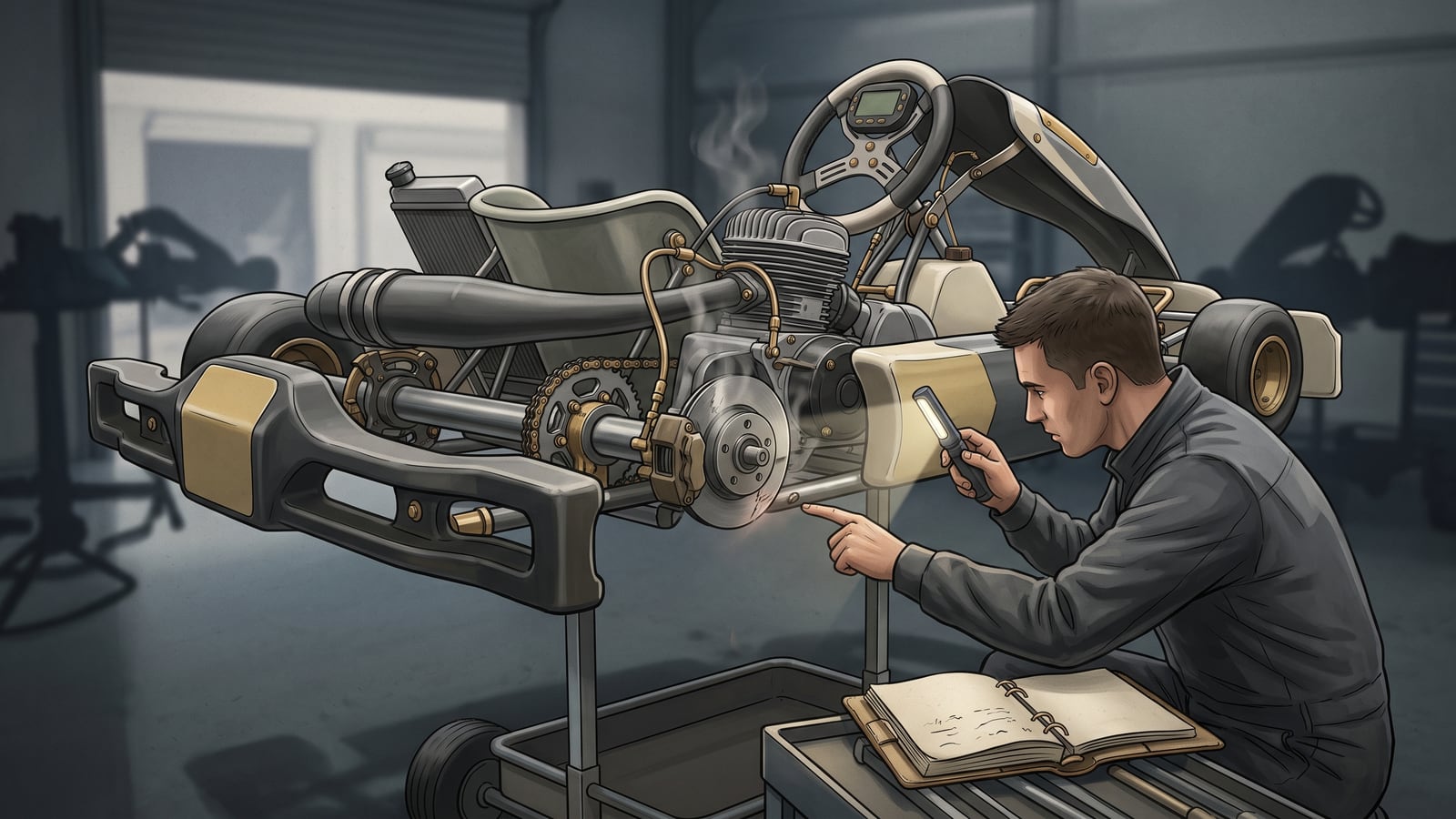
There is a difference between "there's a mark on the left bodywork I didn't notice before the session" and "the bodywork is unsafe." The first is something you saw. The second is a conclusion about cause, severity, or whether it's fit to run — and that conclusion belongs to someone with the training or the documents to make it.
This article gives you the first kind of record: a six-stage checklist for looking at the kart after a session. Work through it, compare what you see against what you remember or expect, and write it down. Make the record useful to whoever looks at it next — you next weekend, a parent, a mechanic, or a scrutineer. A release decision, in this article, means deciding whether the kart may run. Nothing here makes that decision for you.
The sequence and the log that follow are Motorsigma's editorial organization: a way of grouping the checks that makes them easy to work through in order. The sources we drew on for this article don't prescribe this exact six-stage sequence, and we don't present it as field-tested or officially endorsed — it's a structure built to keep observation and conclusion apart.
Seeing versus deciding
An observation names a location, describes what's visible, and — where useful — says what it's being compared against. "The chain guard has a scuff near the rear mount, and I don't remember it being there this morning" is a complete observation. It doesn't say what caused the scuff, whether it matters, or whether it'll be fine to run tomorrow.
A conclusion does one of those things. "The mount is loose," "the tyre is worn out," "it's fine to run" — each is a judgment about cause, condition, or fitness. Making that call takes hands-on inspection, measurement, or an authority this checklist doesn't give you. If you can't finish a sentence without touching, testing, or deciding, you've stopped observing. Note it and move on; the handover section below tells you where it goes next.
This distinction is the whole point of what follows. Everything in the checklist keeps you on the observation side of that line.
The six-stage observation checklist
Work through these six stages after the kart is parked and the session is over. At every stage, look only — don't touch, move, operate, measure, or test anything, including the engine, any rotating part, or anything that might still be hot. Describe what is visible; note a location and a comparison. The finished checklist does not decide whether the kart can run — that decision sits outside this checklist and belongs to the responsible person or applicable authority, using the relevant documents.
Stages one through five below use CRG-derived system categories; stage six, the ordering, the prompts, and the handover log are Motorsigma's editorial organization. If your kart or engine isn't a CRG product, use these headings as a starting structure, but check the official documentation for your exact kart and engine for the category list and terminology that actually applies to it.
1. Bodywork and visible completeness
- What looks different from how you remember it before the session — a mark, a shift in position, a panel that seems to sit differently?
- Compare left and right, or front and back, wherever the kart has matching panels. Do they still match?
- Describe what you see in plain terms — a scuff, a gap, a panel edge sitting lower than the other side — without labelling it broken or deciding what caused it.
2. Tyres and wheel attachment
- Look for any difference between one tyre or wheel and its equivalent on the other side of the kart.
- Compare the same tyre or wheel with how it looked before the session, if you have something to check it against.
- Describe what you see — a mark, a patch that looks different, something out of place near the hub. Don't measure, check pressure, judge wear, or test for looseness. Whether a tyre or wheel is damaged or fit to continue is not something this checklist decides.
3. Steering
- Note where the steering components sit, and whether anything looks different from the last time you looked.
- Compare the parts you can see — wheel, column, any linkage visible from outside — against what you remember.
- Describe any difference in position or condition. Don't turn the wheel, push on the linkage, or test for play — those are hands-on checks.
4. Pedals and brakes
- Look for where a difference appears — pedal position, a line or hose you can see, a mark near the pedal box.
- State what you're comparing it with: how it looked earlier in the day, or how the equivalent side looks.
- Describe the difference neutrally. Don't press the pedal, test the brake, or conclude the system works. A look tells you what's in view — nothing about whether the brakes function.
5. Chain and drivetrain area
- Look for any difference around the chain and sprocket area — position, guard alignment as seen from outside, anything that looks displaced.
- Describe what you see without touching the chain or deciding whether tension or alignment is correct. A look-only method like this one can't establish either — that question belongs with the applicable engine and chassis documentation and the person responsible for the kart.
- If the kart uses one of the Rotax 125 MAX evo, Junior MAX evo, Mini MAX evo, or Micro MAX evo engines — per BRP-Rotax's installation instruction, edition 2021-03-01 — chain length depends on the chassis and transmission ratio. Alignment must follow the chassis manufacturer's advice, so a visible glance can't confirm either. That's a job for the engine and chassis documentation together, not this checklist.
6. Record and hand over
- Move anything you noticed in stages one through five into the handover log below.
- Record and escalate each unresolved item — write down what you saw, not what you think it means, and pass it to the person who can act on it.
- Remember that a completed checklist is not a fitness-to-run decision, a technical inspection, or proof of compliance with any rulebook. It's a record of what looked different, nothing more.
The five-field handover log
Copy this template and fill in one row per observation. Keep every field to what you noticed — no suspected cause, no remedy, no severity label, and no run or no-run call.
| Session context | Observed condition | Location or system heading | Visual comparison or change noticed | Follow-up owner or route |
|---|---|---|---|---|
| (e.g., "Session 3") | (what you saw) | (which stage above) | (what it's compared against) | (who handles it next) |
A hypothetical filled row might look like this:
| Session context | Observed condition | Location or system heading | Visual comparison or change noticed | Follow-up owner or route |
|---|---|---|---|---|
| Session 3 | A visible mark | Left bodywork | Not noticed before this session | Person responsible for the kart |
Nothing in that row says what caused the mark or whether it matters. That's deliberate — the log preserves what you noted so the next person doesn't have to guess whether "damaged" means a scratch or a crack.
Who that next person is depends on what you noticed. A mark on bodywork usually goes to the person responsible for the kart. A question about a specific part's design or fitment may need applicable manufacturer information. Anything touching rules, eligibility, or whether the kart can compete belongs with the event authority or qualified inspector. Match the follow-up to the kind of unresolved item — don't default to whichever contact is easiest to reach.
Where authority takes over
The checklist and log get you as far as an honest, plain record of what's visible. Past that point, several things depend on documents and people this article doesn't replace: the manufacturer's own procedures for a specific part, the technical regulations for your category, and the event's own scrutiny process. None of those are optional add-ons to the observation record — they're where the record's job ends and someone else's begins.
Electric drivetrains
This checklist doesn't cover electric powertrains at all. The regulatory material that classifies and homologates electric karting drivetrains sets out coverage and technical categories — it isn't a general observation, isolation, handling, or repair procedure you could apply across products. If you're running an electric kart, use the exact product documentation for that drivetrain, and check with the event authority for anything specific to your competition.
Rules and scrutiny
Within the cited CIK-FIA framework, homologation and official-control provisions apply only to the categories and authorities that framework covers. If a rule matters to your plans, check the current regulations for your class and event rather than treating any summary — including this one — as the final word.
As one clearly scoped example: under Motorsport UK's National Competition Rules 2026 Edition 4, the competitor in Motorsport UK competition in 2026 remains responsible for conformity with event regulations, and limited pre-event scrutiny does not transfer responsibility for the kart's safety, roadworthiness, or full compliance. This checklist does not replace scrutineering. Under the same rules, a vehicle involved in an accident, or modified after pre-event scrutiny, must be re-presented to scrutineers for further examination. Outside Motorsport UK's 2026 framework, the same principle points you to the applicable organizer and governing authority for that event, not to this article.
Where to go next
This checklist covers the after-session half of a kart's routine; the pre-session inspection checklist builds the equivalent routine for before you run. If the same conditions keep showing up in your handover log, the kart maintenance schedule turns recurring items into planned work, and the after-session record template covers what to log about the run itself, beyond the kart. For everything else on keeping a kart ready between sessions, start at the maintenance hub, or step back to the wider karting section for the rest of the site.
Your next step: copy the five-field handover log into your notes before the next session, and label it for the exact kart, engine, class, and event you're running — so whoever reads it later knows exactly what it applies to.