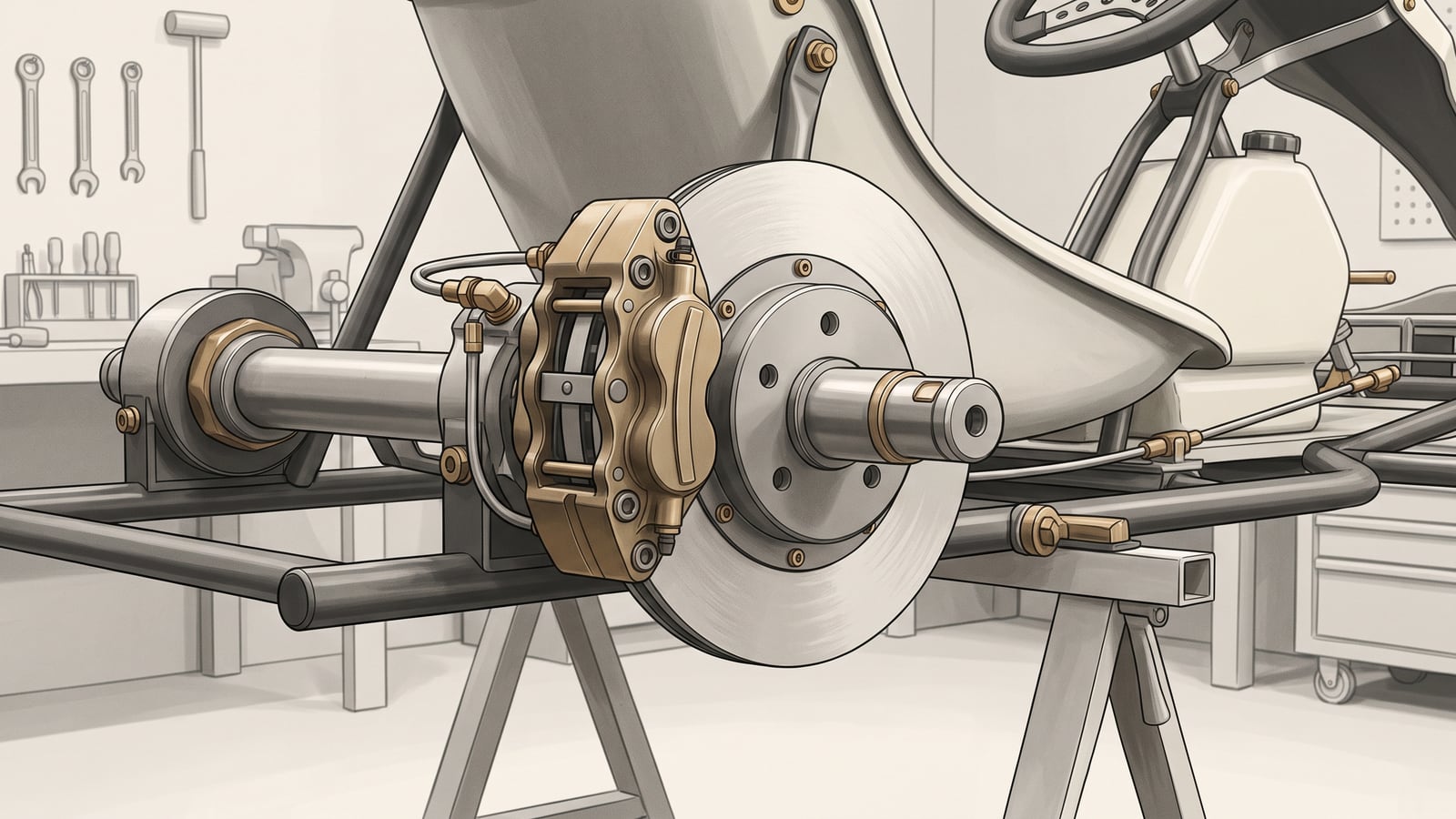
Before you touch a kart's brakes, the first job isn't a wrench. It's a name check.
Say you find a CRG manual with real CRG numbers in it — fluid type, pedal play, a bleeding sequence. That doesn't tell you the manual applies to the brakes bolted to your kart. CRG's 2026 Racing Line chassis is fitted with a system called VEN 11b, but the inspected CRG Racing Kart User Manual doesn't name a brake model at all. Same brand, no proven match. That gap is the whole problem this guide exists to solve.
This is a global guide for owner-drivers maintaining their own racing karts. It doesn't cover rental karts or event-specific procedures, and it can't replace instructions matched to your exact system, the rules your event applies, or a competent inspection when something looks wrong. If you find a brake defect or you're not sure the brakes are sound, that kart doesn't go on track until someone qualified has looked at it. Keep that in mind as you work through the checklist below.
Identify, match, then decide
Work through this beside the kart. Write down only what you can verify — a chassis badge alone doesn't tell you what's fitted.
Record what you can see:
- Chassis and brake-system manufacturer
- Brake-system model or name (write "unknown" if you can't find one)
- Homologation marking, if visible
- Visible part references (numbers stamped or printed on the caliper, master cylinder, etc.)
- Title and edition or version of any document you find
Leave a field as "unknown" or "clarification needed" rather than guessing. A chassis badge only tells you who built the kart — it doesn't tell you which brake system is fitted or which document covers it.
Trace the system, pedal to disc. Follow it in this order and just note what's there:
- Pedal and its linkage
- Master cylinder
- Lines or tubes
- Caliper or calipers
- Pads
- Disc or discs
This pass is for identification and obvious condition only — a cracked line, a missing bolt, a part that looks broken. It isn't a substitute for the checks a manufacturer's inspection instructions would require.
Sort what you find into document types. A product announcement, a document index, a homologation form, and a parts listing can all tell you what's fitted or where to look. None of them, on their own, tells you how to service it. Only a document that expressly covers your exact system, by name or homologation number, counts as a service instruction.
Compare identifiers. Does the document's stated system name, homologation number, and component references match what you wrote down in step one? If they do, you've got a match. If the document stays silent on system identity, or names a different one, you don't.
Choose one outcome:
- Use matched instructions — if the identifiers line up, work only from that document.
- Pause for documentation — if the manufacturer is right but the system or edition isn't confirmed, stop and ask.
- Keep the kart off track and get competent inspection — if you've found a defect or you still have a safety doubt after all this, don't run it.
One more thing before you close this checklist: none of the sources behind this guide describe a generic test you can run afterward — no low-speed check, no standard "pump the pedal and go" verification. If a matched manufacturer document gives you a specific verification step, use that. Otherwise, there isn't one to borrow.
A worked example. Picture an owner with a 2026 CRG Racing Line chassis who finds an older CRG manual in a toolbox. Their first instinct is to use its fluid and bleeding instructions. Then they check: CRG's 2026 chassis page names VEN 11b as the fitted brake system, but the manual itself never names a brake model at all. The identifiers don't line up — nothing in either document links the manual's contents with VEN 11b. The interpretation is simple: document mapping unresolved. So the owner writes down "VEN 11b, per chassis documentation" alongside the visible part references from the kart, and emails CRG or their dealer asking for the current VEN 11b service instructions. They don't run the kart on the old manual's numbers, and they don't invent a test to check whether it's "probably fine."
What each document establishes
Not every official-looking PDF is a service manual. Treat one like it, and you can skip steps a real manufacturer instruction would require.
| Document type | What it establishes | What it doesn't authorize |
|---|---|---|
| Product announcement | Which system is fitted to a given chassis or model year | Fluid, procedures, limits, or release |
| Document index | Which system a document covers and where to find it | Fluid, limits, service procedures, or release checks |
| Homologation form | System identity, construction, and component references | Service procedures or wear limits |
| Parts listing | That a part or tool exists and its item number | Compatibility or how to use it |
| Service manual | Procedures and limits — but only within what it expressly states | Anything outside its stated scope |
A product announcement, a document index, a homologation form, and a parts listing identify or route; on their own, none of them authorizes service. A service manual can, but only for what it expressly states. Service instructions must expressly match your system before you can rely on them.
Birel ART's braking-system document library is a good illustration of the routing role: it lists separate documents for separate systems rather than one universal manual. That separation is the basis of this article's document-selection method, not a stated Birel ART instruction: match the installed identifiers to the current manufacturer document before treating any instructions as applicable, rather than reaching for the closest one alphabetically.
The OTK item numbered 0156.00 makes the parts-listing limit concrete. The official listing identifies it as a brake-master-cylinder bleeding tool. That's all it establishes. It doesn't say which systems it works with, what fluid to use, what the bleeding steps are, or what counts as done. Owning the right tool is not the same as having the right procedure.
The Free Line identity match
Here's a case where identification succeeds, and still isn't enough on its own. Suppose an owner finds the marking "007-BRKF-01" stamped on a component and traces it to Birel ART's homologation form for the Free Line FL RR EVO Group 2 braking system, valid from 2025 to 2027. The form maps the hydraulic components (master cylinder, tubes, and calipers) and the friction components (pads and discs), plus the regulator, to catalogue references. It also requires the homologation marking to stay visible and readable.
That's a real identity match — the owner now knows, with reasonable confidence, which system is fitted. But the form isn't a maintenance procedure. It gives a new-disc dimension of 12 mm ± 1 mm, and that figure describes the part as manufactured, not a wear limit or a point at which the disc needs replacing.
If no matching service instruction is available, the practical result is still "clarification needed." The owner can now ask Birel ART or a dealer a precise question, quoting the homologation number and component references — but they still can't select fluid, bleed the system, or judge wear from the form alone.
Why the CRG mapping stops
The following section describes a specific, unidentified CRG system depicted in one manual. There is no documented mapping to VEN 11b, and nothing here should be read as a VEN 11b specification or a CRG-wide procedure.
CRG states that its 2026 Racing Line chassis all use the VEN 11b braking system. Separately, the inspected CRG Racing Kart User Manual contains detailed brake instructions but never names the brake-system model it's describing, and never states that those instructions cover VEN 11b. Two real CRG documents, and no bridge between them. That's not an oversight you can paper over by assuming continuity — it's the exact situation this guide is built to catch.
What the legacy manual demonstrates
It's worth looking at what the older manual contains, because it shows what a properly matched document would look like if you had one for your system.
For its unidentified depicted system, the manual specifies Xeramic DOT 4 brake fluid, a 15-hour fluid change interval, a 25-hour seal change interval, and 3–5 mm of pedal play. It calls for replacing the master-cylinder pin (part SBN.00202) once its diameter drops below 5 mm. It gives a specific bleeding sequence, and a pad-replacement sequence using a 4 mm Allen key, an 8 mm spanner, and the centre caliper's safety clip and fixing bolts — though it doesn't give a torque value for those bolts.
That's the level of detail matched instructions can offer: specific numbers, specific tools, a specific sequence. The inspected evidence doesn't show that any of it carries over to VEN 11b or to CRG brakes generally. It's useful only inside the manual's own, unidentified system — which is exactly why identification has to come first.
Three possible outcomes
What you should do next depends on what the evidence in front of you shows.
| Situation | What it establishes | Immediate consequence |
|---|---|---|
| Identifiers match a current service document | You have manufacturer-scoped guidance for this exact system | Work from that document only |
| Manufacturer known, system or edition unresolved | Identity, not procedure | Record identifiers, request the correct document |
| Defect found or safety doubt remains | A physical concern, documented or not | Kart stays off track |
Use expressly matched instructions
This is the outcome you want, and it's available when the installed identifiers and the current service document genuinely agree — no unresolved model, no guessed edition. The advantage is real: you get manufacturer-scoped fluid, tool, limit, and procedure guidance for whatever the document expressly covers.
The tradeoff is that this article can't confirm the physical match or release readiness for you — that judgment still rests on the document and, where it falls short, on a person qualified to look at the kart. And one system's instructions can't quietly fill gaps in another's. This option doesn't fit when all you have is an identification source, or when a defect or safety doubt is still open.
Pause for current instructions
This is the right call when the manufacturer is known but the system, edition, or the mapping between documents isn't resolved — the CRG example above is the clean case of it. The advantage is that you avoid borrowing plausible-sounding specifications that may not apply, and you end up with a precise request: manufacturer, marking, part references, all in hand.
The tradeoff is that fluid, parts, limits, and procedures stay undecided until you hear back. Send the request to the manufacturer or a dealer; if there's also physical uncertainty about the parts themselves, that points toward competent inspection rather than a document search alone. This isn't the right outcome once a defect has already been found — at that point you've moved past a documentation question.
Keep off track and seek inspection
CRG's own manual says explicitly not to take the kart on track with broken or missing parts, and it advises keeping oily sprays away from the discs and calipers during cleaning — useful, specific guidance, but not a complete list of everything that could go wrong with a braking system.
The benefit here is a clean line: if in doubt, don't run it, and get someone who can physically assess the exact system involved. The tradeoff is that this guide can't diagnose the defect or tell you when it's fixed — that's a competent inspection's job, and documentation may still be needed afterward before service can proceed.
Observation is not service
There's a real line between looking and working, and it's worth keeping straight.
Reading markings, recording part references, tracing the pedal-to-disc path, locating documents, and noticing an obviously broken or missing part are the identification checks this guide asks for. They don't establish condition beyond what's visible, and they don't establish release readiness.
Opening the hydraulics, choosing fluid, and bleeding the system are service work. So are replacing retained components, judging wear, and adjusting or repairing parts. So is deciding whether the kart is fit to run. Each depends on instructions matched to the exact system, and where doubt remains, on competent inspection.
The sources behind this guide don't supply a generic threshold for pedal feel, fluid leakage, brake drag, pad wear, or disc condition that applies across systems. Each of those criteria has to come from instructions matched to the installed system.
Check the authority before work or release
Once you know what you're missing, it's worth knowing exactly who or what can answer it.
- Matching manufacturer instructions supply only what they expressly state — fluid, intervals, limits, sequences — and nothing beyond their own stated scope.
- The manufacturer or dealer resolves questions about identity, edition, or the mapping between a chassis announcement and a service document.
- Competent inspection handles a found defect or a physical safety doubt that documentation alone can't settle.
- Applicable event requirements are a separate obligation on top of all this — check them with your organizer or governing body, since they aren't covered by the manufacturer documents above.
Each of these four is best suited to a different kind of unresolved question. The inspected homologation form and tool listing, in particular, supply no service procedure of their own. Verification that the work is done also has to come from a matched manufacturer procedure. This guide doesn't treat a static observation as a release check.
Where to go next
This article sits in the karting maintenance hub, alongside guides on building a pre-session inspection checklist tailored to the kart in front of you, deciding what fastener checks to run before reaching for a torque wrench, and building a maintenance schedule from the documents that apply to your kart. For the wider picture, the karting section covers driving, setup, and getting started as well as upkeep.
Your next step: record the installed manufacturer, system name, homologation or part references, and document version. Do this before you select fluid, set a limit, choose a tool or part, or run any procedure or release check.