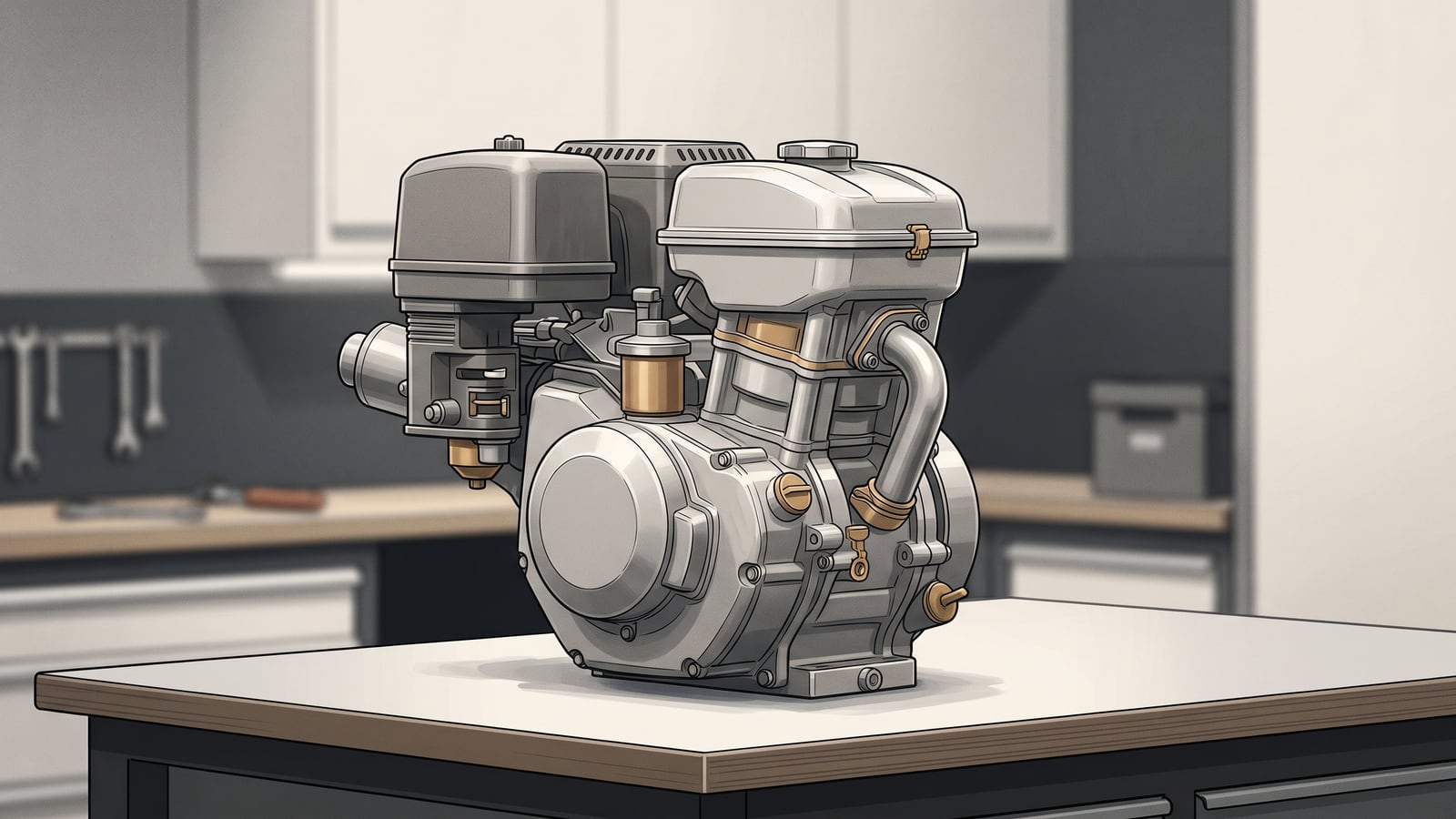
A dependable four-stroke kart maintenance routine doesn't start with a calendar. It starts with two questions, asked in order: what does the manufacturer say about this engine, and what do the current rules say you're allowed to do to it? The manufacturer's documents tell you how a task works and when it's due. The rules tell you whether you're allowed to do that task and still keep the engine eligible to race. Sometimes both questions matter equally; sometimes only one does. You won't know which until you check.
Owning a four-stroke kart engine takes real upkeep, but the documents inspected for this article don't hand you one generic schedule to memorize. None of them supply a universal oil quantity, valve clearance, torque value, service interval, or owner-service permission that covers every four-stroke kart engine. What you need instead is a repeatable process for finding the numbers that apply to your engine, class, and season — and a place to write down what you found.
Identify the engine and documents
Record the controlling identity
Before you look anything up, write down the details that will select the right documents:
- exact engine model
- serial number or other identifier the rules recognize
- class and series
- event and season
- region, if the rules vary by region
"Four-stroke" is a family name, not a specification. It can't tell you an oil quantity, a valve setting, a torque figure, or whether you're allowed to open a housing. Two engines in the same family, built for different classes or seasons, can carry different numbers and different permissions. Get the identity right first, and the rest of the process points you at the correct paperwork instead of the nearest one.
Retrieve documents in order
Once you know what engine you have and what you're racing it in, work through the sources in this order:
- Get the current manufacturer manual, maintenance schedule, and any service bulletins that apply to your exact model.
- Get the current factory, series, or class technical rules for your engine.
- Check the governing body's rules, plus any organizer or event supplementary regulations, for anything additional.
- For each task, note what the manufacturer specifies and what the rules permit.
"Technical rules" here means the written specifications and permissions a series or class sets for the engine — what may be changed, checked, or replaced, and by whom. "Supplementary regulations" are the extra requirements an organizer or event adds on top of the class rules, and they can restrict things the class rules leave open.
If you race Briggs 206 or Junior 206, the manufacturer publishes a manuals index you can use to find the current document set. Treat it as a signpost to the real document, not a source for any actual setting or procedure.
Separate instructions from permission
A manual can tell you exactly how to do something and still not tell you whether you're allowed to do it in competition. That's the distinction this whole routine turns on, and it's worth stating plainly before you get into individual tasks.
| Document | Question it answers | Scope that must match | Where it falls short |
|---|---|---|---|
| Manufacturer manual, schedule, bulletins | How and when does this task apply to my engine? | Exact model and document edition | Doesn't necessarily say whether the work is legal for your class |
| Factory or series technical rules | What am I allowed to touch, adjust, or replace? | Class and season | May not spell out a full procedure or interval |
| Governing body, organizer, event rules | What extra requirements apply at this event? | Organizer, event, and any supplementary regulations | No particular organizer or event is assumed here — you supply that scope |
Run a task through all three checks and you land on one of three outcomes: it's documented and permitted, it's documented but limited by a rule, or it's restricted, sealed, or unclear enough that you stop and ask before touching anything. Here's a concrete example of how that plays out, within the 2026 Briggs rule set: within the 2026 Briggs technical rules, the rules take priority over anything in the Briggs literature that conflicts with them, and a task is permitted only where the rules allow it. That's true for that rule set, in that season — it isn't a claim that every organizer or class works the same way.
The same task, three questions
Picture an owner-driver whose kart came back from a dusty club meeting with a visibly clogged air filter. The manufacturer's document is the right place to find the actual maintenance instruction or trigger for that filter — what condition calls for cleaning versus replacement, and how often to check it under normal use. The technical rules for the class may limit which filter components can be swapped or altered, since some series treat the air filter as a controlled part. The event or organizer's rules might add a further requirement on top of that. Neither source can be assumed to do the other's job: confirm the procedure in the applicable manufacturer documents and confirm permission in the applicable rules before you touch anything.
Seals create different referral routes
A seal, in this context, is a controlled closure or marking that the applicable rules treat as a condition of eligibility — breaking it, or having it broken without authorization, can affect whether the engine is legal to race. What a seal means, and who's allowed to open one, depends entirely on which rule set you're under.
Two examples make the point, and they are not interchangeable. Within the named 2026 Briggs rule set, tampering with a factory seal makes the engine ineligible, and any dismantling that would break that seal is referred to a Briggs authorized-dealer route rather than done by the owner. Under the named 2026 T4 Senior/Senior 168 rules, opening and resealing the engine is limited to a Tillotson or appointed sealing-agent route — a different authority, within its named class and season. Neither example tells you what a seal means for an engine outside its own rule set. If your engine carries a seal you don't recognize, that's a question for the applicable rule set and the authorized service route it names, not a guess based on either example above.
Build the routine by category
With the document order and the permission distinction sorted, you're ready to work through the usual maintenance categories. For each one, ask the same four questions: what does the exact engine document specify, what use or condition triggers the check, what does the class-specific permission or task-specific limit say, and what finding would make you stop and refer the work instead of doing it yourself. Treat each category below as a prompt to look up the exact instruction for your engine, not a procedure you can follow as written. Where the rules impose task-specific limits, note those too.
Oil, level, and routing
Oil grade, level-checking method, additives, and breather or overflow routing are worth separating into their own lookups. In the scoped Briggs example, the manufacturer's recommended oil grade is guidance, not a rule, while the rules themselves prohibit oil additives and require specific catch-container routing for the breather and overflow — enforceable requirements within the named rules, not suggestions. The recommended oil grade is guidance; prohibited additives and required routing within the named rules are not. This article doesn't give you a quantity, change interval, or product recommendation — get those from your engine's manual.
Filtration and cooling
Air filtration, fuel filtration, and cooling components — shrouds, blower housings, and the airflow paths between them — are all worth regular inspection. Both the Briggs and T4 rule sets place scoped restrictions on some of these parts, and a change that looks purely cosmetic can still affect eligibility, so this is one place worth checking the rules before you clean, replace, or modify anything.
Valve lash and accessible fasteners
Valve lash and accessible-fastener checks belong in the routine. But the exact clearance, torque figure, tool, and permission to do the work yourself have to come from the engine's own documents and the applicable rules. Briggs and T4 materials each cover scoped topics here, including some external thread repairs, but publishing a generic setting or torque value risks putting the wrong number on the wrong engine. Look it up for your engine, every time.
Use, storage, and exposure
How hard and how often you run the engine, how long it sits in storage, and whether it's been exposed to wet or dusty conditions can all reasonably change what you check and how often — without changing what the documents actually say. So can more personal factors: how committed you are to keeping the kart in top shape, and whether you have access to a qualified mechanic. The Tillotson TPP225RS-02 schedule, for example, organizes its maintenance table by engine hours rather than by calendar time. Copy the exact hour intervals from the current schedule for your engine; they're not reproduced here.
Keep one maintenance log
A routine only helps if you can look back at it. A compact log keeps the essentials together: the engine's identity, the document you used, what the rules said, and what you found and still need to follow up on. That's useful whether you're the only one touching the kart, or you're handing it between a parent, a volunteer mechanic, and a race team over a season.
Blank log template
Engine identity
- Model:
- Serial / permitted identifier:

Competition scope
- Class / series:
- Event:
- Season:
- Region:

Source
- Document title:
- Revision / edition:
- Document date:

Task
- Category:
- Date / engine-use reference:
- Document-specified interval or trigger:

Result
- Completed action:
- Findings:
- Next due trigger:

Permission
- Seal or restriction status:
- Authorization or escalation required:
Hypothetical dusty-meeting entry
Here's how that template looks filled in for the dusty-meeting example above. Every field that would need an actual source is marked as such. This demonstrates the process; it isn't a completed service record.
Engine identity
- Model: [owner's model — example only]
- Serial / permitted identifier: [copy from engine plate]

Competition scope
- Class / series: club 4-stroke class [example]
- Event: local club meeting
- Season: current season
- Region: [reader's region]

Source
- Document title: clarification needed — pending manufacturer manual lookup
- Revision / edition: clarification needed
- Document date: clarification needed

Task
- Category: air filtration
- Date / engine-use reference: day after a dusty club meeting
- Document-specified interval or trigger: copy from applicable document

Result
- Completed action: none yet — filter inspected visually only, found heavily clogged
- Findings: filter element may be a controlled part under class rules; not cleaned or replaced pending check
- Next due trigger: pending confirmation from class technical rules and, if needed, the organizer

Permission
- Seal or restriction status: clarification needed — checking whether this filter component is restricted
- Authorization or escalation required: yes — contact class technical official or authorized service provider before touching the part
Suppose the class technical official replies that the filter element itself isn't a controlled part under the current rules — only the housing and its mounting are sealed. That answer narrows the question but doesn't close it: the owner still needs the manufacturer's exact cleaning or replacement instruction, and still needs to confirm the club's own event rules don't add a further restriction on top of the class rules. The log records the official's answer, leaves the completed-action field open, and sets the next due trigger to "pending manufacturer document and event-rule check." If the class rules had instead confirmed the element is controlled, the entry would record that no cleaning occurred and that a class-approved replacement or an authorized service visit is the next step. Either way, nothing happens to the engine until every applicable document has answered. That's the pattern worth copying, even when your own situation looks nothing like a dusty air filter.
Verify before you work
The checks below matter most in the moment right before you perform a task. Stop if the procedure or the permission for it is missing or unclear. Also stop if it points toward sealed, internal, or safety-critical work — continuing without a clear answer can affect the engine's eligibility or push you past what any document has told you how to do safely.
Run through this before you start:
- Engine identity confirmed against the current documents.
- Current manufacturer instruction for this exact task found.
- Current class, organizer, and event scope identified for this task.
- Task-specific procedure or trigger located in the manufacturer document.
- Permission and seal status checked against the applicable technical and event rules.
- If anything above is missing or restricted, a referral route recorded — manufacturer documentation, the governing body or class rules, organizer or event rules, and an authorized service provider where applicable.
Three outcomes follow from that checklist:
- Proceed — the task is documented and permitted.
- Proceed within a limit — the rules allow the work but bound it in some way.
- Stop and refer — a document is missing, a rule is unclear, or a seal or restriction applies.
Any competition-eligibility example in this article — Briggs or T4 — applies only to its own named engine, class, season, and document version. Your organizer or event may add requirements neither one mentions.
Where to go next
This article focuses on planning and recordkeeping for four-stroke maintenance; teardown and internal repair are their own project. For the fuller picture, the karting maintenance hub collects the related how-tos, including the guide to building a document-led maintenance schedule, the method behind a pre-session inspection checklist, and the questions to ask before checking a fastener with a torque wrench. From there, the wider karting section covers everything from getting started to race weekends.
Your next step: record the engine model and its serial or other permitted identifying number.