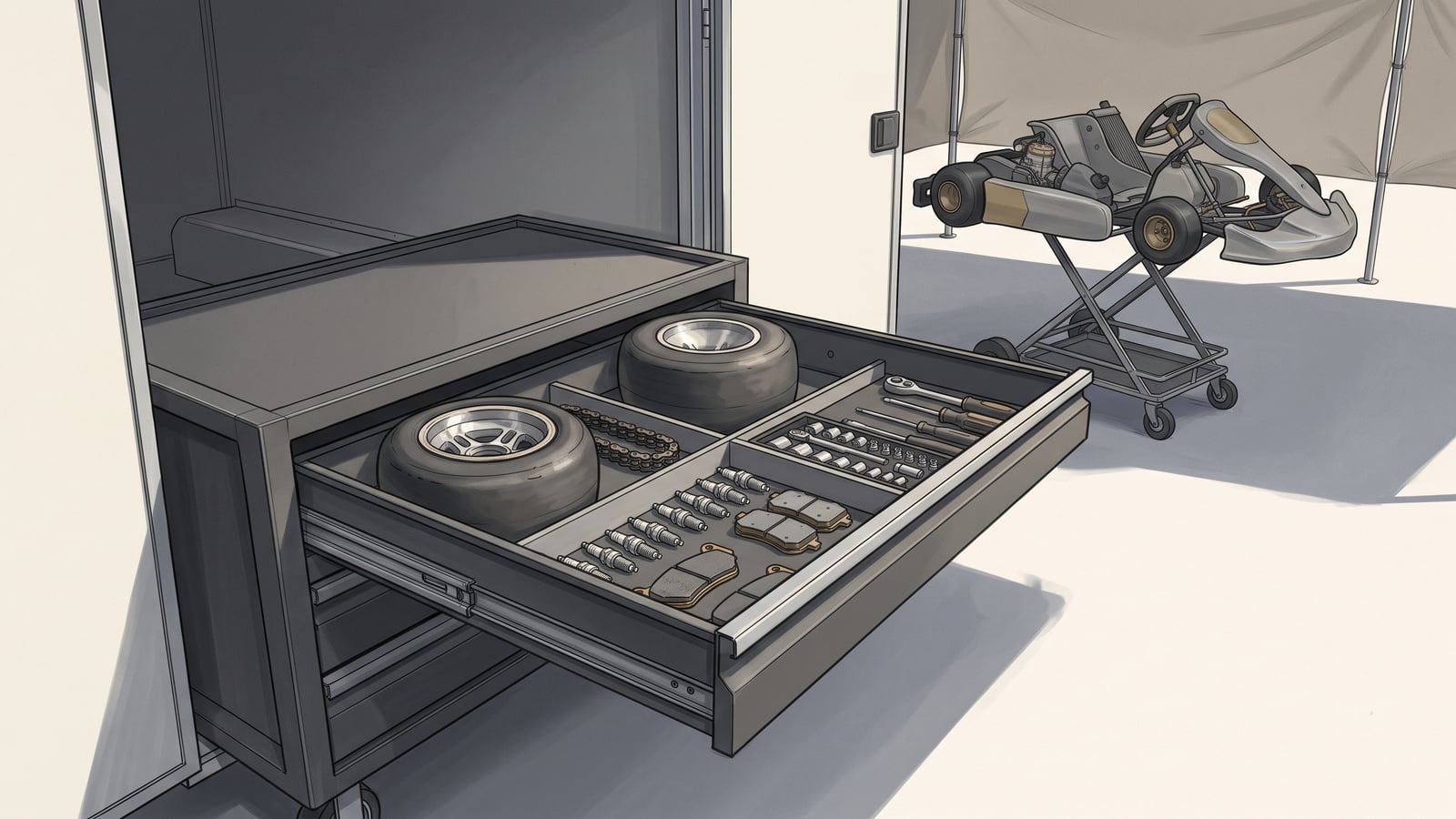
You don't need to pack for every repair that could theoretically happen. Everything you might carry trackside falls into one of three buckets: carry it now, add it for a documented job or a stated condition, or defer it until you can confirm it belongs there at all.
What follows is a qualitative decision aid — not a demonstrated outcome method or a shopping list — for thinking through what's in front of you.
Classify the item
Before you rely on anything in your kit, work out its exact job and whether it fits your kart, whatever applicable current documentation says about it, competition permission if the item is for use at an event, and whether you have the competence or authorized help the work actually requires. Owning a tool, or having seen someone else carry one, doesn't answer any of those questions on its own — uncertainty leads to defer and confirm.
With that in mind, run each item through these six questions in order.
- Known need. Is there a routine task or a recurring condition you already know this item handles on your own kart?
- Documented purpose. Does current documentation for your exact kart, engine, chassis, or component call out this item for a particular job?
- Fit and permission. Is compatibility established, and do current event or class rules allow the use you have in mind?
- Conditions and support. Do the weather, track conditions, or how far you'll be from parts and help change the case for carrying it?
- Burden. Are you willing to pay for it, store it, protect it, inspect it, and replace it when it wears out?
- Decision. Choose carry now, add for a documented job or stated condition, or defer and confirm.
This is deliberately qualitative: there's no score to hit, no fixed number of spares, and no price that tips an item from one bucket to the next. Those numbers depend on your kart, your budget, and your local track.
Compare the three choices
Kit size doesn't make a good trackside kit — an established role for every item does. A kit where each item has a confirmed job serves you better than one sized to some rule of thumb, whether that means padding it out of habit or trimming it just to travel light.
| Established purpose | Documentation and compatibility | Permission and competence | Conditions and local support | Cost, storage, and upkeep | |
|---|---|---|---|---|---|
| Carry now | Confirmed, recurring | Already matched to your kart | Already established | Already accounted for | You're already carrying it |
| Documented job or condition | Tied to one instruction or condition | Must stay identifiable | Applies to that use only | Tied to the expected condition | Added only while relevant |
| Defer and confirm | Not yet established | Unknown or unmatched | Unresolved | Unresolved | Avoided until confirmed |
Carry now
This suits an item with an established, routine purpose on your kart, where fit and safe use are already confirmed. You've got it on hand for a need you already know you'll have, and it's easy to justify when you're packing — you're not debating whether it belongs.
What it costs you is ongoing: buying it, storing it, inspecting it periodically, and replacing it eventually. And an item earns this category by matching your kart and your circumstances now. If either changes, recheck the fit — don't assume the item still belongs just because it's already in the bag. Carry now is a poor fit when the purpose is only hypothetical, or when compatibility, permission, or competence hasn't been confirmed yet.
Add for a documented job or stated condition
This suits an item tied to a current product instruction, a defined maintenance job, or a condition you reasonably expect to meet — a wet forecast for the weekend, say, or a scheduled service task named in your manual. The advantage is specificity: the item has a defined use, so you're not carrying it out of habit.
The tradeoff is that you need to keep the supporting document or condition identifiable alongside it — a part number or a page reference noted with the item does the job. That support doesn't automatically carry over to a different product, a different procedure, or next weekend's visit; each use needs its own match. This category is a poor fit when the documentation is for a different product or procedure than the one you have, or when the condition is speculative and you lack the competence to act on it.
Defer and confirm
This suits anything whose job, fit, permitted use, safe handling, or required support you haven't established yet. It keeps you from buying on spec and from relying on something you don't know works for your situation.
The cost is that you'll need to arrange confirmation, or line up parts or competent help, before you can rely on the item — and it won't be there if you need it unexpectedly before that happens. Defer and confirm is a poor fit only when a recurring, already-confirmed need has made the item part of your normal prep; at that point it belongs in carry now instead.
Three ordinary situations
The following are illustrative situations meant to show how the classification plays out day to day. They are not tested inventories, compatibility findings, or technical recommendations — in each one, watch for the factor that changes the classification.
A recurring task
Picture an owner who's weighing up an item that already handles a task they know comes up regularly on their kart. If that need is genuinely established — it's happened before, and the item fits — carry now is a reasonable call, as long as they store it properly and check it before each visit.
But suppose the "routine" was really just copied from another kart at the track, and this owner has never confirmed the need applies to their own setup. Then the item drops back to defer and confirm until that's sorted out. Frequency only helps once purpose and suitability are established — otherwise it's just imitation wearing the shape of a habit.
A defined visit or job
Now picture a driver who's expecting a particular condition this weekend, or who has a current instruction naming an item for one specific job. That's a clean fit for the documented-job category: they pack the item for that visit or job, and note the instruction or condition alongside it.
If that need becomes a regular feature of every visit, it graduates to carry now. But if the instruction turns out not to match the exact product or job in front of them, it slides to defer and confirm instead — a document for the wrong item doesn't support carrying the right one.
An unfamiliar spare
Picture a helper packing the kit who comes across a spare part nobody can identify a use for. Nobody present knows what it fits or what job it's meant to solve. That's defer and confirm: the practical next step is finding product information or someone with the relevant knowledge before trusting the part at the track.
Set this next to the first situation. The owner with the confirmed recurring item accepts the ongoing burden of storing and inspecting it, because its role is settled. The helper with the unidentified spare sets it aside instead — carrying it further would just take up space without making it any more useful, and it can't move into the documented-job category until someone finds a use it matches.
When documents control the choice
Manufacturer instructions and competition rules can control the choice, as the next two examples show.
Manufacturer instructions
CRG's user manual tells owners of its covered products to follow its instructions and safety notices, keep the original parameters the manual states, and use original CRG spare parts. Check your own spare selection against the applicable manual. That requirement comes from one manufacturer, for its own products only.
Rotax's installation instruction for its 125 MAX evo engine variants, edition 03/2021, directs users to follow that instruction together with the Operator's Manual, and to also consider the applicable chassis manufacturer's own information. Its chassis-installation procedure names two specific tools — an 8 mm Allen key and a ratchet wrench — while noting that instructions may differ by chassis, since it's presented as general information rather than a chassis-by-chassis guarantee. Treat that as a procedure-specific example: for that documented job only. It doesn't give you permission to do the work on its own.
Competition permission
Physical compatibility and competition permission are two different questions. Within its stated 2026 RMC and IRMCE scope, the global technical regulation says that anything not expressly allowed is forbidden — a stricter default than "anything not banned is fine." Applying that rule to anything specific requires checking the official RMC regulations index for current bulletins and the applicable organizer's or event's own provisions, since those can differ from the global regulation.
Where to go next
This article sits in the kart maintenance hub, alongside guidance on how to build a maintenance schedule from the documents that apply to your kart, how to put together a pre-session inspection specific to the kart in front of you, and what to check before you reach for a torque wrench on a fastener. From there, the wider karting section covers everything from getting started to race weekends.
Your next step: take one item you're weighing for the kit and write beside it the exact routine need, current document, or stated condition that supports carrying it. If you can't name one, that item goes in defer and confirm until you can.