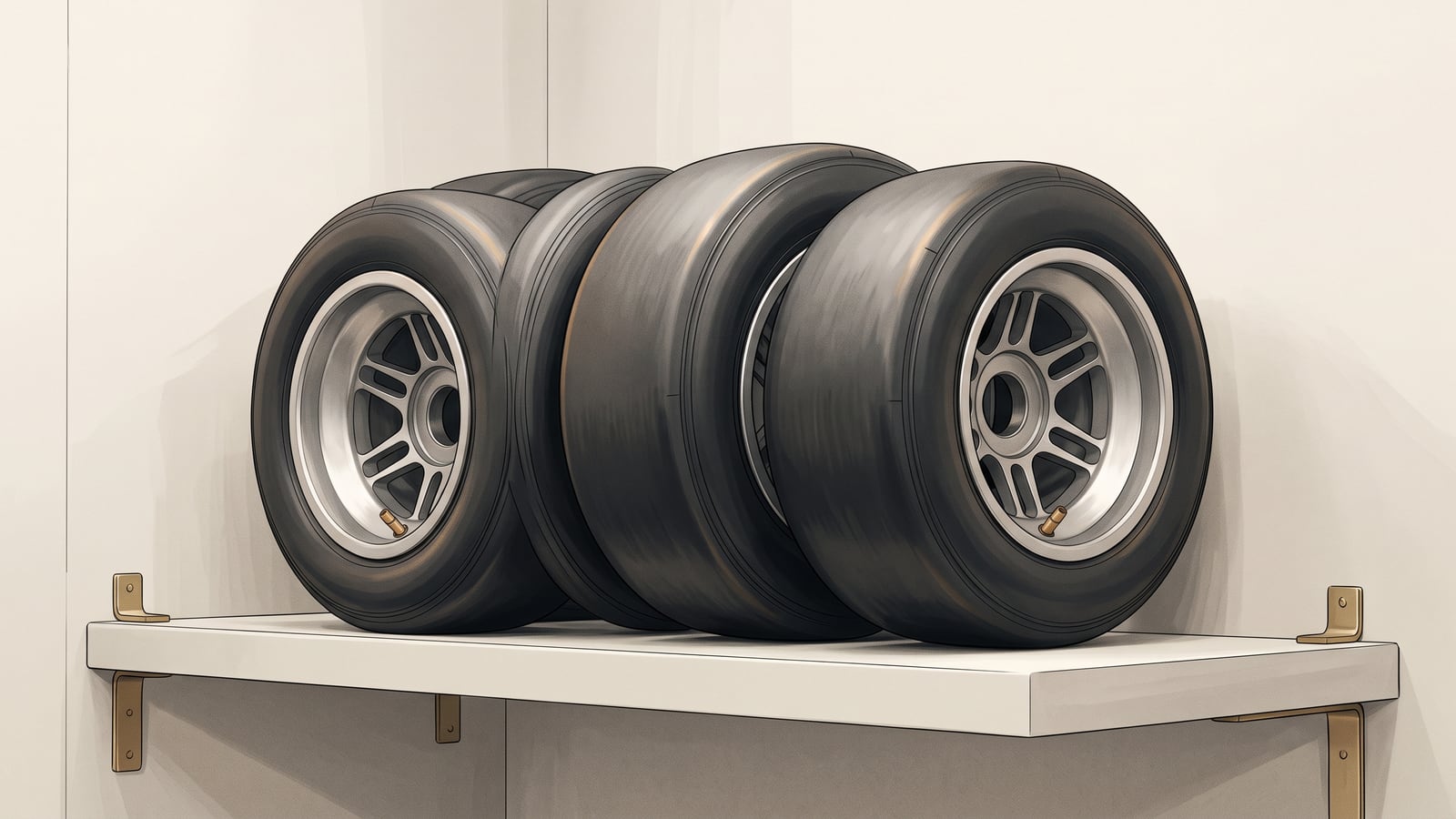
Choose the path first
A tire looks like a tire. A rim looks like a rim. But the tire, wheel, valve, and bead-retainer setup sitting in front of you — plus whatever you'll use to inflate it — isn't automatically the same as the one in your head from the last kart you worked on, or the video you watched last winter. The inspected evidence doesn't support a single mounting sequence, pressure, or storage rule that covers every kart tire. What applies is whatever the current documentation for those specific parts says, plus whatever your event requires.
That leaves three honest paths:
- Proceed, but only within the documentation that applies to the parts you have.
- Hand the job to someone competent and properly equipped to do it.
- Stop and get clarification, because an identity, a document, or a rule is missing or conflicting.
Owning a compressor and a tire iron doesn't put you in the first group. Neither does knowing "roughly how it's done." What puts you there is having the tire's own paperwork, the rim's own paperwork, the equipment's own manual, and the event's own rules — all agreeing with each other — plus the competence and equipment those documents call for.
What changes the choice
The three paths aren't interchangeable. Which one fits depends on what you know and don't know yet.
| Path | Best fit | What you gain | Trade-off | When it stops fitting |
|---|---|---|---|---|
| Proceed within documentation | Tire, rim, equipment, and event paperwork are identified and consistent, and you meet the competence and equipment it calls for | Work stays tied to the actual products; discrepancies get caught before inflation | Takes time to collect several current documents; there's no shortcut | Any identity or document is missing, they conflict, or damage is present |
| Competent service | You lack the required competence, equipment, or both, or a document sends the work to qualified personnel | Moves hazardous compressed-air work to someone equipped to do it safely | You still have to supply the correct tire, rim, and event identity — a provider can't guess those for you | The provider can't establish product fit, or reaches for a generic procedure instead |
| Stop for clarification | Identities are missing, documents are unavailable, figures conflict, or event eligibility is unresolved | Prevents an unsupported number or step from becoming the working assumption | The job stays unfinished until the gap closes — sometimes needing more than one manufacturer or organizer | All applicable identities and documents are already established and agree |
Picture two owners at the same club meeting. One arrives with the tire's box, the rim's part number, and a printed copy of the equipment manual — everything matches, and the owner has the equipment and competence those documents call for. That owner can work through the applicable steps directly. The other knows only that the kart is a well-known brand, with no idea which tire is mounted or what the rim requires. That owner's session goes toward identifying the parts — or toward finding someone who can handle both jobs at once.
Verify before mounting
Before any of that work starts, two things need to be in place: an honest picture of the hazard, and a way to record what you know versus what you're guessing at.
The safety boundary
Inflating a tire stores energy in the tire itself. If a tire ruptures or a wheel component separates violently during inflation, the result can be a serious or fatal injury. That's not scare language specific to karting — it's how the UK Health and Safety Executive describes the risk in its occupational guidance for motor-vehicle repair work, and it's worth taking seriously regardless of how routine the job feels.
For controlled inflation, that guidance points toward a clip-on connection rather than one you have to hold in place, enough hose that the operator can stand outside the path a failed tire or component would travel, and a setup where the gauge or control can't be jammed open. An unrestricted airline, or a connector someone has to hold against the valve by hand, is what that guidance rejects. This is UK HSE occupational guidance, not a kart-specific global rule — it doesn't hand you a hose length, a stand-off distance, or a kart-specific equipment list. Those particulars come from the actual product instructions for your tire, rim, and inflation equipment, which is exactly what the checklist below asks you to go find.
The pre-mount checklist
Fill this in before you inflate anything. A blank or uncertain field is information too — it tells you which of the three paths you're on.
- Tire family, size, markings, manufacturer: ________________
- Wheel or rim identity (make, part number, any markings): ________________
- Valve and bead-retainer configuration (type, and how it's meant to seat): ________________
- Current tire documentation located and read? ________________
- Current wheel/rim documentation located and read? ________________
- Inflation and mounting equipment identified (regulator, gauge, hose, and chuck; plus any remote-inflation device, tire band, or containment aid) and its current manual located? ________________
- Applicable event documents checked — organizer, series, class, and any supplementary regulations for this event: ________________ (no single rule is assumed here; confirm the ones that apply to you)
- Discrepancies, damage, missing paperwork, or uncertain compatibility noted: ________________
- Operator competence and equipment adequate for this specific job? ________________
Once every field is filled in, you land on one of three outcomes:
- Proceed — the applicable documentation is in hand, consistent, and you meet what it asks of you.
- Get competent service — competence or equipment is the gap.
- Stop for clarification — an identity, document, or rule is still missing or conflicting.
If anything's missing or unclear, don't guess from a nearby product instead — confirm the tire, rim, and equipment instructions that actually apply, and check the current organizer, series, class, and event documents. Go to the source that actually controls it — the tire manufacturer, the rim manufacturer, the equipment manufacturer, and the current organizer, series, class, or event authority — and use competent service when uncertainty remains, particularly for hazardous work you're not equipped or qualified to do.
Why the instructions differ
It helps to see two real manufacturer documents side by side to understand how specific these procedures are.
Product instructions stay product-specific
Tecno's published instruction for its tire-inflation process lays out a defined set of steps and states a 4 bar ceiling for the configuration it covers. Vega USA's mounting instructions for its own product line are different. They call for inspecting the rim, applying lubricant, using a tire band, and avoiding heat, and they list paired pressure figures of 4 bar and 62 psi. Neither document describes a generic kart tire. Each applies only to the applicable product or configuration it was written for, and you should not combine these into a universal sequence — not the steps, and not the numbers. If your tire and rim aren't the ones a given instruction covers, that instruction doesn't apply to you yet, no matter how similar the parts look.
Where the numbers disagree
Vega USA's own page pairs two figures for the same limit: 4 bar and 62 psi. Those two numbers should describe the same pressure, so it's worth checking whether they do.
The conversion is straightforward. One bar is 100,000 pascals, so 4 bar is 400,000 pascals. One psi is 6,894.757 pascals. Dividing 400,000 by 6,894.757 gives about 58.015, which rounds to 58.0 psi. So 4 bar is approximately 58.0 psi, well short of the 62 psi Vega also lists. That roughly 4 psi gap is bigger than anything you'd expect from ordinary rounding between metric and imperial figures. As a check on the method, using a purely hypothetical 5 bar that isn't tied to any real limit: the same math gives about 72.5 psi (500,000 ÷ 6,894.757). The conversion itself holds up; it's the published 4 bar/62 psi pairing that doesn't.
What this calculation gets you is a confirmed inconsistency, nothing more. It doesn't tell you which figure — 4 bar, 58 psi, or 62 psi — is the one Vega intends for your specific tire. Confirm with Vega USA for the exact product before using either number; this calculation identifies the inconsistency but does not select or repair a safe limit. If you're standing at the kart with a gauge in hand and this is the only document you've got, that's a stop-and-clarify moment — don't just pick one of the numbers and go.
Care, storage, and retirement
Once a tire's mounted and has seen use, the questions change. It's no longer "how do I put this together" — it's "should I keep using this, and how do I store it between sessions." No universal storage configuration, exposure limit, retirement age, or heat-cycle count is supported here. What governs is the current guidance for the identified tire, and where that guidance can't be found, the honest answer is you don't know yet.
Care, storage, and retirement decision aid
Use this to reach one of four outcomes: continue within identified guidance, seek qualified assessment, remove the item from use because an applicable instruction requires it, or clarification needed. The logic is simple: missing identity, guidance, or rules means clarification; guidance that's found but leaves the condition or applicability genuinely uncertain means qualified assessment; a current instruction that specifically calls for removal means removal; and continuing is available only once current guidance and event rules are in hand, agree, and leave no material uncertainty.
Record, for the component in front of you:
- Identified tire and rim (or "not yet identified").
- Current manufacturer guidance located for each (or "not located").
- Applicable event rules checked (or "not checked").
- Observed condition (visible damage, wear, anything unusual).
- Storage instructions found for this tire, or an honest "unknown."
- Anything still uncertain.
A hypothetical case. Say an owner knows the kart is a CRG but hasn't yet identified which tire is mounted, what rim it's on, or which manual covers the inflation equipment. With those identities missing, the aid can't produce anything but clarification needed — there's nothing to check condition against yet, and guessing at a tire family or rim spec here would just be inventing an answer.
The owner then tracks down the tire's markings, matches the rim to its part number, and pulls the applicable manuals. Now the decision aid has something to work with. Inspection shows the rim is visibly cracked near a mounting hole. For applicable CRG equipment, CRG directs replacing a damaged rim and directs users not to take the kart out with worn or damaged tires, so the rim decision is clear: replace it. The tire is a separate question. The owner's notes show its age and roughly how many heat cycles it's had, but those notes can't establish a retirement threshold by themselves — that decision still depends on the identified tire manufacturer's current guidance, or on a qualified assessment where the condition remains uncertain.
That's the shape of it: one component can reach a clear, supported outcome while another, right next to it, still needs more information before it can.
Where to go next
You've just worked through how to verify a tire and rim before mounting. The mounting steps themselves are a separate topic. For the maintenance decisions that come before and after that, start at the kart maintenance hub. From there, building a kart maintenance schedule from the documents that apply to your kart carries the same identify-then-follow approach across the rest of your upkeep, a pre-session kart inspection is where you'd catch a tire problem before it becomes a mounting problem, and running a repeatable tire-pressure test picks up once your tires are mounted and you're hunting for a working pressure on your own kart and track. Beyond maintenance, the wider karting section covers everything from getting started to race-day logistics.
Your next step: write down the exact tire family, wheel or rim, valve and bead-retainer configuration, and inflation equipment you're working with — that's what tells you which documentation to go find.