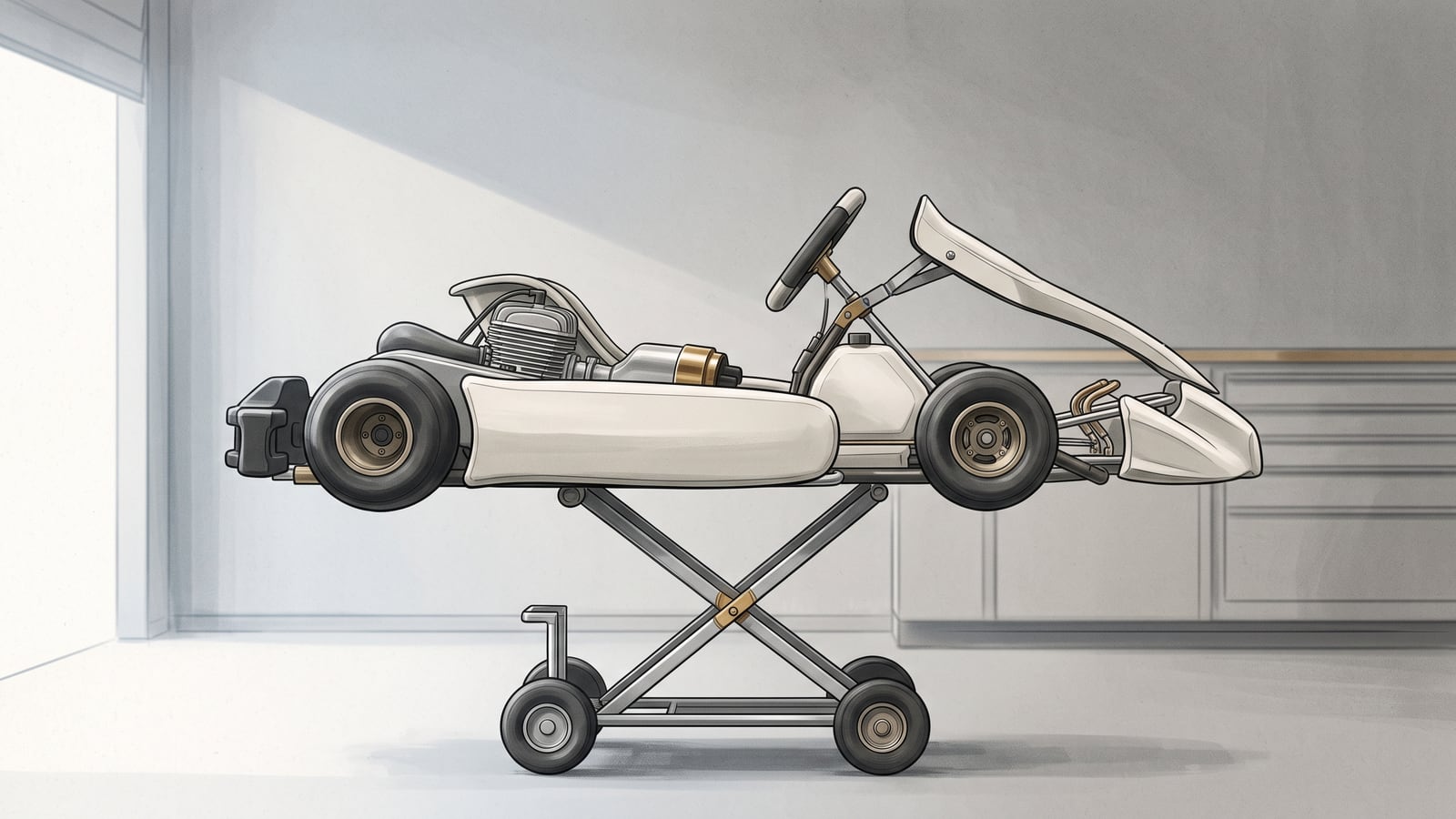
Hand over a condition
There's a difference between putting a kart in the corner of a garage and handing it over in a known condition. Parking it is one decision. A handover is a record: what's fitted, what you found, what you did, and what you left unresolved.
That distinction matters because a stored kart doesn't become safe or ready to drive just because it's clean and covered. The manuals for different engines, batteries, and chassis prescribe different preservation work, so the exact fitted product's current manual has to govern what you do — and anything you notice but can't assess stays recorded as unresolved rather than assumed fine. The point here isn't to make storage sound complicated. It's to give you an ordered way to identify what you have, record its condition honestly, do only the preservation work that's specified for those exact parts, and keep anything unresolved visible instead of letting it quietly disappear until the next session.
Before you drive the kart again, it needs a separate stage: recommissioning. That's the inspection and service pass that happens after storage and before operation — checking what you left open, rechecking the current manuals, and deciding what needs attention before the kart goes back on track. This piece covers storage and the handoff into recommissioning, not the recommissioning inspection itself. It asserts no jurisdiction-, class-, event-, transport-, disposal-, or season-specific rule — it's a general method, usable wherever you race.
Identify the kart as stored
Start by writing down exactly what's fitted. You need:
- the chassis make and model
- the engine, including which variant
- the battery, if there is one, and its charger
- the tyres
- the brake system
- any accessories worth noting
Then, for each of those, note the title and the version or date of the manual that covers it:
- one for the engine
- one for the battery and charger, if they're separate documents
- one for the chassis
- one for the tyres
This matters more than it sounds like it should. The preservation steps later in this piece only apply to the exact products they were written for. If you don't know which manual governs a part, you can't safely follow instructions written for a different one.
If you don't know a product's exact identity, or can't find its current manual, write "clarification needed" next to that field.
Clean, inspect, and record
Once you know what you're looking at, work through it chronologically: note the condition you're starting from, clean only in ways supported for the parts you have, look over what's visible, and write down what you see rather than diagnosing it on the spot.
This is where it's tempting to reach for a can of something and spray it on anything that looks dull. Resist that: for covered CRG racing karts, the manufacturer's own guidance keeps oily sprays away from covered brake discs and calipers. That's a CRG example for CRG's covered products — it isn't a universal cleaning rule, and it doesn't tell you what's safe near your particular brake system. The current manual for your exact chassis and brake system is where that answer lives.
Beyond that one caution, this won't hand you a list of chemicals, lubrication points, or service values — the inspected sources don't establish general-purpose instructions across chassis and brake systems. What you can do here is observe and record: scuffs, cracks, corrosion, loose fasteners you spot by eye, anything that looks different from last time. Write it down. You're not fixing it yet — you're making sure it doesn't get forgotten.
Check the storage location
The storage location also needs a qualitative check. A few questions are worth running through before you commit a spot:
- Is the area clean, or will dust, grit, or debris settle on the kart over months?
- Is it dry, with no risk of condensation or a leaking roof?
- Is the temperature and humidity reasonably stable, rather than swinging wildly?
- Is the kart away from anything that could contaminate it — solvents, fuel containers, chemicals stored nearby, or another vehicle's fluids?
- Is it protected from impact — from being knocked, leaned on, or having something stacked against it?
If you can't confirm one of those checks either way, mark it "clarification needed" and treat it as an open item on the handover record — an unconfirmed check is not a pass. If a spot fails one of those checks, treat that position as rejected rather than accepted with a caveat — go find the next candidate spot and run the same questions against it. Whatever cold, humidity, or other limitation you can't fully resolve at the position you do choose doesn't get weighed away on your own; it carries forward as an open item on the handover record, for whoever picks the kart up next to see.
Continental's guidance for motorcycle and scooter tyres flags a handful of storage risks: sunlight, humidity, ozone, and extreme temperature. It also warns against contact with oils, fuels, solvents, and other chemicals. That's useful as a qualitative storage-environment prompt: it tells you what kinds of exposure are worth avoiding in general. It sets no storage specification for kart tyres. It doesn't say anything about the pressure to leave in a kart tyre, which way up to store it, whether it should carry load, or whether to leave it mounted or take it off the rim. Those questions go to the manufacturer of the exact tyre you're storing, not a page written for motorcycle and scooter tyres.
Follow the fitted product
Here's the boundary that governs everything from here to the checklist: fuel, chemical, and electrical work; cooling, brake, and tyre specifics; torque and pressure numbers; cleaning and lubrication steps — all of it has to come from current instructions for the exact fitted product. Competition rules are a separate question: ask the relevant track, series, organizer, or governing authority what's legal, since a general storage article can't answer that for you.
The reason this matters isn't caution for its own sake. Rotax and Briggs documents cover different engines and call for materially different preservation work — that's not a disagreement between them, it's evidence that no single storage routine applies across products. The next two sections walk through real examples — a Rotax MAX evo engine and a Briggs 206 crate engine — not as competing recommendations you can mix and match, but as separate product-specific branches. Check the current manual for the exact fitted product you have; don't borrow the neighboring branch because it looks close enough.
Named Rotax MAX evo examples
For the named Rotax 125 MAX evo, Junior MAX evo, Mini MAX evo, and Micro MAX evo engines, Rotax's operator's manual describes a longer lay-up procedure for storage stretching beyond a short break between sessions. It covers the carburettor, the cooling circuit under freezing conditions, sealing the intake and exhaust, treating the exhaust against corrosion, and removing the battery for periodic charging.
That's an orientation to what the manual covers. The single manual title used throughout this piece is how this article labels the document inspected for these named engines; match your own engine to its own current manual rather than assuming coverage from the title alone. If you own one of these named engines, the complete manual is where the real steps live; this only names the categories.
Freezing and battery limits
Two of those categories carry a specific limit worth getting exactly right.
If the covered cooling system on one of these named Rotax engines will be stored below 0 °C (32 °F), the manual requires complete drainage of the radiator and engine — not a partial drain, not antifreeze added instead.
Separately, if the fitted battery is the listed lithium replacement battery covered by that manual, Rotax specifies a particular charger for it: the OptiMate Lithium charger, part number 581325. The manual warns that using a different charger may shorten the battery's life or damage it outright. That instruction is specific to that listed lithium battery — it doesn't extend to a battery you can't identify, a different chemistry, a different charger, or an electrical system this manual doesn't cover. If your battery isn't that one, don't assume the same charger is fine; go back to "clarification needed" and find the document that covers what you have.
Briggs 206 example
The Briggs 206 crate engine is a different product with its own preventive guide, and it calls for a distinct, product-specific fuel and carburettor sequence — one that shouldn't be combined with the Rotax procedure. Briggs's guide has you drain fuel using an approved fuel container and coat the carburettor with WD-40, specific to this engine, as described in the current Briggs guide. The same seasonal-storage guidance carries that fuel-system process forward and leaves Briggs 4T oil in the crankcase over the storage period.
The detail here matters less than the shape of it: fuel and chemical handling specific to this engine, described in its own document. If you have a Briggs 206, the current Briggs guide is where the exact sequence and safe handling steps live. Don't apply this fuel-draining or coating method to a different engine, and don't treat "leave the oil in" as advice for every crankcase — it's what Briggs specifies for this one.
Stabilizer and fuel checks
If you're considering an ethanol-fuel stabilizer for a Briggs 206 over the storage period, Briggs advises checking how it interacts with the fuel-testing method your track or series uses. That's a conditional caution: it doesn't confirm the additive is allowed anywhere, and it doesn't mean every fuel-tech check treats it the same way. Before using one where fuel-tech checks apply, ask the relevant track, series, organizer, or governing authority how it fits their method, rather than assuming a sign on a wall covers your situation.
Create the handover
By this point you've identified the kart, recorded its condition, followed the manual's preservation steps, and noted the storage location. That's the handover: what's fitted, which documents govern it, and what's still open.
Nothing here comes from a manufacturer requirement. This dated record is an editorial handover tool Motorsigma is suggesting; Rotax, Briggs, and CRG don't ask for it. Its job is narrow: if you noticed something during cleaning and inspection that you couldn't resolve — a mark, a sound, a part that didn't look right — the record keeps that visible instead of letting it quietly become "probably fine" by spring. Whoever picks the kart up next — you in three months, a mechanic, or a parent checking a junior driver's kart before a new season — gets a starting point instead of a guess.
Keep recommissioning separate
Recommissioning starts with reviewing whatever you left open and rechecking the current applicable manuals, before anything is driven. It's a distinct stage, and it deserves its own attention rather than getting folded into the storage process as an afterthought.
CRG's pre-track material for covered CRG racing karts illustrates that breadth: brakes, leaks, and steering; pedals, wheel mounting, and chain; bodywork, tyres, and pressure guidance; and steering-wheel attachment. That's useful as an illustration of scope — it shows how much a genuine pre-use check can touch. The CRG-covered-products caveat from the cleaning section applies here too. The real recommissioning inspection for your kart depends on the current manual for your exact chassis, engine, brakes, and tyres.
A clean, well-documented storage handover doesn't shortcut that stage. It gives whoever runs the recommissioning inspection a written starting point instead of relying on memory.
Copyable winter-storage handover
Use this as a template — copy it into a notebook, spreadsheet, or document, and fill it in as you go. It's an editorial handover tool, not a manufacturer-required record: completing it describes what you know and don't know about the kart's condition. It doesn't establish that the kart is safe, compliant, or ready to run, and anything left unresolved that touches safety needs to be assessed before the kart goes back into operation.
Identity and manuals
- Storage date:
- Chassis (make/model): — Current chassis manual (title, version/date):
- Engine (make/model/variant): — Current engine manual (title, version/date):
- Battery (make/model/chemistry): — Charger used: — Current battery/charger manual (title, version/date):
- Tyres (make/model): — Current tyre manual (title, version/date):
- Brakes (make/model): — Current brake manual (title, version/date):
- Other accessories worth noting: — Current manual or document for each (title, version/date):
Mark any unknown field "clarification needed" rather than guessing.
Preservation work
For each product identified above, record the preservation work its current manual calls for — and be just as explicit about what you didn't get to.
| Product/component | Governing manual or document | Work done per it | Work NOT done and why | Open items |
|---|---|---|---|---|
Separately — do not copy these rows into your own record — here's a hypothetical filled sample of that table:
| Product/component | Governing manual or document | Work done per it | Work NOT done and why | Open items |
|---|---|---|---|---|
| Engine | Own current manual (invented reference — no real document behind this row) | Cooling system drained; battery removed for charging, per that manual (invented, example only) | — | None |
| Battery | Not yet located | — | Chemistry and model not confirmed | Confirm identity and locate its current manual before charging |
| Tyres | Not yet located | — | Exact model not recorded at storage time | Identify the exact tyre model and locate its manufacturer instructions before recommissioning |
The three filled sample rows are a hypothetical example, not a real inspection result. They show mixed statuses on purpose: one product with completed, manual-specific preservation work, and two left open because the identity or manual wasn't confirmed at storage time. Leave a row blank rather than guessing at what a manual requires.
Location, cleaning, and condition
If you're weighing more than one candidate spot, duplicate this block per option — fill in a full set of answers for each, then record which one you chose and why in the location decision field below.
- Storage location clean? Y / N — notes:
- Dry, no condensation or leak risk? Y / N — notes:
- Temperature and humidity reasonably stable? Y / N — notes:
- Expected minimum storage temperature:
- Free from nearby contamination sources (solvents, fuel, chemicals, other vehicle fluids)? Y / N — notes:
- Protected from impact? Y / N — notes:
- Location decision: selected position — failed checks — mitigation taken — remaining limitations — final status (accepted / accepted with open items / rejected)
- Cleaning performed (describe, per applicable manual):
- Visible condition observed (describe):
Fault and service record
| Date | Item | Observed condition | Action taken | Status | Source/manual reference |
|---|---|---|---|---|---|
| 16 Aug 2026 | Brake system | Condition questioned during visual check; cause not diagnosed | None; left for inspection | OPEN — must be assessed before operation | Exact chassis/brake manual not yet confirmed; clarification needed |
The completed row above is a hypothetical example, not a real inspection result. It shows the level of detail expected: the observer noticed something worth flagging, didn't guess at a cause or attempt a fix, and left the item openly unresolved with a note on which document needs confirming before anyone acts on it. That's the whole point of the record — it preserves the uncertainty instead of hiding it, and the brake item stays OPEN until someone assesses it.
Recommissioning handoff
- Open items carried forward from storage record:
- Manuals to recheck before operation:
- Kart/record received by:
- Date received:
- Recommissioning assessment or service status: pending / booked / in progress / complete (Motorsigma editorial labels, not a manufacturer status scheme) — note who's doing the assessment and, once scheduled, when
Where to go next
This piece covers the storage handover only; it doesn't walk through the recommissioning inspection itself or day-to-day maintenance planning. For that, the kart maintenance hub is the place to start. From there, building a maintenance schedule from the documents that apply to your kart extends the identify-and-record habit this article uses into an ongoing routine, recording a post-session visual inspection shows the same look-and-record approach applied after a normal session rather than at the end of a season, and building a product-specific pre-session checklist is close to what a recommissioning check will eventually need to draw on. Beyond maintenance, the wider karting section covers driving, setup, and getting-started topics if storage isn't the only thing on your mind right now.
Your next step: write down the exact chassis, engine, battery, charger, and tyre identities fitted to your kart, marking any unknown field "clarification needed".