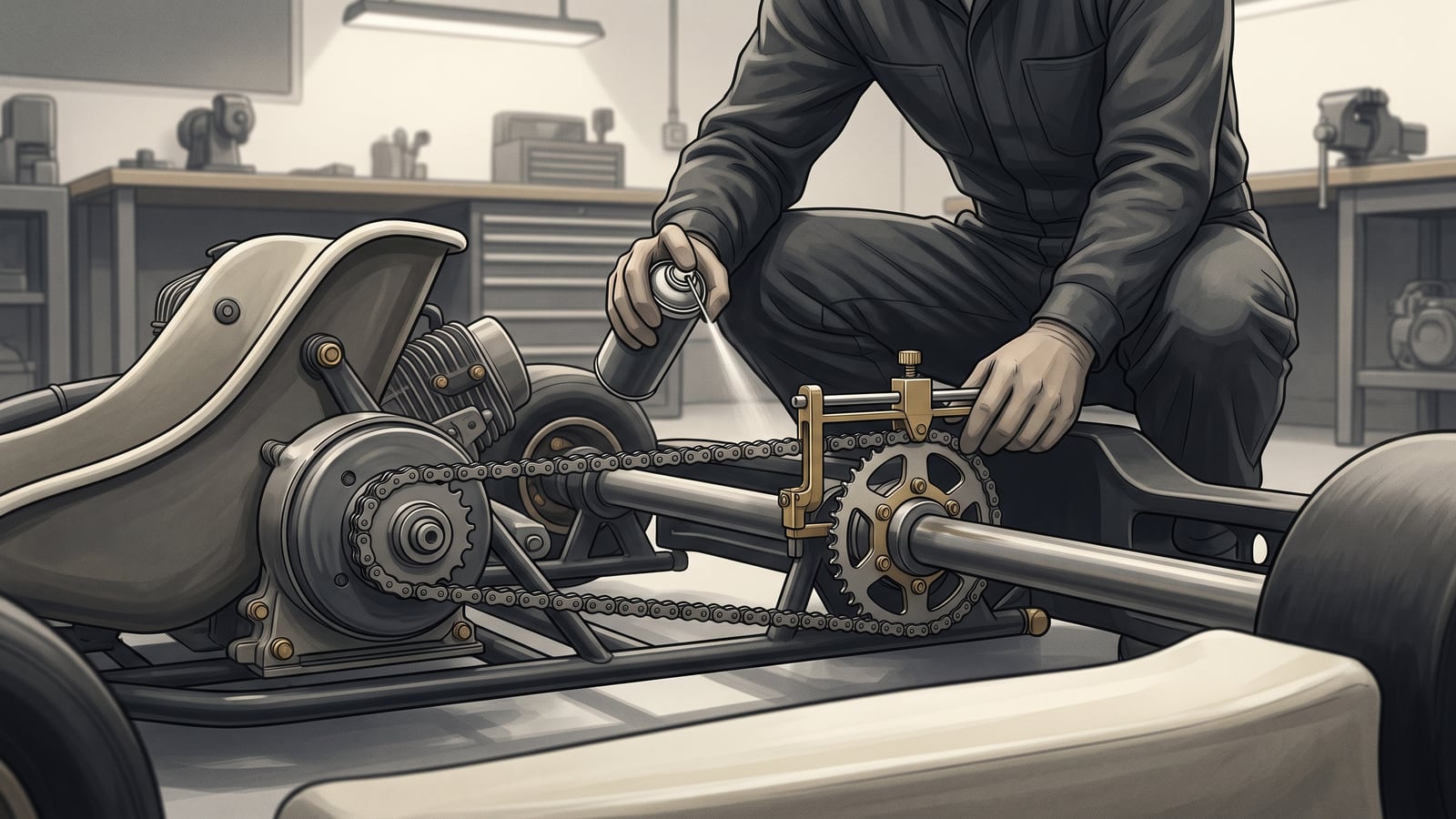
You don't need a universal chain tension figure. You need to know which document governs the kart sitting in front of you, and what that document says about your chain, your sprockets, and your lubricant.
This article uses a documentation-first method instead. A number that's correct for one chain, one sprocket set, and one axle arrangement can be wrong for the next kart on the same trailer. So this article doesn't hand you a setting. It gives you a method: identify the exact kart and component configuration, find the applicable manufacturer documentation for those exact parts, copy what it says into a record you keep, and stop before adjusting anything the documentation doesn't cover.
Below, you'll find an ordered checklist for building that record, a short example of filling one in, and a compact aid for telling a routine check from one that calls for the applicable manufacturer documentation or an experienced mechanic.
Start with the configuration
A few terms are worth pinning down before you go further, because the rest of the article leans on them.
The drive chain is the loop connecting the engine's output to the rear axle. The driving sprocket sits on the engine side; the driven sprocket sits on the axle. Alignment describes whether the driving and driven sprockets sit in the same plane so the chain runs straight between them. Tension, sometimes called slack, describes how much the chain can move up and down between the sprockets. Lubrication is the lubricant, application method, and timing that the applicable documentation specifies for the chain. A wear limit is the point at which a manufacturer's documentation says a chain or sprocket should no longer be used.
None of those definitions tell you how to measure or set anything. That's deliberate. How you check alignment, how much tension is correct, what lubricant to use, and where the wear limit falls are all things the applicable manufacturer documentation for your exact kart and component configuration has to answer. When it doesn't answer one of them, that setting or method remains unknown — not zero, not optional, not something to estimate from a chain you've used before.
That's the whole thesis. Everything below is about building a record instead of guessing.
Manufacturer-led chain-care checklist
Treat this as a form you fill in step by step, working through it in order. It's fine if a field ends up reading "not established." That's an honest answer. It reflects the documents you actually hold, rather than something recalled from memory or borrowed from a chain guide written for a different vehicle.
Capture the applicable instructions
Record your configuration. Write down the kart make and model and the engine make and model. Then record identifiers for the chain, driving sprocket, driven sprocket, and lubricant you've got installed. Note the brand, size, or part number for each — whatever the label gives you. If you don't know one of these, track it down before going further; a setting cannot be assumed to carry over from a different chain or sprocket unless documentation applicable to your installed parts confirms it. If a part carries no manufacturer marking at all, record that plainly — "no manufacturer marking found" — rather than guessing a brand or size from memory or from a similar-looking part, and treat that part's identity as unresolved. That's what puts "unclear" in the compatibility field below. The next action from there is physical, not a guess from the bench: take the part itself, or clear photographs of it, to the seller, a dealer, or someone qualified to identify it.
Find the current official documents for those exact items. That usually means the kart or engine manufacturer's manual, and it may mean separate documentation from the chain or sprocket manufacturer. Note each document's title, its version or date, and where you got it.
Copy the specified instructions into the checklist, field by field:
- Compatibility confirmed by documentation? (yes/no/unclear), covering the chain, both sprockets, and the axle recorded above: ___
- Documented safety preparation before working on the chain: ___
- Alignment method or tolerance: ___
- Tension measurement method and setting: ___
- Approved lubricant and application instructions: ___
- Wear criteria: ___
- Fastening sequence: ___
- Required re-checks and their timing: ___
- Disposition (proceed / adjust per documented method / hold and refer): ___
Where the documentation you hold doesn't address a field, write "not established in the documents currently held." Don't substitute a plausible-sounding number. For the compatibility field, an unconfirmed combination reads "unclear," not "yes" — that's one of the stop conditions below, not a box to guess past.
Copy the record
The checklist above tells you what to look for. Copy the blank record below to capture it — the same items, in the same order, with a slot for the configuration and document details that anchor them, and a paired field for what the document says next to what you actually found, did, and confirmed.
CHAIN, SPROCKET, AND LUBRICATION SERVICE RECORD

CONFIGURATION
Kart make and model:
Engine make and model:
Chain (brand, size, part number — or "no manufacturer marking found"):
Driving sprocket (brand, size, part number — or "no manufacturer marking found"):
Driven sprocket (brand, size, part number — or "no manufacturer marking found"):
Lubricant (brand, product — or "no manufacturer marking found"):
Any part with no manufacturer marking found? (yes/no — if yes, name the part; treat its identity as unresolved):

DOCUMENT PROVENANCE (one entry per document — repeat as needed)
1. Document title, version or date, pull date (when you obtained this copy):
2. Document title, version or date, pull date (when you obtained this copy):
3. Document title, version or date, pull date (when you obtained this copy):

COMPATIBILITY
Documented requirement (cited section, not the figure):
Observed condition (chain, both sprockets, and axle as installed):
Result (yes/no/unclear):

SAFETY PREPARATION
Documented requirement (cited section, not the figure):
Action taken:

ALIGNMENT
Documented requirement — method or tolerance (cited section, not the figure):
Observed reading or condition:
Action taken:
Fastening confirmation (if fasteners were disturbed):
Re-check result and time:

TENSION
Documented requirement — measurement method and setting (cited section, not the figure):
Observed reading or condition:
Action taken:
Fastening confirmation (if fasteners were disturbed):
Re-check result and time:

LUBRICATION
Documented requirement — approved lubricant and application instructions (cited section, not the figure):
Observed condition before application:
Action taken:
Re-check result and time:

WEAR
Documented requirement — wear criteria (cited section, not the figure):
Observed condition:
Replacement assessment:

FASTENING
Documented requirement — fastening sequence (cited section, not the figure):
Confirmation all fasteners are secured per the documented sequence:

RE-CHECKS
Documented requirement — required re-checks and their timing (cited section, not the figure):
Result and time:

RECENT SYMPTOMS OR SERVICE HISTORY (noise, derailment, loss of adjustment):

UNRESOLVED ITEMS (list each; log in the register below if more than one):

DISPOSITION (proceed / adjust per documented method / hold and refer):
Leave any field blank rather than guess past it. A blank field here means exactly what it means in the checklist above: "not established in the documents currently held," not a gap to fill from memory.
Inspect, act, or stop
- Inspect before adjusting. Work through the record's fields above in whatever order your applicable documentation specifies, checking each documented criterion as written. Don't jump straight to adjustment just because a chain looks loose or tight by eye.
- Apply only what's documented. If a field still reads "not established," there's nothing to apply yet for that item.
- Stop before adjustment or return to service if any of these is true: a necessary instruction is missing, compatibility between the parts you've recorded is unclear, damage is visible, or a drivetrain problem has recurred after a previous check. In any of those cases, refer the condition to the applicable manufacturer documentation or to experienced mechanical inspection before the kart goes back on track.
A completed example
Say you're working on a CRG chassis with a specific engine, chain, and sprocket set, and you've got the CRG manual plus the engine maker's chain-tension instructions in hand. The kart, engine, chain, and sprocket fields get filled in with their real identifiers, and the safety-preparation field gets copied straight from whatever those documents specify. Then you reach the alignment field — and neither document addresses an alignment method or tolerance for that sprocket pair. The honest entry is "alignment method: not established in the documents currently held." That's not a cue to eyeball it. It's a cue to hold off on that item until you find documentation that does address it, or until you can get experienced mechanical inspection of that exact configuration.
That's the method working as intended. An unresolved field produces a clear decision: wait.
A second completed example
Take a second kart from the same session — this one entirely invented, so the example can show a fuller manual than the two real ones above: call it an Example KZ chassis, with a hypothetical owner's manual in hand that, unlike the CRG and TM KART documents inspected for this article, does state a tension setting, an adjustment procedure, and a re-check interval (all invented — no real document stands behind this example, and every figure in the record below is made up to show the shape of a filled entry, not to be used). Here's what the record looks like once it's filled in. Every number below is invented for this example — none of it comes from CRG, TM KART, or any real manufacturer.
CHAIN, SPROCKET, AND LUBRICATION SERVICE RECORD

CONFIGURATION
Kart make and model: Example KZ chassis (invented; not a real model)
Engine make and model: Example KZ engine, matched to the chassis above (invented value, example only)
Chain: Example Chain Co., 219 pitch, PN EX-219-102 (invented value, example only)
Driving sprocket: Example Sprocket Co., 12T, PN EX-DR-12 (invented value, example only)
Driven sprocket: Example Sprocket Co., 82T, PN EX-DN-82 (invented value, example only)
Lubricant: Example Chain Lube, aerosol (invented value, example only)
Any part with no manufacturer marking found? no

DOCUMENT PROVENANCE
1. Example KZ Chassis Owner's Manual, 2026 edition, pulled from the toolbox copy this session (invented; no real document stands behind this example)

COMPATIBILITY
Documented requirement (cited section, not the figure): Owner's Manual §4.2, chain-and-sprocket part-number table (invented value, example only)
Observed condition: chain, both sprockets, and axle all match the part numbers this manual lists for this model
Result: yes

SAFETY PREPARATION
Documented requirement (cited section, not the figure): Owner's Manual §4.1, disconnect the kill switch and support the rear axle before working on the chain (invented value, example only)
Action taken: kill switch disconnected, rear axle supported

ALIGNMENT
Documented requirement — method or tolerance (cited section, not the figure): Owner's Manual §4.2, align sprockets to the axle's reference marks (invented value, example only)
Observed reading or condition: sprockets aligned to the reference marks as described (invented value, example only)
Action taken: none required
Fastening confirmation (if fasteners were disturbed): not applicable — no fasteners disturbed
Re-check result and time: not applicable

TENSION
Documented requirement — measurement method and setting (cited section, not the figure): Owner's Manual §4.3, measure vertical chain movement at the midpoint; documented range 10–15 mm (invented value, example only)
Observed reading or condition: 22 mm — outside the documented range (invented value, example only)
Action taken: axle adjusters loosened and chain tensioned per the Owner's Manual §4.3 adjustment procedure (invented value, example only)
Fastening confirmation (if fasteners were disturbed): axle bolts torqued per the Owner's Manual §4.3 fastening sequence, both sides confirmed (invented value, example only)
Re-check result and time: re-measured 30 minutes later, at the interval the manual specifies — 12 mm, inside the documented range (invented value, example only)

LUBRICATION
Documented requirement — approved lubricant and application instructions (cited section, not the figure): Owner's Manual §4.5, apply Example Chain Lube every session, chain warm, excess wiped off (invented value, example only)
Observed condition before application: dry, more than a week since last application (invented value, example only)
Action taken: cleaned and lubricated per Owner's Manual §4.5 (invented value, example only)
Re-check result and time: even coating confirmed by sight immediately after application

WEAR
Documented requirement — wear criteria (cited section, not the figure): Owner's Manual §4.6, chain elongation limit and sprocket tooth-wear pattern (invented value, example only)
Observed condition: within the documented limit, no hooked teeth (invented value, example only)
Replacement assessment: not required at this check

FASTENING
Documented requirement — fastening sequence (cited section, not the figure): Owner's Manual §4.3, axle bolt sequence and torque (invented value, example only)
Confirmation all fasteners are secured per the documented sequence: confirmed above, under Tension

RE-CHECKS
Documented requirement — required re-checks and their timing (cited section, not the figure): Owner's Manual §4.3, re-check tension 30 minutes after any adjustment (invented value, example only)
Result and time: 12 mm at the 30-minute re-check — recorded above, under Tension

RECENT SYMPTOMS OR SERVICE HISTORY (noise, derailment, loss of adjustment): none reported

UNRESOLVED ITEMS (list each; log in the register below if more than one): whether this chain is also compatible with the spare driven sprocket kept in the toolbox — a pairing the manual doesn't address, separate from the sprocket actually mounted, which does check out

DISPOSITION (proceed / adjust per documented method / hold and refer): adjust per documented method, re-check complete, proceed
That's the method working with a fuller document behind it: a documented range, a reading that falls outside it, the documented fix, the documented fastening sequence, and a documented re-check that comes back inside range before the disposition field gets filled in. The spare-sprocket line stays open. It isn't a reason to hold the kart today, but it's a real question, worth tracking rather than assuming one way or the other.
A third completed example
A third kart from the same session raises a different problem — three unresolved items at once, none of them exotic on its own. This example is fully hypothetical, like the one above: no real kart, engine, or manufacturer stands behind it.
The driven sprocket carries no manufacturer marking at all — no brand, no size, nothing stamped into the metal to look up. Its identity is unresolved, so its compatibility can't be confirmed against any document, real or invented. The chassis manual for this kart — call it an Example Cadet chassis, invented for this example — never addresses an alignment method or tolerance for this sprocket pairing. And the driver mentions the chain has jumped twice in the last two sessions.
CHAIN, SPROCKET, AND LUBRICATION SERVICE RECORD

CONFIGURATION
Kart make and model: Example Cadet chassis (invented; not a real model)
Engine make and model: Example Cadet engine (invented value, example only)
Chain: Example Chain Co., 219 pitch (invented value, example only; marking stamped on the chain itself)
Driving sprocket: Example Sprocket Co., 11T, PN EX-DR-11 (invented value, example only; marking stamped on the part)
Driven sprocket: no manufacturer marking found
Lubricant: Example Chain Lube (invented value, example only)
Any part with no manufacturer marking found? yes — driven sprocket; treat its identity as unresolved

DOCUMENT PROVENANCE
1. Example Cadet Chassis Owner's Manual, 2026 edition, pulled from the toolbox copy this session (invented; not a real document)

COMPATIBILITY
Documented requirement (cited section, not the figure): Owner's Manual §3.1 confirms chain and driving-sprocket part numbers; it doesn't address a driven sprocket it can't identify (invented value, example only)
Observed condition: driven sprocket unmarked, can't be matched against the manual's parts table
Result: unclear

SAFETY PREPARATION
Documented requirement (cited section, not the figure): Owner's Manual §3.2, disconnect the kill switch before inspection (invented value, example only)
Action taken: kill switch disconnected

ALIGNMENT
Documented requirement — method or tolerance (cited section, not the figure): not established in the documents currently held
Observed reading or condition: not checked — no method documented
Action taken: none
Fastening confirmation (if fasteners were disturbed): not applicable
Re-check result and time: not applicable

TENSION
Documented requirement — measurement method and setting (cited section, not the figure): Owner's Manual §3.3, measure vertical chain movement at the midpoint; documented range 8–12 mm (invented value, example only)
Observed reading or condition: 10 mm — inside the documented range (invented value, example only)
Action taken: none required
Fastening confirmation (if fasteners were disturbed): not applicable — no fasteners disturbed
Re-check result and time: not applicable

LUBRICATION
Documented requirement — approved lubricant and application instructions (cited section, not the figure): Owner's Manual §3.4, apply Example Chain Lube every session (invented value, example only)
Observed condition before application: adequately lubricated
Action taken: none required
Re-check result and time: not applicable

WEAR
Documented requirement — wear criteria (cited section, not the figure): Owner's Manual §3.5, wear criteria cover the chain and the driving sprocket only — the manual has no criteria for a sprocket it can't identify (invented value, example only)
Observed condition: chain and driving sprocket within the documented limit; driven sprocket condition can't be assessed against any criteria while its identity is unresolved
Replacement assessment: cannot be assessed for the driven sprocket until its identity is confirmed

FASTENING
Documented requirement — fastening sequence (cited section, not the figure): Owner's Manual §3.3 (already applied above, under Tension)
Confirmation all fasteners are secured per the documented sequence: not applicable — no fasteners disturbed

RE-CHECKS
Documented requirement — required re-checks and their timing (cited section, not the figure): Owner's Manual §3.3, re-check tension only if adjusted
Result and time: not applicable — no adjustment made

RECENT SYMPTOMS OR SERVICE HISTORY (noise, derailment, loss of adjustment): chain has jumped twice in the last two sessions

UNRESOLVED ITEMS (list each; log in the register below if more than one):
- Driven sprocket identity and compatibility — no manufacturer marking found
- Alignment method or tolerance for this sprocket pairing — not established in any document held
- Recurring chain-jump symptom — cause not established by this check

DISPOSITION (proceed / adjust per documented method / hold and refer): hold and refer
None of the three open lines is individually unusual — this article has already treated an unmarked part, an unestablished method, and a recurring symptom each as its own stop condition. What changes here is that all three land on one kart at once. The disposition field doesn't average them into something safer. It holds the kart and sends all three lines to the register.
Three examples, three outcomes, one method. An unresolved field waits. A documented field with a reading outside it gets the documented fix, the documented fastening sequence, and the documented re-check before the disposition field gets filled in. And when several fields come up unresolved on the same kart, the record doesn't try to resolve them on the spot — it holds the kart and carries every open line to the register.
Keep an unresolved-items register
One "not established" field reads fine as a note inside the checklist. Several start to bury each other — a blank alignment field here, an unclear compatibility question there — and you're hunting through the whole record to find what's still open. When more than one field is unresolved, or a compatibility question needs an answer from outside the documents you hold, pull them into a short register of their own:
UNRESOLVED ITEMS / COMPATIBILITY QUESTIONS

Item:
Why unresolved:
Who it goes to (supplier / dealer / kart or engine manufacturer / experienced mechanic):
Status (open / referred / resolved):
The spare-sprocket question from the second example above is exactly this kind of entry — real, not blocking today's disposition, and worth tracking down before it's needed rather than forgotten until it is. The third example's three open lines — sprocket identity, alignment method, and the recurring symptom — belong in the same register. When a single check turns up that many open questions, the register is what keeps them from disappearing into the disposition field.
How the dependencies change
A lot can hang on the exact setup. Alignment, tension, lubrication, wear criteria, and replacement compatibility can all depend on it. The relevant variables include the kart and engine, the chain and sprockets, the axle arrangement, and the lubricant. That's not a claim that changing one thing always moves another in a predictable direction. It just means the same number can be right for one configuration and wrong for the next. Nothing in the manuals says a tension setting carries over from one setup to another, so treat each combination as needing its own check.
This is also why motorcycle-chain guidance doesn't carry over here. Motorcycle-chain manufacturers publish cleaning products, lubrication methods, and service intervals. They also publish elongation figures, alignment advice, and paired chain-and-sprocket replacement recommendations. But that guidance concerns motorcycle chains, and it does not establish kart-chain instructions, intervals, limits, or replacement policy. It's a different product on a different machine. Treat it as background reading at most, never as a stand-in for a blank field in the checklist above.
Condition-to-next-check aid
A symptom tells you where to look. It doesn't tell you what's wrong. A drivetrain problem can trigger the next documented check, but the symptom alone doesn't establish the cause — that judgment belongs to the applicable manufacturer documentation or to someone with experienced mechanical inspection of the actual parts, not to how the noise sounds.
| Observed condition or documented result | What the applicable manual can answer | When to stop or escalate |
|---|---|---|
| Routine scheduled check is due | Whether tension, alignment, or lubrication needs checking at this interval, and against what documented criteria | Not applicable — go ahead with the documented check |
| Documented out-of-limit result (for example, tension outside the specified range) | The documented adjustment for that specific reading | Adjust only if the full method is documented. If it isn't, hold off and check with the applicable manufacturer documentation or an experienced mechanic before you adjust or return the kart to service |
| Visible damage to chain, sprocket, or guard | Whether the damaged part has a documented repair or must be replaced | Hold off. Get the applicable manufacturer documentation or an experienced mechanic to inspect it before the kart goes back on track or gets adjusted |
| Unclear compatibility between chain and sprockets, or between parts and axle | Whether the manufacturer confirms that combination | Hold off until directly applicable documentation confirms compatibility, or obtain experienced mechanical inspection, before you adjust or return the kart to service |
| Missing method or limit in the documents you hold | Nothing — the field stays "not established" | Stop and obtain applicable guidance or experienced inspection before adjustment or return to service |
| Recurring noise, derailment, or loss of adjustment after a previous check | Whether the documentation identifies a check you missed | Stop and obtain applicable guidance or experienced inspection before adjustment or return to service. Don't treat the symptom itself as the diagnosis |
On replacement: if a chain or sprocket is worn or damaged beyond what your documentation allows, follow the guidance that applies to the parts you actually have installed. D.I.D and RK, the two motorcycle-chain manufacturers reviewed here, both recommend replacing chain and sprockets together — but that's motorcycle guidance. It doesn't create a kart rule, and nothing in the kart manufacturer documentation reviewed here extends it to karts.
What the manuals cover
Two manufacturer documents anchor the examples above, and it's worth being precise about what each one covers — and what it doesn't.
For CRG racing karts covered by its manual, the pre-track check includes confirming correct chain tension and adequate lubrication. The same manual states that a kart must not go on track with broken or missing parts, and it warns that hair or clothing must not reach rotating kart parts. Those are CRG's own instructions, scoped to CRG products covered by its manual. The manual names the check — tension, lubrication — without giving you a value or a method to hit it.
For the TM KART KZ-R3, the maintenance table calls for checking chain tension and lubrication, and sprocket alignment with the rear axle, before use — and checking chain wear and lubrication again during use. Like the CRG manual, it names what to check without giving you the measurement method, tolerance, or wear criteria that would turn it into a procedure you could run on a different kart.
Neither manual gives you a method, tolerance, limit, or return-to-service procedure you can carry over elsewhere. They tell you what CRG and TM KART require for their own products. Methods and settings for other configurations remain outside the scope of these two manuals.
Where to go next
You'll find this article in the kart maintenance hub, alongside guidance on building a maintenance schedule from the documents that apply to your kart, putting together a pre-session inspection checklist for the kart in front of you, and logging what you find after a session. If chain care is your way into kart upkeep more broadly, the wider karting section covers driving, setup, and getting-started topics too.
Your next step: write down the exact identifiers for your kart, engine, and chain, plus both sprockets and your lubricant, in one place. That record turns every document search that follows — tension, alignment, wear, replacement — into a lookup instead of a guess.