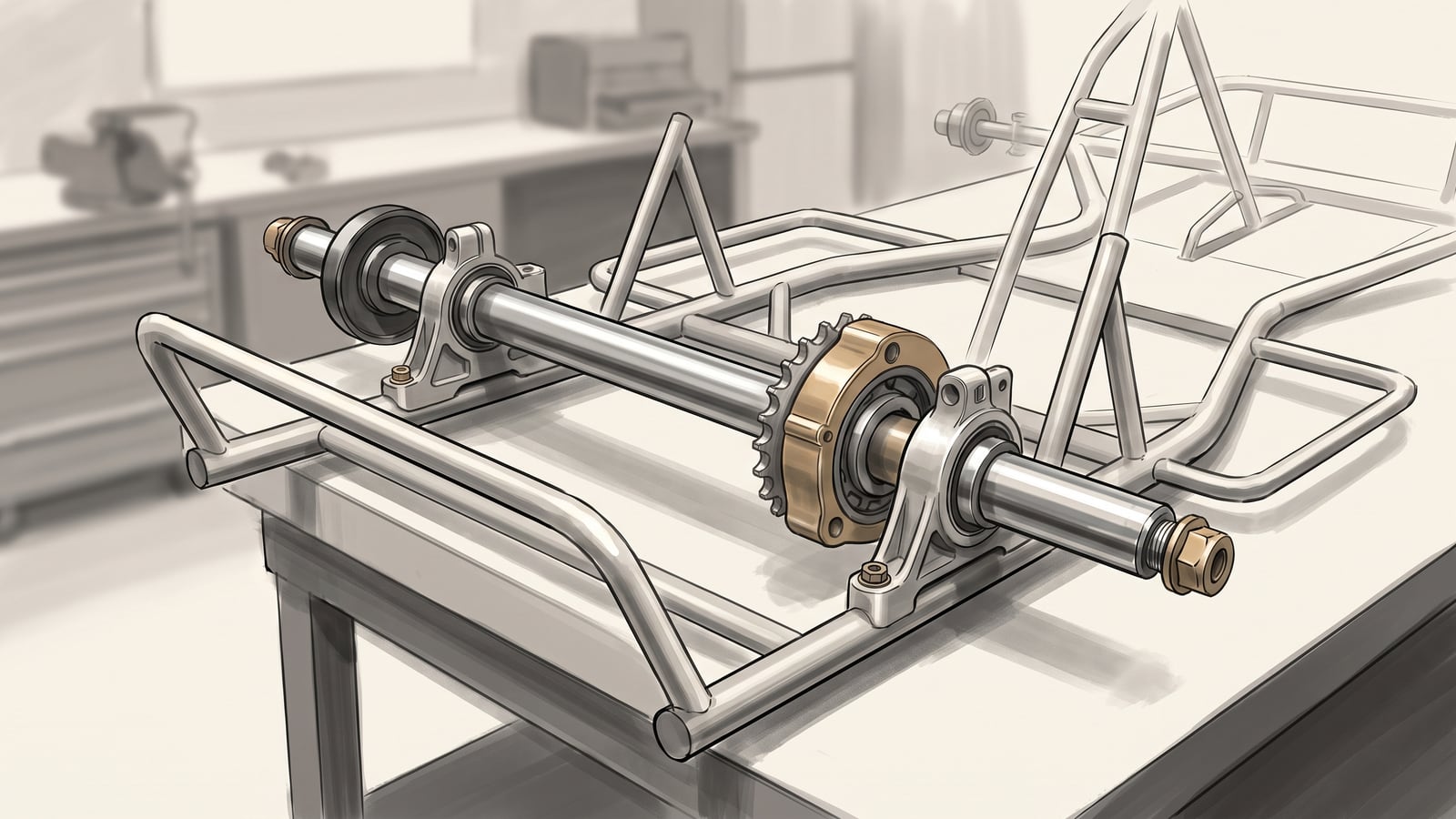
You push the kart and feel the rear wheels drag more than they should. Or you're out on track and notice the back end doesn't roll free the way it used to. The instinct is to blame the bearing. Hold that thought until you've worked through the checks below.
Rear-end drag is unexpected resistance or unevenness at the rear axle. That's a plain description, not a test result — there's no standard way to produce it and nothing to measure it against. What you've noticed is real, but it doesn't tell you where it started. On a solid rear axle, the bearings share space with the brake hardware, the chain-driven components, the sprocket cassette and its retainers, and the axle itself. Any one of them can produce resistance that feels like a bearing problem. This article works from documentation-led guidance, not a workshop test of your specific kart, and it can't isolate the cause for you. What it can do is give you a bounded order to work through, a record to fill in as you go, and a clear point where the job stops being something to improvise.
Rear-end drag is an observation
Noise, heat, resistance, and play at the rear axle are observations rather than proof of anything. Each one has multiple possible causes in a connected system like this — the bearing, the brake, the drivetrain, or the axle and its retention could all produce something that feels similar from the driver's seat or under your hand at the stand. The observations alone don't tell you which. There's no universal pass/fail threshold here: this article won't tell you how much heat or play is fine, because that depends on the exact parts fitted to your kart and what their documentation says. Treat what you notice as a starting point for the checks below.
Jumping straight to "the bearing's gone" and pulling the axle apart is the mistake to avoid. Do that before you've ruled out the brake or the chain, and you can waste a part, disturb the evidence that would have pointed you somewhere else, or — if the brake is involved — end up driving an unsafe kart.
Check in this order
Work through these five steps before you touch anything with a spanner.
- Stop if the brake is defective or its condition is uncertain. This is conservative editorial guidance, not a universal rule: if you can't establish that the pedal and brake are working properly, don't keep testing or driving the kart. Go to the applicable brake and chassis instructions for your kart, or a competent kart professional, before doing anything else. CRG's own kart manual treats brake uncertainty as a hard stop — a useful example, though it applies only to karts that manual covers.
- Record the circumstances. When did the drag show up? Was it steady, or did it come and go? Note anything else you noticed. It might be noise, heat, or play. It might be visible contact or damage, a loose fastener, or contamination. The record below has space for specifics like chips, scratches, deformation, or seal wear.
- Inspect only what's accessible from outside. Look at what you can see without loosening, disconnecting, opening, or adjusting anything. The sources behind this article don't supply a universal wheel-spin test, a standard "release the brake and see" procedure, a chain-isolation method, or a generic clearance or temperature check that applies across karts. If your chassis or component documentation has one, use it — this article doesn't offer a substitute.
- Identify exactly what's fitted. That means the chassis model, bearing type, and brake system; the drivetrain arrangement — chain, sprockets, cassette; the axle and retainers; and the edition of each document you're using. Product identity comes before any care decision, because the same symptom can call for a different response on different karts.
- Let the documentation — or a person — decide the focus. Use the current chassis and component documentation for what's fitted, and check applicable organizer requirements where relevant if this kart runs under a series or club. When the safe next step still isn't clear from those, hand it to a competent kart professional rather than guessing.
Preserving what you can see before you disturb anything is worth taking seriously. Schaeffler's published guidance on inspecting damaged rolling bearings makes a similar point for industrial bearings generally: look at the mounted condition and the surrounding evidence before you take anything apart, since disassembly can obscure the clues that would explain what happened. Treat it as a way to approach the investigation. The steps for getting a kart axle out aren't here — they belong in the exact manual for your kart.
Use the rear-end-drag decision aid
Before you fill this in: what you record here is a set of observations, not a diagnosis. If a spec or procedure depends on the exact parts fitted and isn't in your documentation, mark it unknown rather than guessing.
Copy this observation record
Use this as a template — on paper, in a notes app, or handed to whoever inspects the kart next.
- Kart and chassis: model, and its document edition and applicability to this exact kart
- Bearing: construction if known, and its document edition and applicability, if the bearing's instructions are separate from the chassis document
- Brake system fitted: and its document edition
- Drivetrain arrangement: chain, sprockets, cassette, and its document edition
- Axle and retainers: as identified, and relevant document edition
- Organizer or club requirement: as applicable to this event or series, or not applicable
- Initial condition: what you were doing when you noticed the drag
- Resistance: description
- Noise: description, if any
- Heat: description, if any
- Play: description, if any
- Visible contact or damage: yes/no/unsure, with description
- Contamination or seal condition: as observed
- Brake certainty: confirmed sound under current instructions or by a competent professional / uncertain / defective
- Drivetrain check permitted by the applicable document: what was checked, or unknown if no applicable method is identified in the current documentation
- Documentation gaps: any field above left unresolved, and what document or authority would resolve it
- Referral owner: who's tracking the open items above, or handling a professional referral, if any
- Bounded interpretation: what this does and doesn't tell you
- Next action (more than one may apply): brake-related stop or follow-up / drivetrain documentation follow-up / bearing-focused inspection / axle or retention documentation follow-up — see the comparison table below for what each covers
Case 1: Brake condition uncertain
A hypothetical CRG kart — one of the models the manual above covers — shows rear resistance during a walk-round. The owner checks the pedal and can't confirm the brake is working properly; it feels different from usual, and there's no way to be sure from the outside. Nothing further gets tested. The record shows brake certainty as uncertain and the next action as stopping use and consulting the applicable CRG brake instructions or a competent kart professional. The interpretation stays limited to "cause unresolved; brake uncertainty controls the next step." Nobody concludes anything about the bearing, because the brake question has to be settled first.
Case 2: The chain method is unknown
A different hypothetical owner can identify the chassis but can't find an authoritative method in the kart's documentation for isolating chain or drivetrain influence from the rest of the rear axle. Rather than disconnecting the chain to see what changes, the record stays honest: no drivetrain-isolation method or criterion has been identified in the applicable document, so that field stays unknown, and the next action is to identify the exact drivetrain fitted and get current instructions for it. That's a completed decision even though it doesn't produce a cause — it stops the owner from improvising a check nobody has documented, and it names the specific gap that needs filling before anything else can happen.
Case 3: Bearing-focused follow-up is warranted
A third hypothetical owner has identified the exact bearing and chassis arrangement, confirmed the brake was sound under the current instructions for that exact brake and chassis arrangement or by a competent kart professional, and had the drivetrain checked using whatever the applicable documents permit. The original resistance and noise are still there afterward. At that point, the record can reasonably call for a bearing-focused inspection — following the manufacturer's process, or by that same professional. The interpretation stays bounded: persistence after the other checks makes the bearing a reasonable focus for the next inspection. It doesn't mean the bearing has failed, and it's not grounds for opening, flushing, or replacing it on assumption.
Compare the four next actions
Once you've worked through the record, the observation usually points toward one or more of four things controlling what happens next — more than one can apply if several gaps turn up at once.
| Next action | Best suited to | What you gain | What stays unresolved |
|---|---|---|---|
| Brake-related stop or follow-up | Any uncertain or defective brake finding | Puts the safety question first, before anything else | The bearing question is still open; use may need to stop until the brake is cleared |
| Drivetrain documentation follow-up | Chain influence is plausible but the isolation method isn't verified | Keeps the check inside the connected system instead of guessing | Often ends in "clarification needed," not a cause |
| Bearing-focused inspection | Exact identity known, permitted adjacent checks done, observation persists | Narrows the next inspection to a plausible system | May still need disassembly by a professional; no universal threshold exists |
| Axle or retention documentation follow-up | Visible damage, loose accessible parts, or uncertain mounting | Protects mounting-position evidence before anything is disturbed | No removal, alignment, or torque method is available here |
An ordinary run through these looks like this: brake doubt ends the session outright, and an unclear chain-isolation method turns the task into finding the right document rather than fixing anything. Resistance that survives the permitted checks narrows attention to the bearing without becoming proof, and visible damage or an uncertain retainer keeps tools off the kart until the exact axle instructions say otherwise.
What this method covers
This is general guidance for owner-driver karts with a solid rear axle. It doesn't cover regional, class, event, season, or governing-body rules — those vary by series. If the kart runs under a club or organizer, check whatever requirement applies there too.
Product identity comes before care
It's tempting to treat "sealed bearing" as one category with a single set of rules. It isn't. The Phantom Triton owner's manual, for example, identifies different PRC bearing arrangements used on that chassis, each with its own care instructions — the right approach for one arrangement isn't automatically right for another, even on the same brand of kart. That's an example of variation between products, not a reason to reuse Phantom's instructions on a different chassis.
The practical upshot: any advice about opening, cleaning, lubricating, or replacing a bearing has to come from the current manufacturer instructions for the exact bearing and chassis arrangement fitted. There's no universal procedure or value that applies across brands, and treating one manual's steps as generic advice is how you end up doing the wrong thing to the right part.
Choose among replacement, observation and undocumented treatment
If the observation persists after you've worked through the record, you're weighing three responses.
Documented replacement fits when the applicable instructions, or a competent inspection, supply a criterion for replacing the part. It doesn't, by itself, prove the adjacent systems were fine — you can replace a bearing and still have the original drag if something else was contributing.
Continued, bounded observation suits a case where nothing points to a stop condition and you're preserving evidence while you gather more documentation. It's a poor fit once there's visible damage, brake doubt, or uncertain retention — waiting isn't the safe option there.
Undocumented treatment means flushing, oiling, opening a sealed unit, tightening something, or adjusting a component without a documented reason. It can mask the symptom, disturb evidence you'd want later, or conflict with what the manufacturer specifies. None of these three options carries a cost, longevity, or performance claim; the choice depends on what your documentation and inspection give you to work with.
Leave axle removal to the exact procedure
Mounting position and the order components go back together can matter on a solid rear axle, but this article doesn't give you a removal or refit sequence — that's not something to improvise from general principles. The Schaeffler guidance mentioned earlier supports preserving mounted-condition information before disassembly, but it is not an axle-removal procedure; when the documentation doesn't cover your situation, defer to the exact manual or a competent kart professional. No chain-disconnection method or brake-release step appears here. Nor does a torque value, fit, alignment, runout check, or lubrication schedule. The inspected sources don't supply any of that in a form that applies across karts.
Visible damage, uncertain retention, missing reassembly or verification criteria, or any point where the safe next step isn't clear from the documentation you have all point to the same answer: the axle stays undisturbed until the exact manual or a competent kart professional settles it.
Where to go next
This piece sits in the kart maintenance hub. From there, a six-stage, look-only post-session inspection checklist gives you a routine for recording accessible conditions like this after every run. Manufacturer-led guidance on chain alignment, tension, and lubrication covers the drivetrain side directly, and the questions worth asking before you reach for a torque wrench covers fasteners more broadly. The wider karting section covers driving, setup, and getting-started topics too.
Your next step: record the exact chassis, bearing, brake, drivetrain, and axle identities on your kart. Note the current document you're using for each one — that's what everything else here depends on.