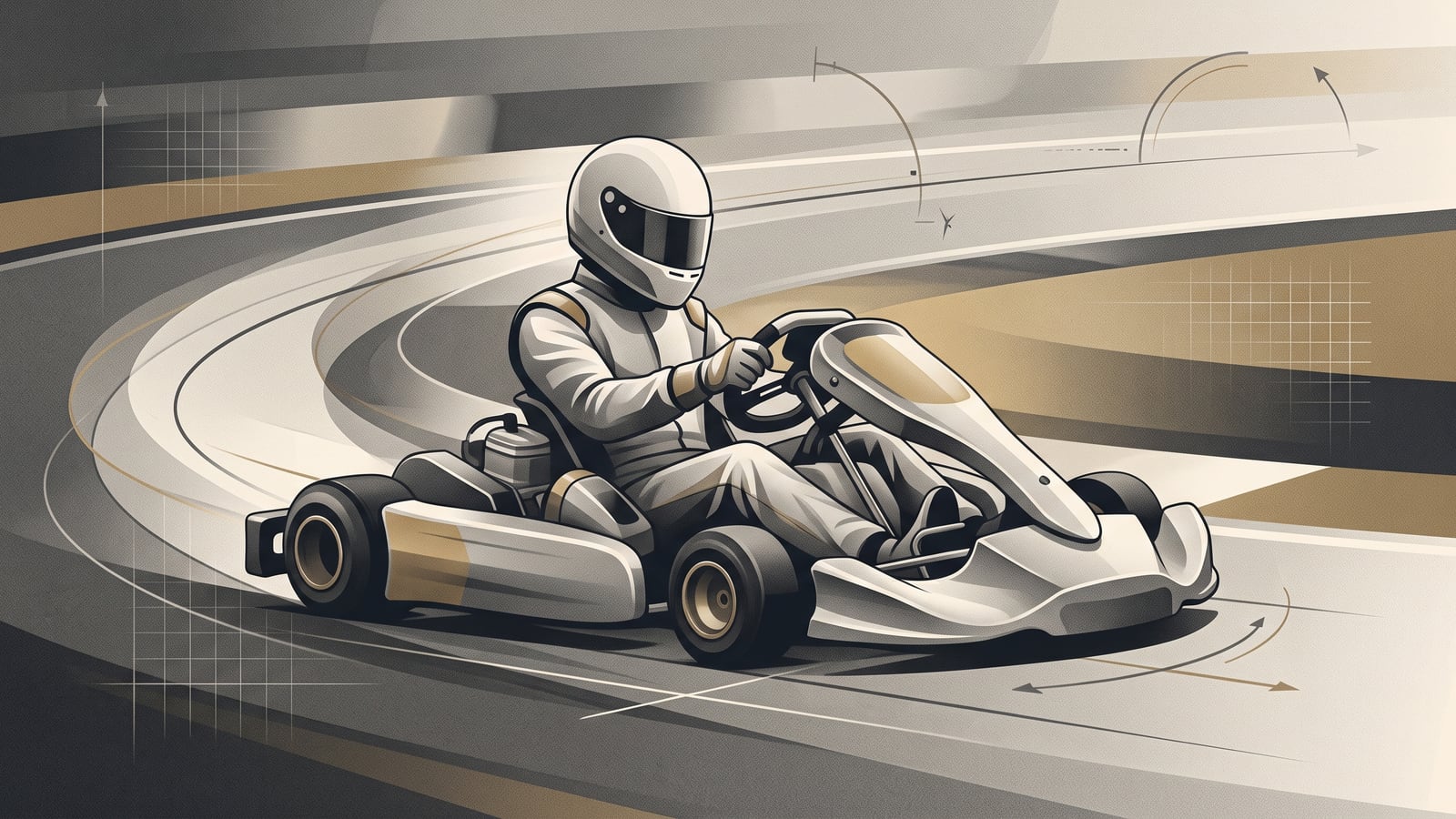
You watch a kart run wide out of a corner, or make a late correction to keep it on the tarmac, and the first instinct is to fix the exit. That's the part you saw. The exit may be where an earlier phase shows up, though, and a useful question is what happened earlier that may have limited the available exit.
That's the idea behind treating entry, apex, and exit as connected phases rather than three separate actions. This is a beginner model, not a rulebook: in practice the phases overlap, and nothing here transfers a car's fixed braking point, turn-in point, or control sequence onto a kart. What happens earlier in a corner may affect what follows, but that doesn't mean every messy exit has the same explanation. The job is to watch the sequence in order, form one bounded guess about where it started, and take that guess to someone who can watch you do it.
Three working landmarks
Before you can trace anything backward, you need words for the parts of a corner. Treat these as working landmarks — places to point at when you describe what you saw — not as fixed geometry or a list of commands.
- Entry is the approach and the first part of the turn, where you arrive and start committing to the change of direction.
- Apex is a useful reference for the part of your path nearest the inside of the corner. It is not necessarily the geometric midpoint, and it isn't a single spot every kart should aim for.
- Exit is the later part of the turn, where your path opens back out toward whatever comes next.
One more piece of vocabulary: turn-in — the moment you first commit steering input — sits inside the entry phase in this article. When the five-step method below asks you to look at turn-in on its own, it's examining one point within entry, not a fourth landmark.
None of these definitions tell you when to brake, how to steer, what gear to be in, or when to get on the throttle. They're just shared language for "where in the corner did this happen."
If you want a sense of how a formal programme uses landmarks like these, the inspected 2020 UK Bambino programme is one programme example: it trained young novice drivers using marked braking areas, turn-in points, and apexes, with instructor feedback built into the session. It illustrates one UK training format, for one age group, at one point in time.
Trace the sequence backward
Here's where the connected-phase idea earns its keep. Excessive entry speed, or being out of position earlier in the corner, may contribute to a compromised exit — that's one thing to check, not the default explanation. A wide exit does not prove the cause was entry speed. It might be. It might not be. To investigate it, look at what happened earlier without assuming the cause.
There's a second wrinkle worth knowing before you start observing. In a sequence of linked corners, the tidiest possible line through the first one can leave you poorly placed for the second. What follows can change the priority — whether the first corner or the second matters more depends on the circuit and the conditions that day, not on a general rule you can apply everywhere. That question depends on local knowledge specific to the circuit and the day.
A five-step observation order
Before you take any of this to the track, remember this is an introductory way to look at a corner — it doesn't hand you a racing line to copy. Follow current venue instructions, and treat a qualified local instructor — someone who knows the circuit, the kart you're driving, and the conditions on the day — as the person who turns your observation into a correction. Kart, circuit, grip, traffic, and current conditions can all change what path actually works, so nothing below is meant to replace that judgment.
The method itself is simple: pick consistent reference points, and look at one limited observation at a time rather than trying to watch the whole corner at once.
- Choose one familiar corner. Keep the kart, the session, and where you're standing or watching from as consistent as you reasonably can, run to run.
- Describe the exit before you diagnose it. Did the path open smoothly, or did it need a late correction? Just describe it — don't decide why yet.
- Trace backward, one item per pass. Work through exit path, then apex position, then turn-in, then entry speed or positioning. Focus on just one of these per lap or per short run.
- Watch, don't change what you do. This is an observation exercise — don't invent a new braking point, turn-in point, or apex to test. You're watching your existing corner, not redesigning it.
- Record one short observation and bring it to a qualified local instructor.
That last step matters as much as the first. The point of focusing on one process item at a time is to give an instructor something specific to look at, then record what you saw and review it with them — not to run an experiment that proves anything on its own. Observations of different phases don't have to come from the same lap: tally how often each phase issue turns up across its own set of laps, then compare those frequencies rather than trying to line up single-lap results across phases. This isn't presented as a way to improve lap time; its purpose is to help you ask a clearer question.
Two better questions
The checklist above doesn't hand you an answer. What it does is turn a vague complaint — "my exit is bad" — into a specific, answerable question. Here's what that looks like in two situations you might recognise.
A wide exit does not name its cause
Picture a hire-kart driver on a Tuesday evening session. Corner after corner, the kart runs wide at the exit. It's tempting to conclude the exit itself is the problem — brake later next time, maybe, or just try to hold it tighter. Instead, working backward, the driver notices the same wide exit seems to follow a similar-feeling entry each time: slightly hot into the corner, a slightly rushed turn-in. That's a hypothesis, nothing more. Entry speed and turn-in are two things that may contribute to a reduced exit path — that observation doesn't prove the cause, and it isn't a reason to start experimenting with a new braking point mid-session.
What it is good for is a sharper question: "My exit needed a late correction on that corner — could you watch whether my entry speed or turn-in is cutting down the path I have later?" That's something an instructor can look at, rather than guess at from "my exit feels bad."
A tidy exit can still mislead
Now picture a beginner who nails a corner. The apex looks clean, the exit opens up nicely — and then the kart arrives at the next corner poorly positioned, with fewer path choices for that corner. Looked at alone, corner one was a success. Looked at as part of a sequence, it may have cost more than it gained.
This is the linked-corner case: what follows can change the priority, and which corner should win depends on the circuit and the conditions, not on a general "always favour the exit" or "always favour the next entry" rule. A circuit-specific question here would be something like: "For these two corners, which part of the sequence should I prioritise? And what should I watch for on the next run?" That's a question only the local instructor — who knows this circuit, this kart, and today's conditions — can really answer.
Where to go next
This guide sits in the kart-driving section, alongside the piece on choosing a provisional path through a corner, the structured practice session plan for building a full day around exercises like this one, and the throttle-control and exit-speed observation exercise, which applies the same one-item-per-pass approach to what happens after the apex. From there, the wider karting section covers everything else around getting a kart on track.
Your next step: write down one familiar corner and the single process item you'll watch for there during your next suitable session.