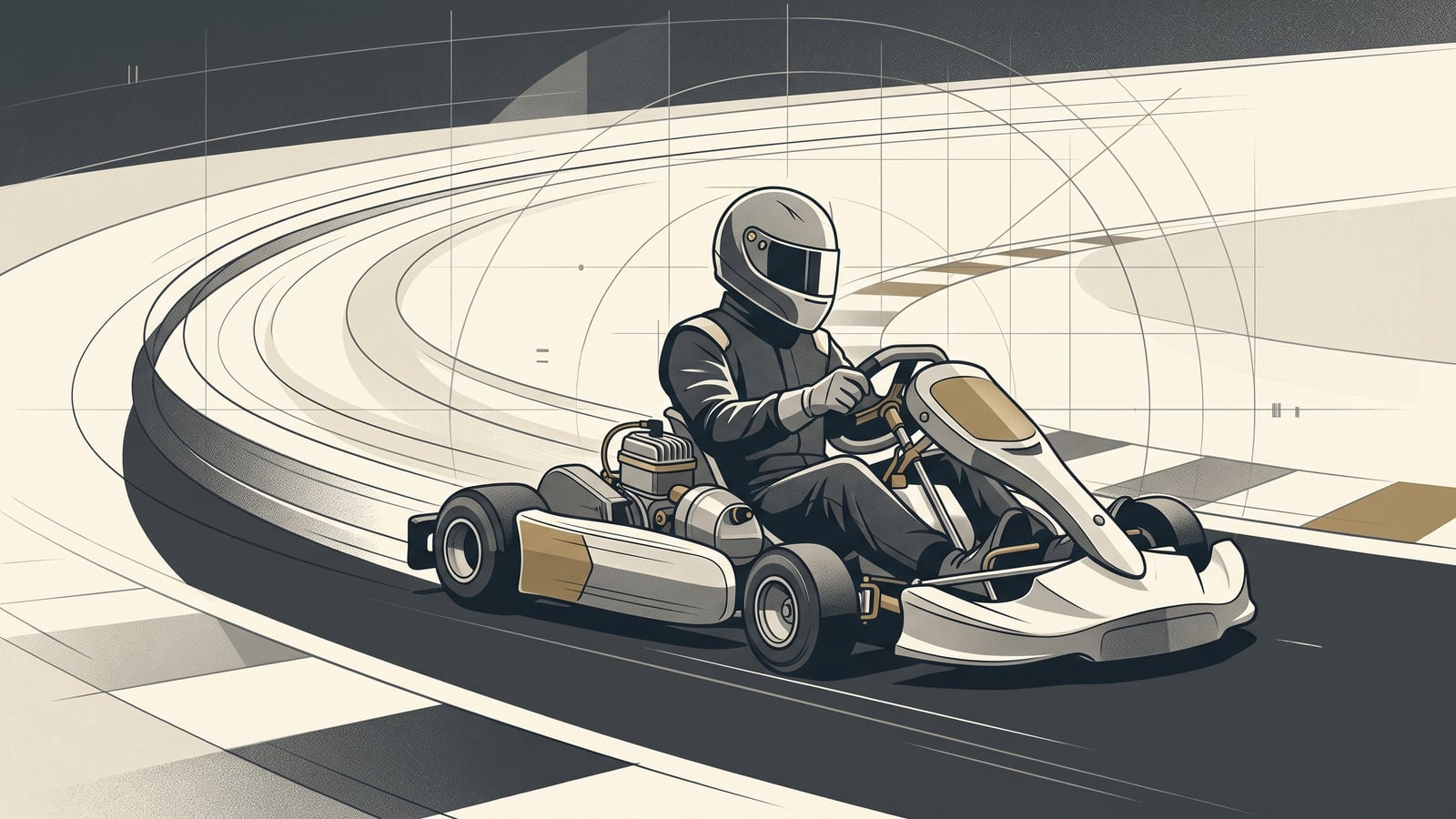
Here's a low-pressure way to pay closer attention to one corner exit: run two passes in the same session, note what you did with the throttle and steering wheel each time, and write down what changed. You don't need a stopwatch, a setup change, or a performance target. You need one familiar corner, a bit of attention, and somewhere to write two short notes.
Observe, don't diagnose
Before any of that, a word on who's in charge of what happens on track. FIA Karting publishes private-testing reference guidance — a useful summary of what a sensible test day looks like. It covers a briefing on circuit direction, pit procedures, marshal posts and signals, and overtaking conduct. It also reminds drivers to stay within their own limits, respond immediately to signals and marshal instructions, stop safely and immediately for a red flag or marshal signal, and avoid sudden dangerous changes of direction. It does not replace applicable requirements: the law where you're driving, your ASN (national sporting authority) or governing body's rules, the sporting regulations for the event, and whatever the organiser, venue, and today's session briefing tell you. Add the marshals and the signals in front of you on the day: each item you just read is a distinct requirement — applicable law, ASN or governing-body rules, sporting regulations, organiser and venue instructions, the session briefing, marshal directions, and session signals — and each controls only within its own scope, with none of those applicable requirements replaced by this article.
Now, the method itself needs its own boundary. Two passes through one corner is an observation, not a test or diagnosis. One comparison can't establish cause. If your steering looked different on the second pass, that's a fact you noticed — it doesn't tell you the throttle change caused it, and it doesn't establish a speed effect or a universal technique. Something else could easily explain what you saw: a slightly different line, a patch of grip, another kart in the way, or just doing the corner a beat later than you meant to. Keep that in mind as you read the rest of this.
Two terms are worth pinning down before you start, because the record template uses them:
- Throttle application just means what you do with the accelerator during the part of the exit you're watching — when you press it, how much, and whether you ease into it or get on it quickly.
- Steering unwind means reducing your steering input as the kart's front end comes back toward pointing where you want to go.
The five-step observation
- Confirm the exercise is allowed today, then pick a corner. Check what's currently in force — the same sources named above, plus the traffic around you — and weigh that against your own comfort and skill level. If any of that makes a two-pass comparison unsuitable right now, stop or defer — current instructions and signals, along with traffic, conditions, and your personal limits, decide whether this happens at all, not the plan you made at home. Once you're clear to proceed, pick one corner you already know reasonably well.
- Decide what you're going to note. Before you go out, choose the conditions worth writing down — which session, which corner, what throttle difference you intend to try on the comparison pass, and anything about traffic or the surface that might matter. Keep both passes inside one session and one corner; don't try to stretch this across different days or different parts of the track.
- Make the baseline pass. Drive it following the briefing and normal session instructions — nothing unusual. Afterward, write down only what you honestly recall about your throttle application and steering unwind on that lap; resist the urge to write what you think should have happened.
- Make the comparison pass, if conditions still allow it. Apply the one throttle difference you chose in step two. There's no required size or timing for that change; it's yours to pick based on what you want to notice. Record the same two things — throttle and steering — the same way you did for the baseline.
- Compare the two records. Write down what changed and what you noticed, and leave the rest alone. Don't turn the comparison into a cause, a diagnosis, a claim about speed, a setup conclusion, or a technique rule. It's a pair of notes about one corner — nothing more.
Copyable two-pass record
Copy this before your session and fill it in by hand or on your phone. It only asks for observations: no stopwatch data, no telemetry, no measurements, no setup changes, and no verdict on which pass was "better."
Session and corner:
Conditions I chose to note:
Baseline — throttle input I intended or noticed:
Baseline — steering reduction I noticed:
Comparison — throttle difference I intended or noticed:
Comparison — steering reduction I noticed:
Other differences I noticed:
What remains unknown:
Observation only: this record does not establish cause, diagnosis, a speed effect, or a universal technique.
A hypothetical example
Here's what a filled-in record might look like — a hypothetical case, invented for illustration rather than drawn from any real session.
Imagine a driver working the same corner twice in one afternoon session. On the baseline pass, they notice their steering stayed turned later than they meant it to — the wheel was still coming back toward straight well after they expected it to be there. For the comparison pass, they choose a smaller throttle application than on the baseline, applying it a touch more gently. Afterward, they notice the steering reduction happening earlier this time.
That's the honest reading: two things were recorded, one after the other, and the second record showed an earlier steering reduction than the first. It stays a chronology. It would be a mistake to conclude the smaller throttle change caused the earlier steering unwind — the line might have been slightly different between passes, another kart might have influenced the entry, the grip might have shifted, the driver's own timing might have varied, or something else entirely could have been at work and simply went unrecorded. The record doesn't say which, and it doesn't say either pass was faster.
If the note raises a question
Sometimes a record like this leaves you with a real question the format can't answer — why the steering felt different, or whether something about the kart is involved. That's fine; it's a sign the observation did its job by pointing at something worth asking about. For questions about your driving, a qualified coach can help. For concerns about the kart or a specific component, appropriate technical support can take a look. Neither one can diagnose anything from this two-line record alone — the record raises the question, it doesn't answer it, and it's a starting point for a conversation rather than evidence to hand over as a finished case.
Where to go next
This article sits in Motorsigma's driving topic hub, alongside other pieces on reading what actually happens on track. If the exit isn't the part giving you trouble, tracing an untidy corner backward covers entry and apex too. If you're wondering whether your two passes — or any two sessions — are fair to compare at all, see comparing sessions fairly. And if you'd like a habit of recording more than just this one exercise, what to record after every karting session covers a broader template. For everything else karting, the karting section is the place to start.
Your next step: before your next session, check the current governing-body or ASN, organiser, venue, and session instructions and confirm this one-corner observation is permitted today. If permission or conditions aren't clear, defer it.