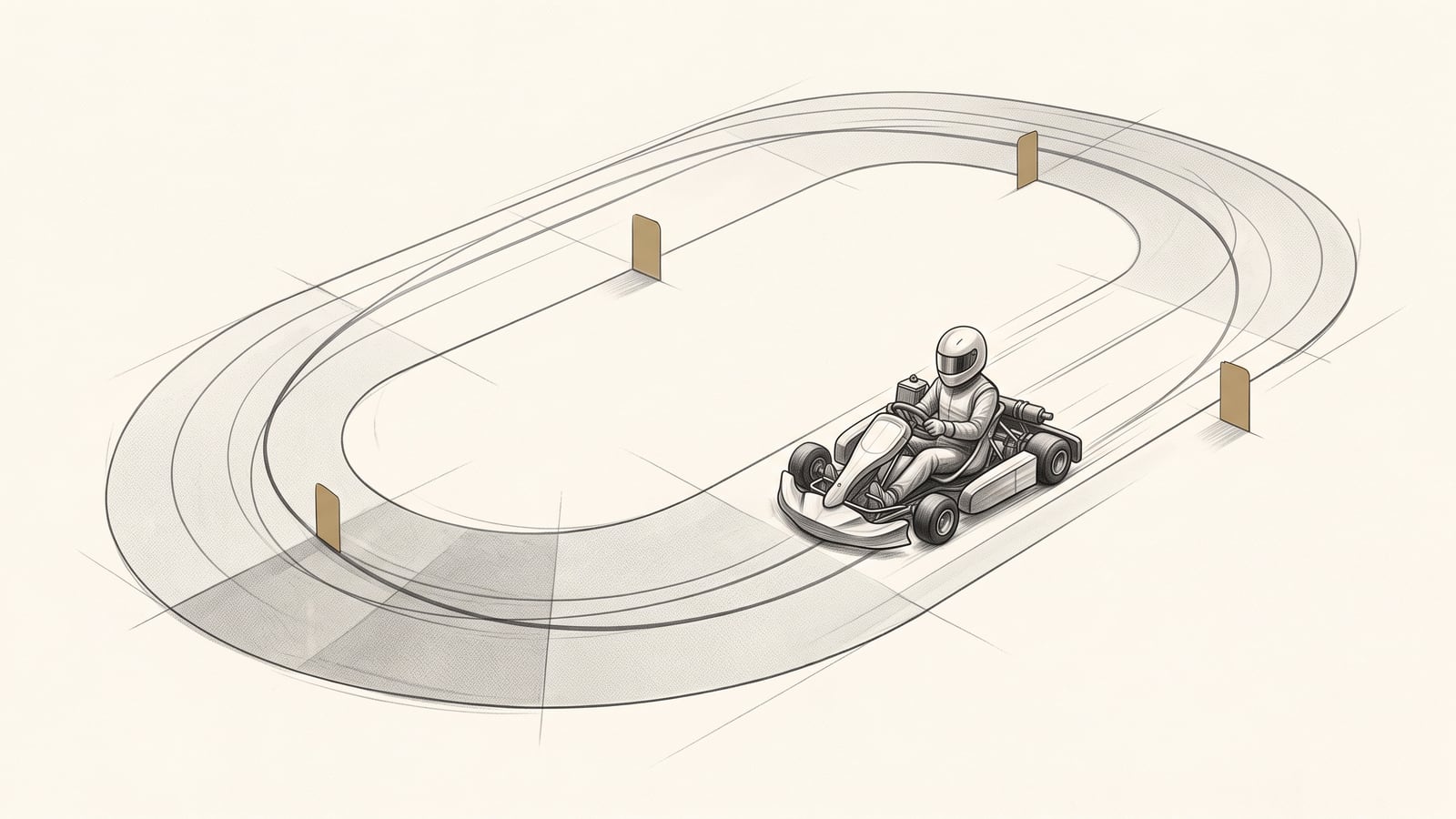
You come off track, pull off your gloves, and someone asks what you worked on. You did plenty of driving. You can't say what you learned from it.
The fix doesn't need a stopwatch, a data logger, or a coach standing on the pit wall. It needs one modest question, chosen before you go out, and a short record of what you noticed afterward. That's the whole method: one objective, a few focused blocks of running, a check you can observe, and a debrief that captures what's still uncertain. None of it requires telemetry, a fixed lap count, or a pace target.
This article gives you that plan in a form you can copy before your next permitted session. It also tells you plainly what the plan can and can't do. It organizes your attention and preserves what you noticed. It doesn't prove you got faster, safer, or more consistent.
Make it one question
A focused block is just a portion of the running you have — one heat, one timed session, one set of laps before the track gets busy — with a single purpose assigned to it. You don't need more running to make it work. You need to decide, before you put your helmet on, what you're going to pay attention to.
The trap is picking an objective that's a promised outcome in disguise. "Gain three tenths this session" isn't something you can watch for; it's a result you're hoping for, and hoping isn't a plan. "Notice whether my braking reference stays the same through one chosen corner" is different. You can watch for that. You can tell, lap by lap, whether it happened. That's the shape every objective in this plan should take: something about your own actions or observations, stated so you'll know during the run whether you did it.
Choose one objective
Pick one narrow thing about your driving to focus on this session — a single specific action or feeling, narrower than a whole corner sequence or a goal like "be smoother everywhere." A useful test: could you describe, mid-session, whether you're doing it right now? If the answer is no, narrow it further.
If you're being coached, keep this to a short chat before you go out rather than a form you fill in together. The coach's job here is to help you state the objective clearly; predicting what it produces isn't part of that job.
Use the running available
However much track time you have — one outing, two heats, a practice day cut short by rain — divide it into blocks and give each block the same objective, or let the objective evolve slightly between blocks if something changes. There's no correct number of blocks and no ideal length for one. A short session might be a single block; a longer day might hold several. Match the blocks to the access you have rather than some standard number you've heard mentioned in the paddock.
Choose an observable check
Before you go out, decide what you'll use to tell whether you did the thing you planned. This is a check that you attempted or noticed the task. It isn't proof that your driving improved. "I felt the same brake point on most of the laps in this block" is a check. "I was faster" is not, because faster could come from a dozen things that have nothing to do with your braking reference.
Pick the check yourself, for this session. What counts as "followed" for a corner-entry objective looks different from what counts for a throttle-application objective, and only you know which one you're working on.
Debrief what remains uncertain
Afterward, write down what you noticed — it's tempting to write what you hoped for instead, so watch for that. Note anything that changed partway through: track conditions going green, traffic building up, the kart feeling different after a stint. Note what you're still not sure about. Then write one question you want to carry into your next permitted session.
Keep your own observation separate from any guess about the kart. If a corner felt different in the second block, that's worth recording as a driver observation. Whether it came from you, from changing grip, or from something mechanical is a separate question — and one this plan doesn't try to answer for you.
Why the sequence is useful
This before-during-after shape — plan, then check during the running, then evaluate and reflect afterward — isn't something Motorsigma invented. It echoes a conceptual before-during-after structure described in sport-practice research on planning, monitoring, and reflection. That research studied self-regulation in sport practice generally; it wasn't built around karting, and it doesn't test this template or measure whether using it improves anything. Completing a plan like this one, or reporting that you use one, is not evidence of better practice on its own — it just gives your attention somewhere useful to go. Following it does not prove improvement; it only gives your practice a shape worth reviewing afterward. Treat the structure as a reasonable way to organize a session; it doesn't come with a demonstrated payoff.
Practice session plan
Copy this into a notes app, a printed sheet, or the back of your session sheet. Every exact choice here — how many blocks, what counts as the check, when you'd stop — is yours to adapt to available running. The success check is a reader-selected check, and your stopping point is a reader-selected stop or reset condition — both depend on what you're working on this session. Nothing below prescribes a duration, a lap count, or a performance target.
Practice session plan — Motorsigma editorial guidance
Session context (duplicate this whole block per outing if your day has more than one — conditions and kart state can differ between them)
Venue / session: ____________________
Available time or access: ____________________
Weather / track conditions: ____________________
Kart condition: ____________________
Shared-kart constraint (if any): ____________________

Objective
During this session, I will focus on: ____________________

Observation
I will watch or feel for: ____________________

Focused blocks (one line per block you actually have; add or remove lines to match your session)
Block purpose: ____________________
Block purpose: ____________________
(add more lines as needed)

Success check
For this session, I will count the plan as followed if: ____________________

Stop or reset condition
I will pause this exercise if: ____________________

Debrief
What I observed: ____________________
What changed during the session: ____________________
What remains uncertain: ____________________
Driver observation (mine, separate from the kart): ____________________
Possible mechanical question (if any): ____________________

Follow-up question
One question to carry into another permitted session: ____________________
A few notes on using it. The success check and the stop-or-reset condition are both reader-selected — pick a check that matches your own objective, not a generic pass mark, and set a reset condition that makes sense for what you're working on, whether that's simply switching your attention to something else or ending the exercise for the day. There's no scientifically designed format behind either field; you're choosing what's useful for this session.
The "possible mechanical question" field is a place to note a thought, nothing more. If something about the kart's behavior seems worth a look, write it down as a separate line from your driver observation. Component-specific action — anything involving an actual change to the kart — falls outside what this plan covers and should follow applicable manufacturer guidance rather than a guess made from one session's feel.
One plan, filled in
Here's a wholly hypothetical example, built for an invented Saturday practice session, to show the level of detail and the tone the template expects. Nothing in it is a real session Motorsigma ran, coached, or recorded — treat every entry as a placeholder for whatever your own session produces.
PRACTICE SESSION PLAN — FILLED EXAMPLE (invented, example only)

Session context
Venue / session: Local club track, Saturday open practice
Available time or access: One 20-minute session
Weather / track conditions: Dry, cool, light wind
Kart condition: Own kart, no known issues
Shared-kart constraint (if any): None

Objective
During this session, I will focus on: braking at the same reference point — the second cone — into the hairpin, every lap

Observation
I will watch or feel for: whether I brake at that cone or somewhere else, lap by lap

Focused blocks (one line per block you actually have; add or remove lines to match your session)
Block purpose: laps 1–8, settle in, note where I'm braking without trying to change it
Block purpose: laps 9–16, hold the same braking point deliberately, lap by lap

Success check
For this session, I will count the plan as followed if: I can say, after each lap in the second block, whether I braked at the cone or somewhere else

Stop or reset condition
I will pause this exercise if: traffic builds up enough that I can no longer tell my own braking point from a point I'm forced into by another kart — if that happens, I'll shift my attention to following safely for the rest of the block

Debrief
What I observed: braked at the cone on most laps in the second block; missed it on two laps, both right after passing a slower kart
What changed during the session: track grip picked up in the second half as more karts ran
What remains uncertain: whether the two missed laps came from traffic or from grip changing under braking — this session doesn't separate those
Driver observation (mine, separate from the kart): felt like I was carrying a touch more speed into the two missed laps
Possible mechanical question (if any): none noted this session

Follow-up question
One question to carry into another permitted session: with a clearer track, does the braking point hold on every lap, or does it still slip when I'm carrying more speed in?
Notice what the example does and doesn't do. It ends on a recorded observation and a genuine open question — not a claim that the driver got faster, safer, or more consistent. The uncertain line stays uncertain instead of quietly resolving itself into a tidy result.
Adapt it to the day
The examples below are hypothetical illustrations meant to show how the same light structure bends to different circumstances. They aren't reports of anything Motorsigma tested, coached, measured, or observed at a track. Each one is a hypothetical example, not a case study.
Limited time and shared karts
Picture a hobbyist who gets one short session before the venue closes the track for the day. There's no room for several blocks here — the plan still works with however many the session allows, sometimes just a single block. Pick one objective, label the block or blocks you have, and use the same debrief afterward. The method scales down without losing its shape.
Now picture two drivers sharing one kart across a session. The template still applies, but each driver needs their own copy, or at least their own observation lines, clearly marked with whose notes are whose. Worth flagging in the debrief: track grip and kart condition may have shifted between the first driver's runs and the second's — a cold track in the morning stint isn't the same track by the afternoon. Duplicate the session-context block for each stint rather than blending both track states into one line; recording that difference matters more than trying to compare the two drivers' laps directly.
Weather and time away
Say the sky opens up halfway through a planned dry-track session. The objective you picked before you went out — say, a braking reference at one corner — doesn't have to change. What changes is the conditions line in your debrief: note that the track went from dry to wet, and treat the comparison across the day as confounded — plain language, that just means something else changed at the same time, so you can't tell which change caused what you noticed. Here, that something else is the weather: it makes it impossible to say what caused any difference you noticed.
Or picture a driver coming back to the track after a long layoff. The temptation is to set a pace target and chase it. A steadier choice is an objective built around observation rather than lap time — something like noticing whether your reference points for one corner still feel familiar — because a fixed pace target after time away compares you to a version of yourself the layoff has already made irrelevant.
Competitive drivers, coaches, and owner-drivers
Competitive drivers can use the same structure to hold onto a hypothesis across a session rather than just accumulate laps. The addition worth making is recording confounders in the debrief — traffic, changing grip, a new set of tires — alongside the observation itself. That keeps a promising pattern honest: a hypothesis you're testing informally is not the same thing as a demonstrated result, and the debrief is where that distinction gets preserved rather than lost.
Coaches helping a driver can use the objective and observation prompts almost as written: help the driver state one narrow thing to watch for, then review the debrief together afterward. The template isn't a scoring system, and turning it into one — counting how often the check was met across a season, say — asks more of it than the structure supports.
Owner-drivers get the most value from the mechanical-question field. If a driver observation and a kart change happen in the same session, it's tempting to credit the change with whatever improved. Changing several things at once makes it hard to tell which one mattered. That's a general caution about attribution — it doesn't turn an informal practice session into a controlled experiment, and it isn't a substitute for one. Keep the driver's own observation on its own line, keep any mechanical question on a separate line, and treat any component-specific action as something to check against applicable manufacturer guidance before you touch the kart, not something the debrief itself settles.
What the plan cannot decide
This template applies only within a permitted session. Current access, eligibility, on-track conduct, safety equipment, and session procedure come from whichever authorities actually govern the running you're using — the applicable venue or operator, the organiser of the day, any series or class authority you're competing under, and the relevant governing authority for your region or discipline. This article doesn't summarize or guess at what those rules say — they vary by venue, series, and location, and the only way to get them right is straight from the source that sets them.
Within a permitted session, the plan can organize your attention and preserve what you noticed. It can't establish that your performance, safety, or consistency improved, that you got more reliable, or that your learning rate or race results changed — those are claims the structure isn't built to support. It also has nothing to say about performance measurement — telemetry, scoring, or rankings — or about the mechanical side: kart setup, tuning, tires, and engines. The administrative side — licensing, flags, penalties, and scrutineering — sits outside it too, along with fitness, medical advice, cost, and specific products. Those all live elsewhere, with the people and documents that govern them.
Where to go next
This plan sits inside the kart driving hub, alongside the practical side of turning laps into progress. If you want a fuller record to keep after every run, see what to record after every karting session; if you're trying to judge whether two sessions are even comparable, how to compare karting sessions fairly covers the conditions that complicate that judgment. If you work with a mechanic or teammate, how driver–mechanic debriefs turn feedback into one bounded decision picks up where this plan's mechanical-question field leaves off. For the wider picture beyond driving practice, the karting section covers equipment, setup, and race-weekend logistics as well.
Your next step: open the details for your next permitted session and copy its available running context — venue, available time, conditions, kart condition, any shared-kart arrangement — into the template before you choose the objective. Everything else in the plan depends on knowing what running you have.