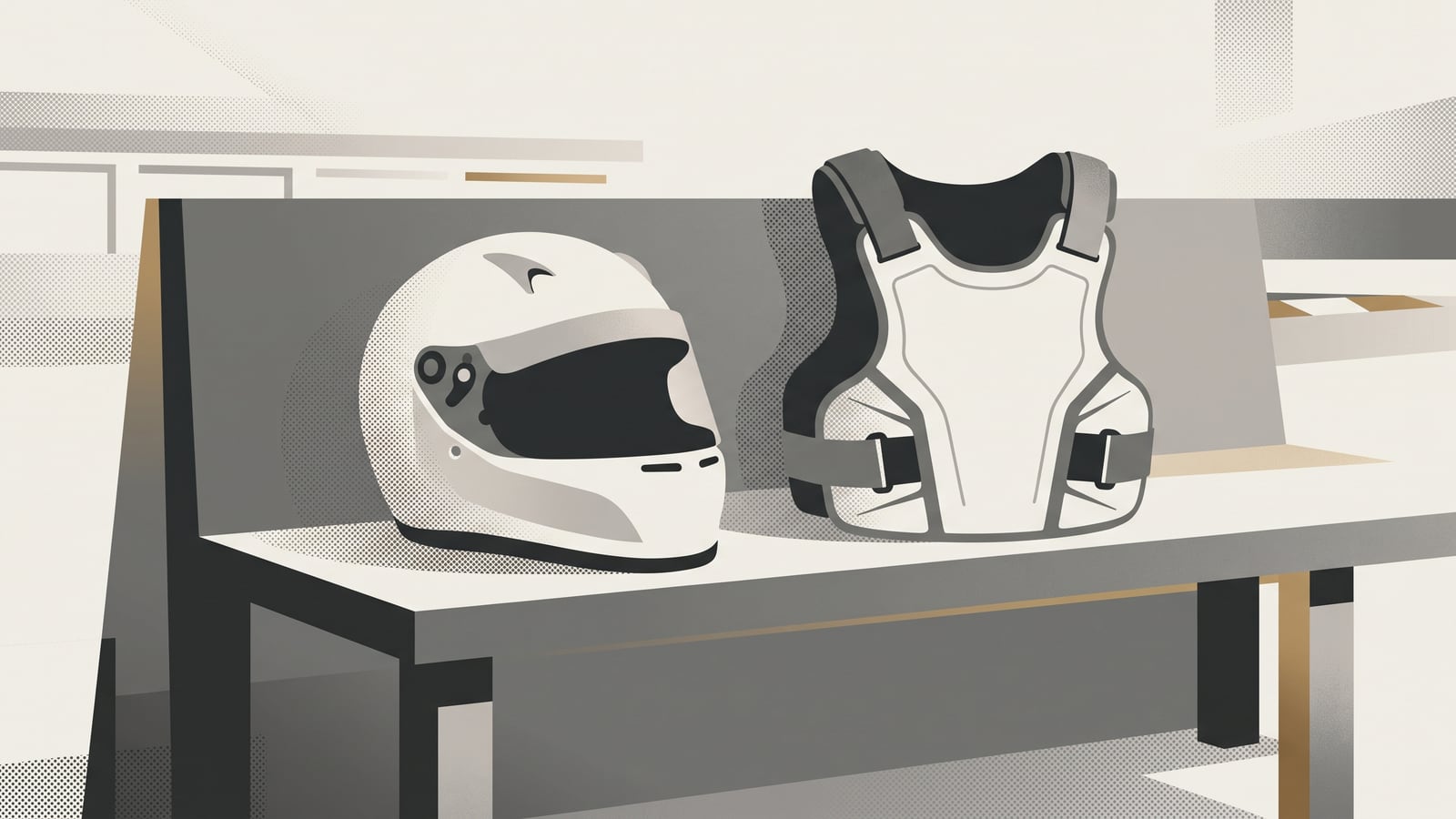
There's no single list that makes your child's karting equipment legal and safe. Instead there's a sequence of three questions, and you need to work through all three before you buy, borrow, or reuse anything.
First: does the event or class your child is entering this time accept the item? Second: does its certification and configuration match what that event requires? Third: does the product fit your child, get used correctly, and stay in serviceable condition, per its current manufacturer instructions? Passing one gate tells you nothing about the other two. A helmet can carry the right certification sticker and still fail the fit check. A product can fit beautifully and still be excluded by the rules of this weekend's event.
That trips up a lot of families, so it's worth saying plainly: certification does not by itself prove event acceptance or fit, and owning the item or getting it from a well-regarded supplier does not establish that it's suitable either. You still have to check.
Three gates, in order
This method works wherever your child races, but the answer it produces doesn't travel with it. The controlling documents depend on your child's current organizer or governing body, the specific event, the class, the season, and the exact version of the rulebook in force. A rule you read last year — or one written for a different class — may not be the rule that governs Saturday's session.
That means two different people answer two different questions. The organizer or governing body tells you what's accepted for this event — the standards, the configuration, the paperwork. The manufacturer tells you how to use, adjust, and care for the specific product you've chosen — sizing, fit, limitations, and what to do after an impact. Neither one substitutes for the other, and neither should be treated as the whole answer on its own.
Once you have those two answers, comparing your options gets a lot simpler.
Four workable paths
Most families are choosing among four options, and none of them is inherently the safe one or the serious one — they just suit different situations.
| Path | When it suits | Main advantage | Main tradeoff |
|---|---|---|---|
| Buy for current fit | You know the event's requirements and can try the product on your child | Direct access to the label and manual | Requires the requirement to already be known |
| Use permitted adjustment | You already have an identified product whose manual allows the change | Can resolve a fit problem without a new purchase | Doesn't fix an acceptance or condition problem |
| Use venue-provided or accepted equipment | An introductory or occasional session | Lower commitment before you know if this sticks | Provision doesn't prove fit or compliance |
| Retain or replace an existing item | Reassessing kit you already own | Avoids replacing something that's still fine | Standards can be superseded; growth and impacts force a fresh look |
Weigh the same things whichever path you're leaning toward:
- What this event accepts
- Whether the item fits your child now, and whether you're allowed to adjust it
- Whether its condition and configuration still meet the requirement
- How easily you can get the item and its current instructions
- How much ongoing upkeep you're ready for — replacements, rechecks after growth, rechecks after a season change
None of the four paths wins outright. Each one answers a different mix of these.
Buy or adjust
Buying for your child's current fit gives you direct access to the label and manual for the product you choose — though existing or venue-provided equipment can come with usable instructions too, if you can identify the item and track them down.
Whichever product you're considering, check its own current sizing and fitting instructions before assuming a size fits — a general size chart doesn't replace them. Later in this article, Bell's own fitting process for its helmets shows one manufacturer's version of that check.
Buying only makes sense once you know what the event requires — otherwise you risk choosing something the rules exclude — and once your child can try the product the way its manufacturer directs.
Adjustment is the quieter option. If you already own a product and its manufacturer's manual allows a specific change, that change can extend how long the item stays useful without a new purchase. But adjustment only works within what the manual allows — it can't fix a product the event doesn't accept, and it can't resolve a condition or modification concern. Under Motorsport UK's 2026 karting rules, for example, non-approved modifications or accessories can invalidate ASN and/or FIA approval.
Use venue kit or reassess what you own
Venue-provided or venue-accepted equipment solves a real problem: you don't want to buy a full kit before you know whether your child even likes karting. That's a reasonable way to keep the first session low-commitment. But the venue supplying or accepting an item doesn't tell you it's compliant, that it fits your child, or that it's in good condition. Supplier or ownership does not establish suitability — that's true whether the supplier is a shop, a club, or the box in the back of your own car. You still ask what governs the session, and check fit and condition the same way you would for something you bought.
Retaining an item avoids replacing it solely because it's already owned, but retention depends on current rule status, configuration, fit, condition, and the selected product's current instructions. But "we already have it" isn't a safety argument by itself. Standards can be superseded between seasons. Growth changes fit. An impact or a visible change in condition can turn a perfectly good helmet into one that needs a fresh look. Retaining and replacing are really the same decision: you're asking whether the item still passes all three gates, and sometimes the answer comes back no.
Three families, three outcomes
These are hypothetical situations, meant to show how the gates play out in an ordinary week — not real families.
The helmet that won't stay put. A family has a Bell helmet that's been accepted at events before, and the child's worn it for a season. Before the next race, they run Bell's own adjustment process — and the helmet still comes loose, rolling off with the chin strap fastened. Their first instinct is to keep using it; it was fine last time. But the result they're seeing is Bell's own stop condition, so they don't clear it. Instead they find a helmet that fits correctly under Bell's process, then separately confirm that helmet against this event's rules. Past acceptance, and the fact that they already own it, don't override a fit failure happening right now.
The trial session. A family books an introductory venue session and doesn't want to buy a kit before their child has even tried karting. Using the venue's equipment fits that plan. But instead of just showing up, the parent asks the venue two things first: which rules govern this session, and whether the equipment's label, fit, and condition can be checked before the child gets in the kart. If the venue can't answer, or the equipment on hand doesn't fit the child, the outcome is "clarification needed" — not an assumed pass because the venue handed it over.
The move to a sanctioned event. A child who's been driving informally at a local venue is entered into a Motorsport UK competition, with an existing certified helmet and the rest of their kit already on hand. The family works through everything the season requires: the event and class rules, the ASN sticker and permitted configuration, then fit, fastening, and condition, one item at a time. One thing they can't yet confirm: nobody has the exact fastening clause of the current rulebook in front of them to check against the helmet as configured. That's the result — the certification says the helmet passed a standard, not that this event accepts it as fastened and set up today. They don't clear the helmet for this event until the fastening question is resolved with the organizer or governing body.
What the scoped examples establish
The rest of this article uses real, named examples — a specific competition's rules, a specific product standard, a specific manufacturer's instructions. Each one is scoped tightly on purpose. None of them adds up to a universal equipment list, and none should be read past its stated scope.
A Motorsport UK example
For Motorsport UK's 2026 karting competition, a crash helmet carrying an ASN sticker — the national sporting authority's approval marking — is required throughout training, practice, and competition. Within this same scope, the rules put responsibility for the current specified standard, correct fit, secure fastening, and serviceable condition on the user. They call for a full-face helmet with a manufacturer-made visor that doesn't obstruct vision, and warn that unapproved modifications or add-ons can invalidate ASN or FIA approval. Complete gloves and boots that cover the ankle are required in this same scope too.
For Cadet and Bambino drivers under 15, Motorsport UK may check the helmet during an event, and it must not exceed 1,550 g unless the Code or the National Competition Rules specify a different figure for that class.
Motorsport UK's own fitting procedure checks six things: fit, strap tension, resistance to the helmet being pulled off from behind with the head held forward, visibility over the shoulders, breathing, and one-handed visor operation. The same six checks show up in the checklist below. That's Motorsport UK's procedure for its own competitors, not a general standard for every helmet everywhere.
Body protection under FIA 8870-2018
FIA Standard 8870-2018 is a product standard, not a guarantee. Its stated objective is to reduce the severity of chest injuries, and it sets out the areas a chest protector must cover and the performance it must meet.
That's meaningfully different from preventing injury outright, and it's also different from saying every kart driver must wear one — whether a particular event requires body protection is a separate, event-specific question, so check the current event regulation for your child's class.
For products homologated to the standard, it requires free movement, a stable position on the body, and coverage of the defined chest and rib areas while the driver is seated in the kart. It also requires the manufacturer's manual to cover sizing, fit, adjustment, limitations, storage, care, and cleaning — and that manual must recommend that the top of the chest protection sit no more than 25 mm below the top of the sternum while the child is seated in the kart. That figure comes from what the standard requires the manual to say, not from an event rule or a measurement you can apply to any product.
Manufacturer instructions set the product checks
Once you've picked a product, its own manual — not the standard, not a general guide — governs sizing, adjustment, care, limitations, and what happens after an impact.
CM2016 is a voluntary Snell/FIA certification standard aimed specifically at children's motorsports helmets, including karting. Its required warning labels tie maximum protection to a good fit and secure retention, and they give an impact-response instruction — but that instruction applies to CM2016-certified helmets specifically. If your child's helmet is certified under a different standard, don't apply the CM2016 instruction to it; follow the selected helmet's label and manufacturer instructions instead.
Bell offers a useful illustration of what a manufacturer's own fitting process looks like, and it's included here as a Bell-specific example, not as a claim that other brands work the same way or that Bell is superior to them. Bell says a tape measurement is only a starting point, and recommends fitting the helmet with the balaclava or head sock your child will race in. Its process checks for even pressure around the head, a correct low-brow position with the eyes near the centre of the eye opening, and a strap snug against the throat. Then comes the critical part: a roll-off check. With the strap fastened, does the helmet stay on when someone tries to roll it off, expose the forehead, or block vision? Bell's guidance is direct on this point: do not use a Bell helmet that remains removable after adjustment, and replace it with a smaller size if it stays that way.
Check the kit while seated
Before you use this checklist, fill in the fields below — the checks that follow can't give you a real answer without them, only "clarification needed."
One more thing: the extra items about sitting in the kart, in the last block below, are editorial usability observations added for this article. They are not a universal compliance or safety test, and passing them proves nothing about legality or crash protection on their own. Where a question can't be resolved with what you have in front of you, the honest answer is "don't clear it — ask the organizer, governing body, or manufacturer," not a guess.
Before you start
- Organizer or governing body: _______
- Event, class, season: _______
- Rules document title and version, date checked: _______
- Product label(s) present and legible: yes / no
- Current manufacturer instructions on hand: yes / no
Sourced checks — helmet
Mark each line as meets, doesn't meet, or can't tell yet. Anything short of a clear meets is a stop: don't clear the kit until the organizer or governing body resolves an acceptance question, or the manufacturer's current instructions resolve a product-specific question.
If Motorsport UK's 2026 karting competition scope applies:
- Close, comfortable fit, no side-to-side movement
- Chin strap tightened and under tension
- Resists being pulled off from behind with the head held forward
- Clear vision over both shoulders
- Breathing unobstructed
- Visor operable with one gloved hand
If a different governing body or class applies, transcribe its own helmet-fit rule here before checking, or mark "can't tell yet" until you can.
If this is a Bell helmet, add Bell's roll-off check after running Bell's adjustment process: with the strap fastened, try to roll the helmet off, backward and forward. Don't use it if it comes off, exposes the forehead, or blocks vision. If it remains removable after adjustment, Bell's instruction is to replace it with a smaller size.
Sourced checks — other equipment
Mark these the same way — meets, doesn't meet, or can't tell yet — and apply the same stop rule above to anything short of a clear meets.
Under Motorsport UK's 2026 karting rules, where they apply:
- Gloves: complete — not mitts, not open-backed
- Boots: cover and protect the ankle
Where a different event or class applies, use its own equipment rule instead, or mark "can't tell yet."
- Body protection, only if homologated to FIA Standard 8870-2018: free movement of arms, body, head, and neck; a stable position; chest and rib coverage per the manual
- Neck protection: per the event requirement and the product's instructions — mark "can't tell yet" unless you have both in hand
- Clothing: per the event requirement — mark "can't tell yet" unless you have the current rule in hand
- Any unresolved impact, condition, or modification question: don't clear it — ask the organizer, governing body, or manufacturer
Editorial usability observations
- Child seated in driving position: comfortable, no obvious restriction
- Steering and pedal reach: comfortable, full range
- Head and neck movement: unobstructed
- Loose items or interference with controls: none observed
Keep a growth-aware record
Treat any fit check as a dated observation, not permanent proof. Kids grow, standards get superseded, and equipment can be bumped, dropped, or outgrown between one check and the next. A simple running record turns each of those moments into a specific decision instead of a vague sense that "it's probably still fine."
Copy this table and fill it in as things change:
| Use context | Event or class | Rules doc (title / version / date checked) | Item | Instruction or requirement consulted | Fit or condition observation | Unresolved question | Next trigger | Bounded next action |
|---|---|---|---|---|---|---|---|---|
Three hypothetical entries show how it fills in:
| Use context | Event or class | Rules doc | Item | Instruction consulted | Observation | Unresolved question | Trigger | Next action |
|---|---|---|---|---|---|---|---|---|
| New season entry | Cadet, Club event | [Club] 2026 supplementary regs, v2, checked [date] | Helmet | Event helmet standard clause | Was accepted last season | Does the new season's regs still accept this standard? | Season rollover | Confirm with organizer before entering |
| Mid-season growth | Same as above | n/a | Body protector | Manufacturer manual | Feels tighter across shoulders than at purchase | Is it still within the manual's fit range? | Noticeable tightness or restriction | Re-run manufacturer fit check; replace if it fails |
| After a heavy off-track knock | Same as above | n/a | Helmet | Helmet's own label / applicable certification instructions | Child reports helmet felt loose after the knock | Does this helmet's certification require post-impact action? | Any impact event | Check the label; if unclear, ask the manufacturer before next use |
Verify the controlling documents
Keep this part compact. You've already gathered most of it for the checklist above: the organizer or governing body, the event, class, and season, the rulebook version, and the product's own label and manual. Gathering all of it before you shop or fit-check saves you from redoing the work later.
One more document worth knowing about: the FIA's technical list system. The inspected index displayed a Technical List no. 87 entry dated 2026-05-05; the list itself was not inspected. The index entry shows that a list exists, but it says nothing on its own about which models or configurations are currently accepted. Drawing any conclusion about a product or configuration requires that someone inspect the current technical list itself, and the applicable event regulation determines separately whether that event requires this homologation at all.
Where to go next
This article sits in the safety and rules hub, alongside guidance on finding the governing body and rulebook for a specific event, choosing a karting helmet, and confirming what equipment a specific booking requires. If your family's still deciding whether and how to start, the guide to a child's next step in karting picks up where this one leaves off, and the wider karting section covers everything from driving technique to setup once your child's on track.
Your next step: obtain and record the current equipment-requirements document for your child's exact event, class, and season from the organizer or governing body.