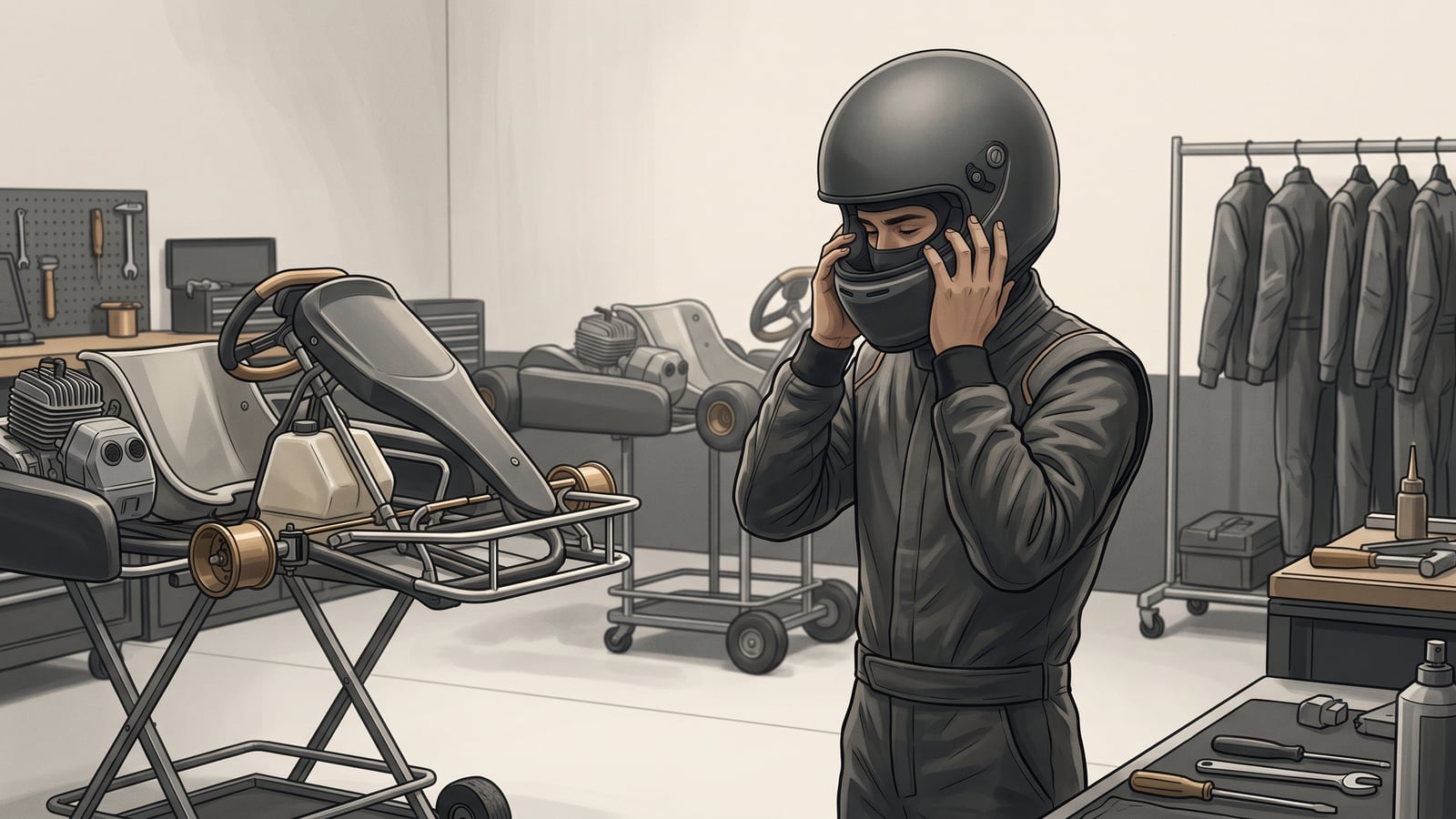
Before you compare a single helmet, find out where it needs to work. A helmet that looks right, fits well, and costs the right amount can still be the wrong purchase if it isn't accepted at the event you're going to. So the useful order is: figure out the event, then figure out the helmet.
This article walks through that order and ends at exactly one of three places: try the helmet in person, go verify one specific fact, or don't buy it yet.
Start with the event
| Who to ask | What they answer | |
|---|---|---|
| Acceptance | The event's current rules, or the officials running it | Whether this helmet type may be used at this event and class |
| Product support | The exact manufacturer | Product-specific questions only — inspection, warranty, availability — within that maker's own services, which vary by manufacturer and region |
Some events route the acceptance question through the relevant national sporting authority (ASN), or through club or event officials.
Compare the three choices
Once you know what the event will accept, you're choosing between three paths: buy a new helmet, consider a used one that comes with some history, or wait until a missing fact gets resolved. None of these is automatically right — each one trades access, information, effort, and money differently.
| Buy new | Consider used, with documented history | Delay | |
|---|---|---|---|
| Event acceptance | Still needs confirming | Still needs confirming | Confirm before doing anything else |
| In-person try-on | Available where you have local access to the exact option | Depends on the seller and location | Not yet applicable |
| History and condition | May involve fewer unresolved ownership-history questions, but still needs the same wearer checks | History questions may remain | Unresolved by design — that's why you're waiting |
| Manufacturer support | Needed only if a model-specific question comes up | May need a model- and region-specific question answered | Not yet applicable |
| Checking burden | Lower | Higher | Lowest — you're pausing the decision |
| Expected use and conditions | Set by how, and how long, you plan to use it | Same, plus whatever wear the previous owner's use and storage added | No commitment yet |
| Budget | Set by what you're prepared to spend | May suit a tighter budget, but that's a personal trade-off, not a safety signal | No spending yet |
Certification tells you a helmet meets a testing standard — it doesn't rank eligible products against each other for comfort, ventilation, or how much protection one offers over another, and none of the sources behind this article set a universal replacement interval for a karting helmet. Comfort and ventilation still come down to trying the helmet on in the conditions you'll use it in: a hot indoor session and a cold outdoor winter meet ask different things of padding and airflow.
Waiting has a real cost too. You may need to arrange a second try-on later, and the option you liked may no longer be available by the time the missing fact gets resolved. That's a reasonable trade against guessing at acceptance, fit, or condition, but it isn't free.
Budget matters, but it cuts both ways: a cheaper used helmet doesn't prove it's a worse choice, and a more expensive new one doesn't prove it's a safer one. What changes the decision is acceptance, access to a proper try-on, and how much of the helmet's history you can establish.
Situation: the appealing helmet found first
Say a parent and their ten-year-old spot a helmet online that looks great and fits the budget, before either of them has checked what their local club requires this season. It's tempting to just buy it and sort the details out later.
The better order runs the other way. The parent emails or calls the club, or checks its current rulebook, and asks whether that type of helmet is accepted for the class the child will race in. If the answer is yes, the helmet becomes a candidate for an in-person try-on — checking that it sits correctly, doesn't press anywhere uncomfortable, has a chin strap the child can adjust properly, and gives clear vision in a racing position. If the answer is no, or nobody can confirm it yet, the purchase waits. Nothing about liking the helmet changes what the rules say.
The cost of getting this backward isn't just wasted money. It's a family showing up on race day with a helmet nobody can confirm is accepted for that event and class, at the moment least convenient to find that out.
Situation: new nearby or used for less
A novice club racer is comparing two options. One is a new helmet available to try at a local shop. The other is a used one, listed for noticeably less — the seller has some of the original paperwork, but mentions, almost in passing, that the helmet took a hit once and was never inspected afterward.
The new helmet still isn't a done deal — it needs the same event-acceptance check as anything else, and the racer still needs to try it on before buying.
The used helmet needs two more things before it's a real option. First, the racer asks the seller for whatever documentation exists and for a straight answer about that impact — what happened, how hard, whether it was inspected. Second, the racer asks the helmet's exact manufacturer whether that model, in that condition, in the racer's region, has any applicable inspection or support route. If the manufacturer has nothing to offer and the impact can't be resolved another way, the sensible move is to let that helmet go and either pay more for the new one or keep looking.
The lower price doesn't tell you anything about whether the used helmet is safe — it's a budget fact, not a safety fact.
Choose one of three outcomes
Once you've checked the event and thought through new versus used versus waiting, here's how to turn that into a decision.
Start with: your intended organizer, event, and class.
- Try in person. Current event acceptance is already established, and the helmet you're considering is available for you (or your driver) to try on directly.
- Verify the missing specific. Exactly one consequential fact is unresolved — usually event acceptance or whether the exact manufacturer supports that model in your region. Go ask the correct side of the authority split above, then come back to step 1 or step 3.
- Do not buy yet. Acceptance, access to an in-person try-on, a reported accident, or manufacturer support remains unresolved in a way that matters, and there's no single question left that would clear it up quickly.
If a used helmet is part of the picture, the checks below cover exactly what's worth asking before you commit.
Checks that can change the purchase
Two kinds of checks are worth doing once you've reached "try in person" or "verify the missing specific": trying the helmet on yourself, and, for a used helmet, asking the right questions about its past.
Try an eligible option in person
Fit, stability, vision, comfort, and ventilation depend on the person wearing the helmet — nobody can approve any of that from a description or a photo. So once a helmet has cleared the acceptance question, try it on:
- Put the helmet on and adjust it following the manufacturer's fitting instructions.
- Check that it stays correctly positioned and doesn't shift or slide over your eyes when you move your head.
- Check for pressure points during a meaningful in-person try-on, following the manufacturer's fitting instructions.
- Confirm the chin strap adjusts properly and holds snug.
- Check that your vision is clear and unobstructed in the position you'll be sitting in, and that ventilation feels workable for how long you'll wear it.
If it shifts, presses, or blocks your vision, try a different helmet or size instead.
A used helmet with unresolved history
Visible checks and seller paperwork are information, not proof — the helmet's hidden protective condition may remain unresolved no matter how complete the story sounds.
That leaves two concrete questions worth asking:
- Ask the seller for whatever purchase documentation exists, plus a direct answer about any known impacts, repairs, modifications, or damage — and anything unusual about how it was handled or stored.
- Ask the exact manufacturer whether that model has any applicable support — inspection, repair, replacement guidance — for the reported circumstances, in your region.
When neither the seller nor the manufacturer can resolve a known or suspected impact, that specific helmet stays outside the buy-now options until something changes.
Where to go next
This article covers the buying decision itself — event acceptance, new versus used versus waiting, and the in-person try-on. For the wider kit list beyond the helmet, the karting equipment guide walks through what to confirm, arrange, or defer for a specific booking. To find the actual rulebook and governing body for your event, see the guide on finding governing bodies and rulebooks for a karting event. If the helmet is one piece of a larger first-season spend, building a local first-season budget puts it in that context, and the equipment hub and the wider karting section cover everything else you'll eventually need.
Your next step: open the current rules for your intended event and class, and copy out the exact helmet requirement that the specific option must satisfy — that's what determines whether it's even worth arranging a try-on.