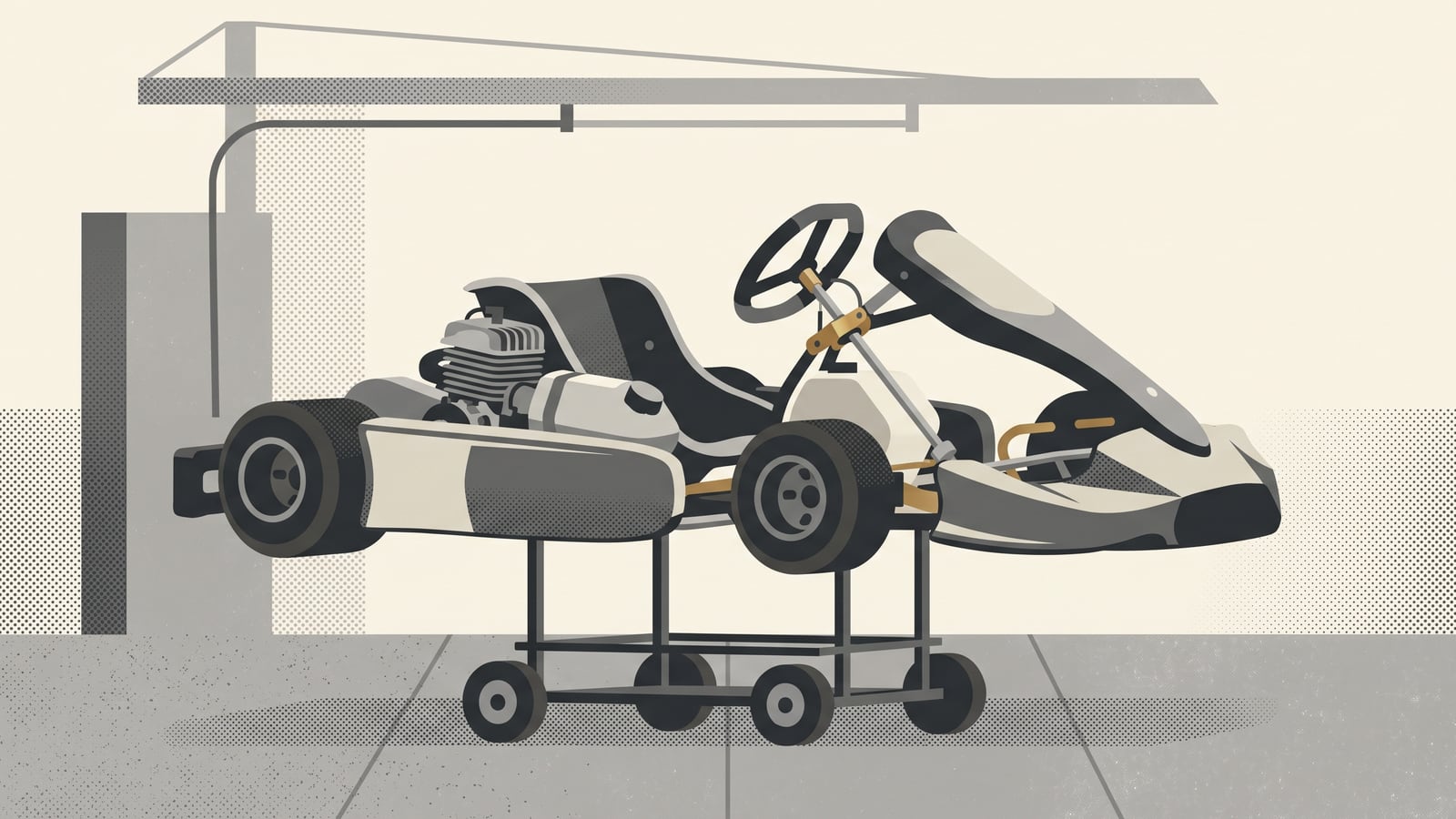
The no-go rule
Here's the rule this article works from: if you find an observable safety-critical defect, or you have an unresolved doubt about one, on brakes, steering, wheel retention, seat retention, throttle return, fuel containment, drivetrain guards, or ballast retention, don't approve the kart for a run. That means correction and rechecking through whatever process applies — the event organizer, the governing body, the kart or component manufacturer, or a qualified local person, depending on what's wrong.
That's conservative editorial guidance from Motorsigma, not a rulebook quote, and it's not a claim that every governing body writes it this way. What follows is a way of looking at a kart — not a diagnosis tool, a repair manual, or a compliance certificate. It won't tell you why a part is worn, how to fix it, or what torque to use. It tells you when to stop and ask someone else.
It's also worth knowing what a pass from scrutineering — the technical check an event runs before you're allowed to compete — means. Scrutineering is a brief compliance inspection carried out against that event's rules; it is not safety certification, and it does not shift the competitor's responsibility for the kart's condition onto the scrutineer. A kart that passed scrutineering last week, or even earlier today, can still develop a problem before your next run. Make this check yourself, every time — don't skip it because someone already looked.
Inspect in this order
A kart has a handful of systems where an unnoticed problem turns into a real hazard on track: the ones that stop you, steer you, keep you and your wheels attached to the kart, control your speed, contain the fuel, guard the moving parts, and hold any added weight in place. Walking through them in a fixed order, every time, works better than checking whatever catches your eye.
None of what follows asks you to measure anything or judge how much wear is acceptable. It asks you to look, work the control by hand where you can, and notice when something feels wrong or uncertain.
Brakes
Push the brake pedal by hand before you ever push it with your foot on track. Notice whether it feels firm, whether it returns cleanly, whether you can see or smell fluid where there shouldn't be any, and whether any visible hardware — pins, clips, lines — looks loose, worn, or missing. Any of that is a reason to stop.
Exactly how much brake redundancy or construction a kart needs, and what counts as acceptable brake condition, depends heavily on the kart and the rules that apply to it. CIK-FIA's technical regulations set out brake-control redundancy requirements for the karts within their scope, and Motorsport UK's rules include their own brake provisions — the two aren't the same document and shouldn't be read as one standard. One manufacturer's manual goes further than a general caution: CRG's owner manual for its covered racing karts instructs that if there's any defect or doubt about the brakes, the kart should not be started. That instruction covers brakes only, and only the covered CRG racing karts the manual applies to — it isn't a general rule for every system or every kart. But it's a good illustration of how directly a manufacturer can state the same conservative principle this article applies more broadly.
Steering
Turn the wheel through its full range by hand with the kart stationary. You're checking for anything insecure — a loose tie rod, a wheel or hub that moves independently of the steering column, play that feels excessive to you, or resistance and binding that don't feel right. There's no universal number of degrees or millimeters of play that counts as fine across karts and classes — that figure, where one exists, lives in the kart's own documentation or the applicable rules, not in a general guide. If something about how the steering moves or feels leaves you unsure, treat that uncertainty itself as the concern.
Wheels and seat
Check that every wheel is attached properly, with no visible looseness, missing hardware, or damage to the hub or nut. Do the same for the seat: the mounting points and any seat stays need to be intact and firmly secured, not just resting in place. Exact wheel-hardware and seat-stay requirements come from the kart's own paperwork and the applicable class rules — this check is about spotting insecurity, not confirming the attachment method itself is correct.
Throttle return
With the engine off, press the throttle pedal and let go. It should return on its own, every time, without catching or hesitating. Look along the cable or linkage for anything that looks frayed, kinked, or obstructed. A throttle that doesn't return cleanly on its own is a stop, full stop — this isn't a case for judging how much delay is tolerable or adjusting anything yourself before a run.
Fuel containment
Look for fuel where you shouldn't see it: around the tank, along the lines, at the overflow. Check that the tank itself is mounted securely and that the pipe and overflow routing look intact rather than pinched, cracked, or loose. Exactly how a tank should be mounted, and what routing counts as correct, varies by kart and by the rules for the event or class you're at — this section is about spotting a visible problem, not confirming the arrangement is compliant.
Guards and axle retention
Confirm that the guard the kart and class require over the chain, belt, or other exposed drivetrain component is in place, properly secured, and not cracked, bent, or missing fasteners. Required guard coverage isn't consistent across governing bodies, classes, or drivetrain types, so what counts as complete depends on what you're running and where. One specific example worth knowing about if it applies to you: Motorsport UK's rules include a rear-axle retaining-device provision, but it's limited to Race Venue Events — it isn't a blanket requirement across every Motorsport UK kart event, so don't assume it applies just because you're racing under Motorsport UK rules generally.
Ballast retention
If the kart carries ballast — added weight used to bring it up to a class minimum — check that it's attached securely, with nothing loose or shifting when you nudge it by hand. FIA Karting and WKA each have their own hardware, placement, and quantity rules for ballast, and the two don't match — this guide isn't reproducing either as instructions. What matters here is simple: loose or uncertain ballast attachment is a no-go, regardless of which rulebook eventually governs the exact fix.
Pre-run no-go checklist
Organizer, class, homologation, product, and manufacturer requirements can add checks beyond this list, or change what a given check looks like for your specific kart — treat this as a conservative baseline, not the full compliance picture for your event.
| System | What to check | No-go result | Correction and recheck |
|---|---|---|---|
| Brakes | Pedal firmness and return; visible leaks; hardware condition | Defect or doubt: don't run | Correct and recheck through the applicable organizer, governing body, manufacturer, or qualified local person |
| Steering | Full-range movement by hand; play, binding, or anything insecure | Defect or doubt: don't run | Correct and recheck through the applicable organizer, governing body, manufacturer, or qualified local person |
| Wheel retention | Secure attachment; hardware present and tight | Defect or doubt: don't run | Correct and recheck through the applicable organizer, governing body, manufacturer, or qualified local person |
| Seat retention | Mounting points and seat stays intact and secure | Defect or doubt: don't run | Correct and recheck through the applicable organizer, governing body, manufacturer, or qualified local person |
| Throttle return | Pedal and linkage return fully with the engine off | Defect or doubt: don't run | Correct and recheck through the applicable organizer, governing body, manufacturer, or qualified local person |
| Fuel containment | Tank mounting, lines, and overflow checked for leaks or damage | Defect or doubt: don't run | Correct and recheck through the applicable organizer, governing body, manufacturer, or qualified local person |
| Drivetrain guards | Required guard present, secure, and undamaged | Defect or doubt: don't run | Correct and recheck through the applicable organizer, governing body, manufacturer, or qualified local person |
| Ballast retention | Attachment checked by hand for movement | Defect or doubt: don't run | Correct and recheck through the applicable organizer, governing body, manufacturer, or qualified local person |
Any defect or doubt on any line above means the same thing: don't run until it's corrected and rechecked through whatever process applies.
Record your findings
The table tells you what a no-go looks like. Recording what you actually found is what turns it from a mental checklist into something you can act on and hand off. Copy this block once per system:
System:
Observed condition:
Unresolved doubt (yes/no):
Initial status from this baseline check (pass / no-go):
Required action:
Applicable contact or document:
Correction performed (what, by whom):
Recheck result (pass / no-go, who/when):
Current status:
The two status lines record different things: the initial status is what this observation-level baseline check found, and the current status is where the system stands after any correction and recheck — neither is a compliance decision, which stays with the documents and people the contact line points to.
Once every system above has a completed record, add one more line: kart-level decision — approved to run, or held for correction and recheck. A single no-go or unresolved doubt on any system holds the kart, no matter how the rest of the sheet reads.
Use the right documents
Once you've looked the kart over — whether you found a concern or just want to confirm what's expected — look for the documents that apply: the event regulations, the governing body or class rulebook, any relevant homologation documents for the kart, and the manufacturer's own instructions.
Four documents come up repeatedly in this space, and each is its own separate, scoped example — not pieces of one merged international standard: CIK-FIA's RT2025 v1.2 technical regulations, the WKA's 2026 dirt-event self-tech inspection form, Motorsport UK's 2026 Edition 4 rules, and CRG's own racing kart manual. Each governs a different set of events, karts, or classes, and each can be revised on its own schedule. Within the cited scope of any one of them, class or event requirements may differ further still — always confirm you're reading the current applicable document for the event in front of you, not last season's copy or a different class's version.
Escalate uncertainty
When a finding stays uncertain after you've looked and checked what you can by hand, it's not your job to decide alone whether it's acceptable. Depending on what the concern is, the right person to involve is the applicable organizer, the governing body whose rules apply to the event, the manufacturer of the part or kart in question, or a qualified local person — a scrutineer, a team mechanic, or someone else with the relevant technical standing. That choice depends on whether the question is about event permission, a rule, a specific product, or a part's physical condition — there's no single contact for every kind of doubt.
Rectification is discretionary
If a formal scrutineering check turns something up, don't assume you're automatically entitled to fix it and try again. At a Motorsport UK event, a scrutineer may allow a problem to be corrected and the kart presented again — but that's a possibility built into the process, not a guarantee, and the kart cannot go on track until it has passed.
Where to go next
This article sits in Motorsigma's safety and rules coverage. From here, a natural next read is building a checklist for the specific kart in front of you, which turns this system-by-system approach into a routine you can repeat before every session. If a fastener issue is what sent you looking for help, four questions to ask before you reach for a torque wrench covers that ground without prescribing numbers this article deliberately leaves out. And if you're still working out which rules and documents actually apply to your event, finding the governing body and rulebook for a karting event is the place to start. All of that sits within Motorsigma's wider karting coverage.
Your next step: open the current event or manufacturer inspection document that applies to this kart before you use the checklist above.