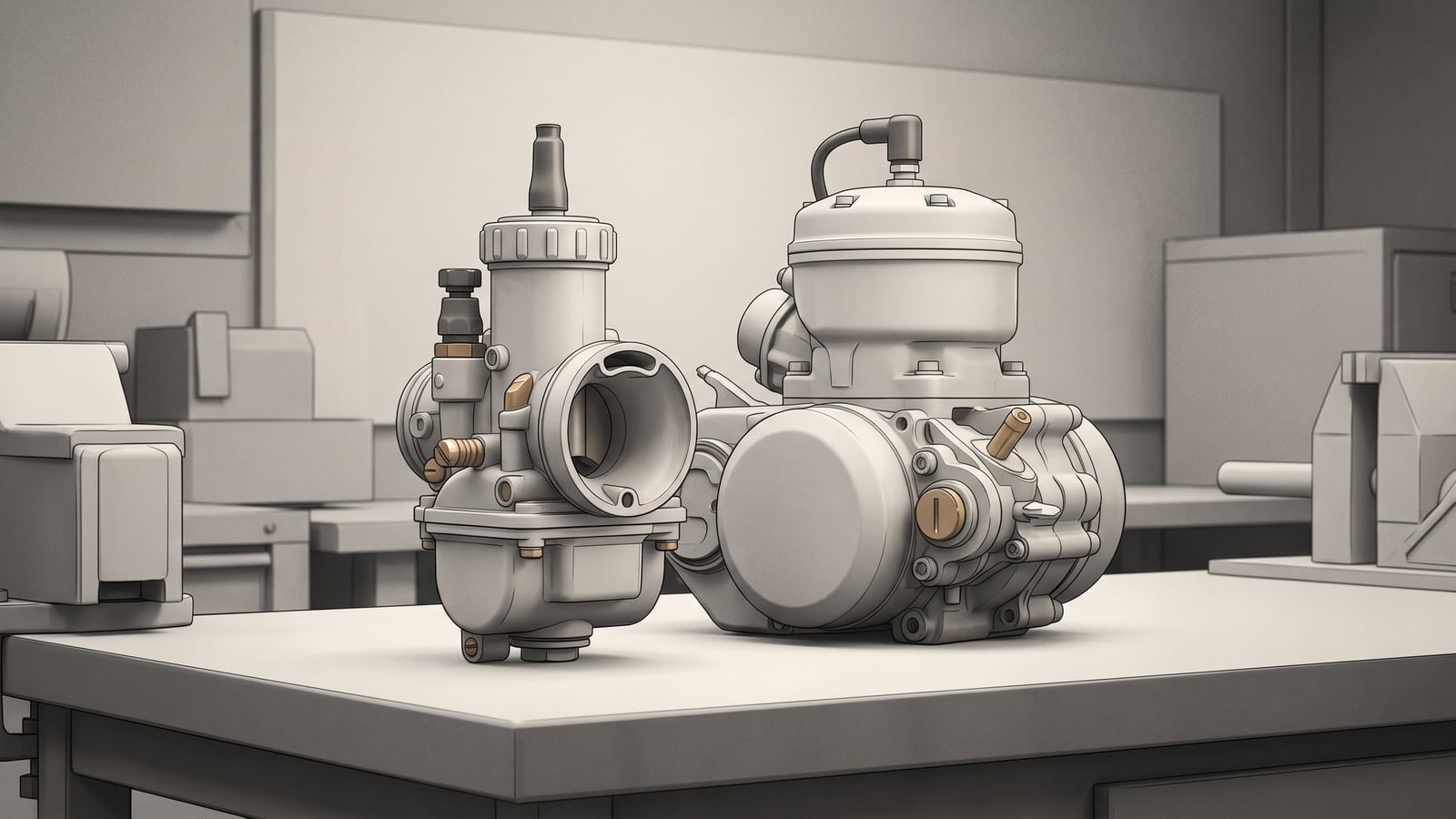
Different carburetors call for different maintenance and baseline paths, once you check what a manufacturer document says about each one. That's the practical problem this article solves: identifying what your exact carburetor needs, and recognizing when the supporting documentation hasn't been obtained or inspected yet.
So the first move isn't to reach for a screwdriver. It's to read what's stamped on the carburetor body and match it to a document written for that exact part.
This article won't give you a tuning recipe. What it gives you is a way to find out whether a supported baseline exists yet for your carburetor and engine, and how to record what's still unresolved while you wait for the missing document or rule.
Identity comes first
Before anything else, copy the marking stamped or cast into the carburetor body, along with the engine model and variant it's bolted to. That combination — not the carburetor's general shape, and not what a similar-looking part usually needs — is what determines which document applies.
A part looking like one you've serviced before, or turning freely under a screwdriver, tells you nothing about what current manufacturer documentation says for the exact carburetor and engine you have. Workshop habit and hearsay aren't documentation either, however confidently they're offered trackside. A supported maintenance or baseline path comes from identity and authority, not from resemblance.
Once you have the marking and engine variant recorded, find the manufacturer's current document for that combination — an operator's manual, a service bulletin, or whatever else the manufacturer currently publishes — and read what it says the carburetor is. Some documents will tell you plainly. Others won't cover your part at all, and that's a useful answer too.
Build the baseline record
Exact procedures, parts, and values in carburetor work are specific to the product and the engine. A step that's correct for one carburetor can be wrong, or unsafe, for another that merely looks similar. Continue only with documentation for the identified combination. If that documentation is missing, or unclear about the design, parts, or safe procedure, stop and take the question to the manufacturer, authorized service support, or a qualified inspector rather than filling the gap yourself.
With that boundary in place, here's a compact record to fill in as you go. It doesn't establish compatibility, legality, settings, or service requirements on its own — it's a place to keep what you've confirmed and what you haven't.
Blank baseline record
- Carburetor marking (copied exactly):
- Engine model and variant:
- Class, event, and season this baseline is for:
- Manufacturer document title and edition:
- Applicable competition rules — title and version:
- Design the document identifies (float system / diaphragm / undetermined):
- Baseline inputs required by the document (for example, reference temperature and altitude):
- Permitted baseline (only what the document states):
- Applicable pre-start checks:
- Unresolved items:
- Status: supported baseline / documentation unavailable — clarification needed
Below the fields, the record branches into two paths, and only one of them can go further with what's publicly documented here.
Float-system branch. Continue only when the manufacturer document for your exact carburetor and engine identifies a float system and supplies the applicable method. The named Rotax MAX evo scope, covered below, is the only illustration this article can offer; it isn't a stand-in for any other float-system carburetor.
Diaphragm branch. Continue only when current documentation from the identified manufacturer establishes the design, the parts, the procedures, and the applicable values. No document inspected for this article covers diaphragm carburetor anatomy, kits, settings, or service steps for any specific product. If that's where you land, leave the design field undetermined, mark the status "documentation unavailable, clarification needed," and add "diaphragm" only once a manufacturer document for your exact carburetor confirms it. That's a complete, usable result.
The documented float path
This Rotax example shows what a document like that can do. Rotax's April 2024 operator manual for the Rotax 125 MAX evo, Junior MAX evo, Mini MAX evo, and Micro MAX evo identifies the Dell'Orto VHSB 34 fitted to those engines as a slide-type carburetor with a float system. That's Rotax's description for this exact carburetor and engine combination, not a definition that applies to every carburetor called a float system, and not evidence about how any diaphragm carburetor is built.
For that same scope, the manual states reference calibration conditions of 25 °C (77 °F) at 400 m (1,310 ft) above sea level, and directs the reader to its own table when actual conditions differ. Those numbers are Rotax's stated reference point for this exact carburetor and engine, not a general starting value for float-system carburetors elsewhere.
The 2024 manual also describes an app-based route for main-jet recommendations, built from engine selection plus weather or geographical inputs. This article can only say what the manual describes; it hasn't verified whether that app is currently available or how it behaves today.
What this path buys you is a bounded, documented route: identity, reference conditions, and a stated method for producing a recommendation. What it costs you is the work of gathering the inputs the document asks for, plus confirming separately that whatever the manual permits is also permitted in competition — which the manual alone never guarantees.
The documentation-only diaphragm path
If your carburetor's markings, or informal descriptions of it, point to a diaphragm design, this article can't take you past identification. No publicly inspected manufacturer document supplied the anatomy, kit contents, settings, or service procedure for any specific diaphragm carburetor here.
If your documentation search ends here, record the marking and the missing document, keep the design field at undetermined, and note it in the unresolved-items field.
A completed decision loop
Here's how the record might fill in for one hypothetical owner-driver racing a 125 MAX evo.
She copies the carburetor marking and confirms it matches the Dell'Orto VHSB 34 fitted to her 125 MAX evo, then records the engine model and variant. She locates the April 2024 Rotax operator manual, records its edition, and notes that it identifies a float system for that combination. In the baseline-inputs field, she records the manual's stated reference conditions: 25 °C and 400 m above sea level. So far: identity confirmed, document in hand, inputs recorded.
She checks for the applicable competition rules for her class and event and doesn't yet have them, so she leaves that field open and notes it in unresolved items. Her record at this stage reads:
- Carburetor marking: matches the Dell'Orto VHSB 34
- Engine model and variant: Rotax 125 MAX evo
- Class, event, and season: her class and this season's event, pending confirmation
- Manufacturer document title and edition: Rotax 125 MAX evo Operators Manual, Ed. 04/2024
- Applicable competition rules — title and version: not yet obtained
- Design the document identifies: float system
- Baseline inputs required by the document: 25 °C, 400 m above sea level
- Permitted baseline: not yet determined
- Applicable pre-start checks: per the same manual
- Unresolved items: applicable class/event rules not yet obtained
- Status: baseline recorded; competition use pending rule confirmation
The float-system identity and the reference conditions are real, useful entries; they just don't authorize anything at the track until the rules catch up.
A week later, she obtains the applicable class and event rules. Two things can happen next. If the rules expressly permit the change she was considering, she records the exact permission, its source and version, and the authority that issued it, and the baseline moves from pending to permitted for that item. If the rules are silent, unclear, or don't cover that part, the field stays marked "clarification needed" — adjustability was never the same thing as permission, and neither is a well-documented float system.
What the two paths change
The two branches don't differ in how good or reliable the underlying carburetor design is — this article makes no such claim. They differ in what documentation exists, what you can record, and where the work stops.
| Dimension | Float-system path (Rotax scope) | Diaphragm path (as documented here) |
|---|---|---|
| Authoritative design identification | Confirmed by the manufacturer manual for the named scope | Not established by any document inspected here |
| Verified guidance available in this article | Design identity, reference conditions, and a described calibration route | Identification only; no procedure or values |
| Inputs and record burden | Gather the manual's stated reference-condition and weather/geography inputs | None beyond marking, engine variant, and missing-document status |
| Competition-permission layer | Separate from the manual; requires current rules and event authority | Same requirement, once a document eventually exists |
| Stop condition | Stops if identity, manual edition, or rules can't be confirmed | Stops now, at documentation unavailable |
Start with the float-system path when your document names your carburetor and engine and states the reference method; that's the only situation where continuing past identification makes sense. Treat the diaphragm path as a documentation-and-referral exercise when your only description of the part is informal, or when the manual you've found covers a different product. Neither path is the "easier" one in any general sense — each one just reflects how much has been published for the part you own.
Two ordinary cases
Picture two owners at the same club meeting. The first has a carburetor whose markings match the Rotax VHSB 34 scope described above. She pulls the April 2024 manual, records the edition and the stated reference conditions, and notes that her event's rules haven't arrived yet. Her record is useful today — identity and reference inputs are down on paper, even though the permitted-baseline field stays open until the rules do.
The second owner has a carburetor he's always heard called "diaphragm-type," but no manufacturer manual he can point to. He records the marking, marks the design as undetermined, and notes the missing document. He doesn't borrow the first owner's reference conditions, because they were never written for his engine. His next move is contacting the manufacturer or a qualified service source.
Now picture two competitors with visibly adjustable carburetors. One races in a class where the current rules expressly permit a specific change — an adjustment covered in that season's rule text — and she records the exact wording, the rule version, and the issuing authority before making the change. The other has an equally adjustable part but no applicable class or event rules in hand yet. He leaves the permitted-baseline field unresolved rather than treating "it turns" as "it's allowed." In both pairs, the difference isn't what the carburetor looks like. It's what document exists and what it says.
Confirm competition permission
A manufacturer document tells you what a part is and, sometimes, how to set it. It doesn't tell you what your event allows. Legality depends on the current engine rules plus the applicable sanctioning body and organizer, class, event, region and season, and those layers have to be checked separately, every season, for the actual event you're entering.
The 2026 Briggs 206 factory rules are a useful, scoped example of how narrow a permission can be. They permit only the specified stock carburetor and allow alterations only where expressly permitted. Within that, they allow adjustment of the float-arm tab as a limited, named exception, while the jets and slide remain subject to stock or unaltered requirements. The rules also address five factory needle-clip settings, the throttle-cable cap, and the OEM choke lever, each covered on its own terms. None of that summary substitutes for reading the actual rule text before you act; consult the rule text for implementation, because a permission described loosely here can carry conditions that only the document itself states.
What "expressly permitted" means: a change is allowed because the current rule text says so — not because a similar change is allowed somewhere else, or because the part can physically move. Briggs also labels its own class structure as reference-only, and explicitly allows sanctioning bodies or organizers to alter that structure for their own licensing protocols. So even a manufacturer's own factory rules may not be the final word on what your specific event permits; that's set by whichever sanctioning body and organizer run it.
If you spot something in this article that doesn't match the current rule text or manual, the site's corrections route is linked from the header and footer at /about.
The scoped pre-start check
For the named Rotax scope, the manufacturer's pre-start checklist includes confirming free movement of the carburetor's Bowden cable and checking that the carburetor piston is connected in the idle position. That's specific to this product and this manual; carrying that exact terminology over to a different throttle system could lead you to check the wrong thing, or miss the check that matters for your carburetor. Before acting on it, confirm the check against the current applicable manual for the carburetor and engine you actually have.
When the documents run out
This article stops short of hands-on service and design-specific detail, for any carburetor. It leaves out:
- Cleaning, disassembly, inspection, gasket and fuel-line work, cable adjustment, and full rebuild or reassembly
- Diaphragm-carburetor components, kits, cross-references, and replacement intervals
- Plug-colour diagnosis, symptom lists for lean running or detonation, one-size-fits-all tuning sequences, universal safety-wire rules, prices, and performance or reliability claims
That also narrows what "one change at a time" means here. It isn't a general tuning method you can apply to any carburetor. It means recording only the changes your exact product documents describe and your applicable rules permit, one at a time, in the baseline record above.
A record that honestly says "clarification needed" is more useful than one that guesses. The next person who reads it — a mechanic, a scrutineer, or you in six months — can tell exactly what's confirmed and what still needs a document that hasn't been obtained or inspected yet.
Where to go next
This article sits in the karting maintenance hub, alongside guidance for building a document-led kart maintenance schedule once you know which manuals actually apply, a pre-session kart inspection checklist you can adapt to the kart in front of you, and a guide to building a baseline setup for each track once your carburetor documentation is settled. From there, the wider karting section covers everything from getting started to race weekends.
Your next step: copy the carburetor's identification marking into the baseline record.