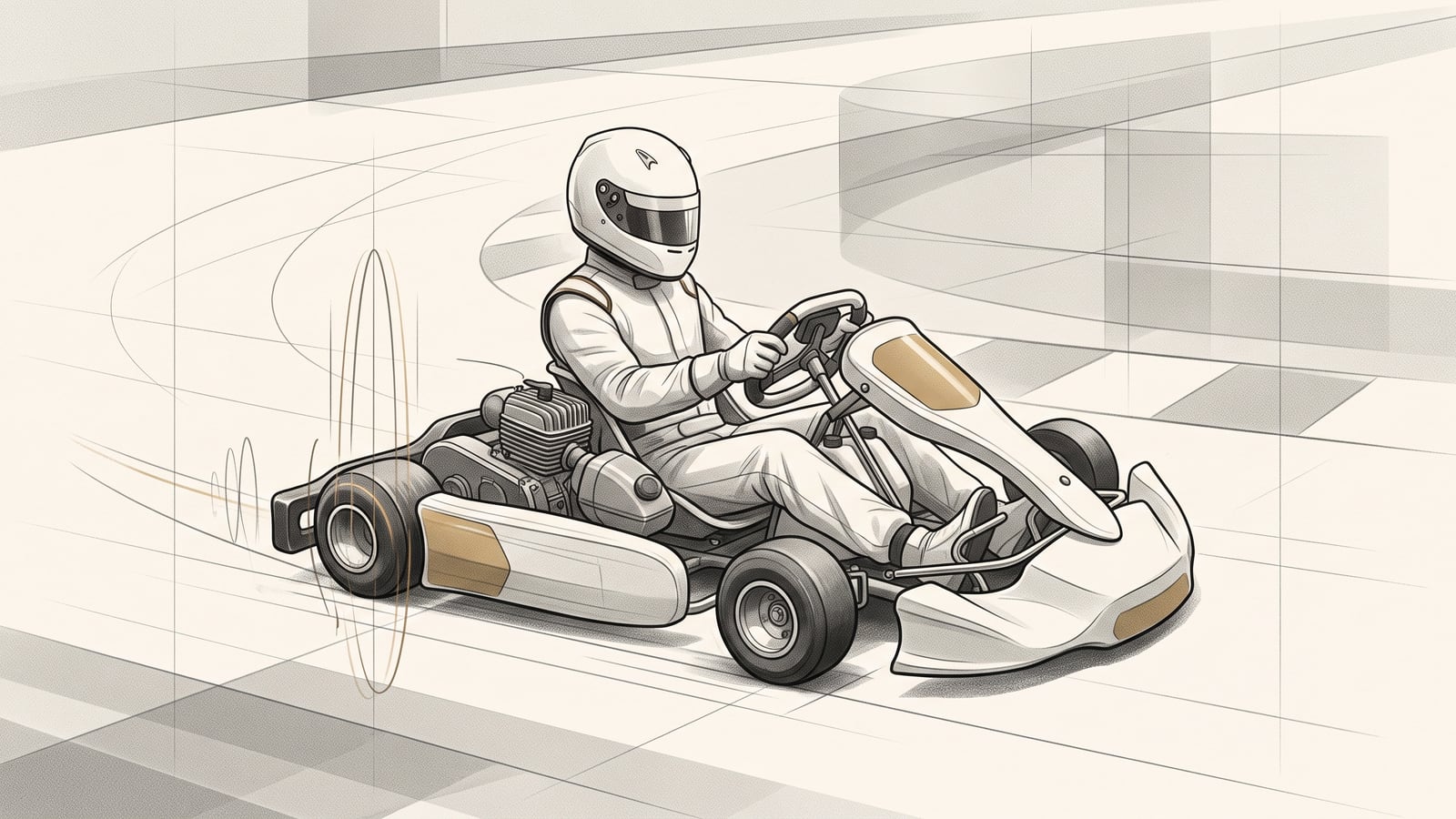
Record the phase first
Before you touch a bolt on the chassis, answer one question: what does the kart actually do, and where in the corner does it do it? "Hopping" and "binding" are labels people reach for in the paddock, but a label isn't a diagnosis. It's a starting point — and if you accept it too fast, it can send you toward the wrong adjustment.
So start smaller. Where in the corner does the behavior show up — entry, mid-corner, or exit? What are your hands and feet doing at that moment? Does it happen every lap, or only sometimes? What's the grip level and surface like, and what was the last thing you changed on the kart? Answering these questions well usually tells you more than naming the symptom. And if the answers don't point cleanly toward one explanation, writing that down as unresolved is a fine outcome — better than forcing a diagnosis that isn't there.
The inside-rear model
Within 2026 CIK-FIA scope, the driven rear wheels share a one-piece axle, so both rear wheels spin at the same speed even though they travel different paths through a corner. ANGRI's cornering explainer, describing a simplified no-differential model, treats that mismatch as the reason the inside rear tyre needs to lose some grip, or lift slightly, for the kart to get around the corner — what the model calls inside-rear unloading.
That same simplified model treats weight transfer, the kart's centre of gravity, caster, and chassis stiffness as contributing factors in how much it unloads. Treat this as a simplified model, not a complete causal account of what your kart is doing on a given lap. It names some of the moving parts; it doesn't hand you a verdict. Excessive lift is one possible mechanism behind a hopping-like report, not a confirmed cause of it, so hold off on turning this explanation into an adjustment until you've worked through the checks later in this article.
Hopping, binding, or unresolved?
With the corner phase and inputs written down, compare what you saw against three broad patterns. None of them is a diagnosis by itself — they're a way to organize your observation so the next step matches what's actually happening.
| Hopping-like | Binding or flat-tight-like | Unresolved | |
|---|---|---|---|
| Observed character | Repeated bouncing or chatter | Steady drag, kart doesn't unload the inside rear — an equipment-specific example from the Ignite K3 guide | Overlapping or inconsistent report |
| Corner phase and input | One K3-specific account places this from mid-corner to exit on high-grip tracks; a separate specialist glossary describes bouncing near the apex as throttle is applied | From turn-in through the corner in the K3 guide's example, with exit momentum falling off | Changes between laps or doesn't match a single phase |
| Condition sensitivity | Often associated with high-grip conditions in the K3-specific account | Described only under that guide's stated conditions, not a universal definition | Can't yet be tied to a condition |
| Best fit | A repeatable bounce you can locate by phase | An entry-to-exit drag with lost momentum, on equipment like the example in that guide | Reports that shift or contradict each other |
| Limitations | More than one mechanism can produce a similar feel | Terminology and threshold aren't universal | Doesn't hand you an adjustment |
| Poor fit when | The main complaint is steady drag, not bouncing | The bounce shows up near the apex instead | You have a clean, repeatable, single-phase report |
| Lowest-risk next move | Complete the observation card, then rule out whichever confounder was most recently changed or is cheapest to check | Complete the observation card, then rule out whichever confounder was most recently changed or is cheapest to check | Complete the observation card for every report you have, then apply the same confounder check |
Whichever column you land in, that next move follows the same order: whatever was most recently changed first, then whichever confounder is cheapest or fastest to verify. If neither can be checked before the session ends, the comparison waits — that's a legitimate stopping point, not a failure to diagnose.
That same K3 guide ties two of these columns together in one narrower place: it says hopping is usually associated with binding in high grip. That's a chassis-specific claim about one guide's terms. It doesn't sort every kart's report into one column or the other.
Before you settle on a column, jot down these details:
- Corner phase (entry, mid-corner, exit)
- Steering, brake, and throttle inputs at that moment
- Whether it repeats every lap or only sometimes
- Grip level and weather
- Track surface state
- Tyre state
- Current setup
- The last change you made to the kart
Nothing on that card is a measurement you need special equipment for — it's what you already noticed or can ask the driver directly. If the card doesn't cleanly match one column, the honest answer is that the report may remain inconclusive, and that's fine. An ambiguous report isn't a failure — it's a reason to keep watching before you touch anything.
Three hypothetical days
These are illustrative scenarios, not field reports. Nobody measured a real kart to produce them; they exist to show how the same classification method plays out when conditions or history change.
A high-grip afternoon
Picture a kart that starts bouncing from mid-corner through exit on a rubbered-in, high-grip afternoon. The phase matches one guide's description of hopping. But a bounce on a grippy track doesn't prove one mechanism. It's tempting to read this as confirmation that the inside rear is lifting too much and reach for a stiffer axle or a lower rear end. Resist that. The useful move is to note the exact phase and whether it tracks with throttle application, then run through the confounder checks below before deciding anything about setup.
Two reports from one corner
Now imagine two drivers coming off the same corner with different complaints. One says the kart drags from turn-in and loses momentum on exit — that resembles the flat-tight example from the K3 guide, an equipment-specific example rather than a universal definition. The other says the kart bounces only as they get back on the throttle near the apex, closer to the hopping terminology used elsewhere. Write down phase and character for each. If the same kart alternates between both reports without settling into a repeatable pattern, treat it as unresolved rather than picking whichever label sounds more familiar.
After unrelated work
Picture a complaint that shows up right after wheel, hub, brake, or drivetrain work — nobody touched the setup on purpose. The work itself may have introduced drag or misalignment, and that's a plausible confounder worth checking before you look anywhere else. Free-running checks and a look at the current baseline come first. If anything about component condition is uncertain, stop and get it checked rather than trying to resolve it with more laps.
Inspect before tuning
Confounders are boring, which is exactly why people skip them. Skip that step and a driving habit or a dragging bearing — both plausible confounders — can get mistaken for a chassis problem.
On the driving side, check whether brake and throttle overlap, trail-braking, deliberate sliding, or extra steering input coincides with the complaint. None of these is an accusation — they're just common, observable habits that can produce a similar feel to a mechanical issue.
For the mechanical side, work through a compact inspection:
- Brake drag
- Wheel or bearing friction
- Alignment-related rolling resistance
- Drivetrain alignment
- Possible wheel, axle, hub, or tyre run-out
Each of these is a plausible confounder worth ruling out, not a confirmed cause. This article doesn't cover specific tolerances or repair steps, because those depend on your chassis and change over time; if you find something that looks worn or out of alignment, that's a reason to stop setup testing and use current manufacturer documentation or qualified inspection rather than guessing at a fix.
If a session only leaves time to check one confounder — driver habit or mechanical item — the same ordering convention from the comparison table applies: check whatever was most recently changed first (the "After unrelated work" scenario above is exactly this case), then whichever is cheapest or fastest to verify. That's a recording convention for deciding what to check first, not a claim that one confounder is more likely than another.
Why adjustment directions differ
Once you've ruled out inputs and mechanical confounders, it's tempting to hunt for a universal fix — stiffer here, lower there. The material available doesn't support one. One chassis maker's guide gives three examples, and each describes that chassis only under the stated conditions.
For the OTK chassis described, a too-soft rear axle may flex and contribute to binding in the guide's stated high-grip conditions. Lowering the rear ride height may add on-power exit grip while making it harder for the inside rear to lift. And fitting the applicable rear torsion bar may improve exit grip while restricting flex as grip increases. All three effects depend on conditions, and none of them is a rule you can carry to a different chassis, tyre, or class. Start any test from your kart's current baseline, in the conditions you run, rather than from someone else's setup sheet.
The one-session checklist
Once you've classified the report and screened the confounders, the goal is a single controlled session built around one question at a time.
- Write down the baseline observation and the conditions from the report you're investigating.
- Run through the input and mechanical confounder checks above.
- Compare the kart to its current manufacturer baseline before you decide anything looks off.
- Select either one non-adjustment check or one permitted and reversible change — never both at once.
- Carry out the selected check or make the selected change, note what you did, and repeat the same observation under comparable conditions where practical, then record the result.
- Restore the baseline if the result is worse or unclear. Stop entirely if condition, legality, or safe operation is in question.
This improves your ability to attribute a result to the selected check or change. It doesn't prove the change was safe, permitted, or correct — that's a separate question, and the next section covers it.
Copy the observation card
The fields above are scattered across this article — the comparison table, the phase-and-condition bullets, the confounder lists, the six steps. Here they are as one copyable record, so you're not assembling the format yourself mid-session.
KART HANDLING OBSERVATION CARD

OBSERVATION
Corner phase (entry / mid-corner / exit):
Steering, brake, and throttle inputs at that moment:
Repeats every lap, or only sometimes:
Grip level and weather:
Track surface state:
Tyre state:
Current setup:
Last change made to the kart:

CLASSIFICATION
Best-fit category (hopping-like / binding-like / unresolved):
What would change this classification:

CONFOUNDER STATUS
Driver-input confounders (overlap, trail-braking, sliding, extra steering) — ruled out / not yet checked:
Mechanical confounders (brake drag, wheel/bearing friction, alignment-related rolling resistance, drivetrain alignment, run-out) — ruled out / not yet checked:
Confounder checked first, and why (most recently changed, or cheapest to verify):

NEXT MOVE (choose exactly one, or none)
One non-adjustment check, or one permitted and reversible change:

FOLLOW-UP COMPARISON
What you did:
Same observation under comparable conditions — result:

DECISION
Restore baseline / keep the change / stop (condition, legality, or safe operation in question) / comparison waits:
Fill it in as you go rather than after the fact — the confounder and next-move fields are easy to blend together from memory once the session's over.
One card, filled in
This is a wholly hypothetical example, built to show how the card handles two drivers reporting different things about the same corner — the "Two reports from one corner" scenario described earlier in this article. Nobody measured a real kart to produce it; none of the observations below are real.
KART HANDLING OBSERVATION CARD (invented example, example only)

OBSERVATION
Corner phase (entry / mid-corner / exit): Driver 1: turn-in through exit. Driver 2: mid-corner, as throttle is reapplied near the apex. (invented text, example only)
Steering, brake, and throttle inputs at that moment: Driver 1: steady throttle from turn-in, momentum falls off before exit. Driver 2: bounce coincides with getting back on throttle near the apex. (invented text, example only)
Repeats every lap, or only sometimes: Driver 1: most laps this session. Driver 2: most laps this session. (invented text, example only)
Grip level and weather: High grip, dry, same session for both drivers. (invented text, example only)
Track surface state: Rubbered in. (invented text, example only)
Tyre state: Mid-life, same set both drivers ran. (invented text, example only)
Current setup: Unchanged from the last recorded setup sheet. (invented text, example only)
Last change made to the kart: None since the previous session. (invented text, example only)

CLASSIFICATION
Best-fit category (hopping-like / binding-like / unresolved): Unresolved. Driver 1's report resembles the binding-like column; Driver 2's resembles hopping-like. Both are recorded as given, not averaged into a single column. (invented text, example only)
What would change this classification: If a second session showed one driver's report repeating and the other not, that would start to separate them. (invented text, example only)

CONFOUNDER STATUS
Driver-input confounders — ruled out / not yet checked: Not yet checked for either driver. (invented text, example only)
Mechanical confounders — ruled out / not yet checked: Not yet checked. (invented text, example only)
Confounder checked first, and why: None — no recent component work on this kart, and nothing on the mechanical list was obviously cheaper to check than another. (invented text, example only)

NEXT MOVE (choose exactly one, or none)
One non-adjustment check, or one permitted and reversible change: None selected — see decision below. (invented text, example only)

FOLLOW-UP COMPARISON
What you did: Not run this session. (invented text, example only)
Same observation under comparable conditions — result: Not run this session. (invented text, example only)

DECISION
Restore baseline / keep the change / stop / comparison waits: Comparison waits. No confounder could be checked before the session ended, and the two drivers' reports don't agree, so nothing was adjusted. (invented text, example only)
Notice what the card does with the disagreement: both drivers' observations stay on the record, attributed to the driver who gave them, and the classification comes out unresolved rather than splitting the difference between "hopping" and "binding." That's the honest reading of two reports that don't agree — not a verdict on which driver is right.
Permission and stop limits
For 2026 CIK-FIA competition, any modification has to comply with the Technical Regulations and the specific regulations for your category — if those documents don't permit it, it's forbidden, full stop. That's a question of competition legality, separate from whether a change suits your equipment.
Before you make an actual adjustment, check both current manufacturer documentation for your chassis and engine, and the applicable ASN, organizer, series, or class authority for the event you're entering. One historic product guide's restriction on unauthorized modifications is specific to that manufacturer; it doesn't establish current Margay policy. Even so, it points at the right instinct: check manufacturer policy and class legality separately, rather than assuming one covers the other.
If you're unsure about steering, braking, fasteners, component condition, or assembly, that's a stop condition. A setup test can't resolve it. Clearing it calls for current manufacturer documentation or qualified inspection, not more laps.
Not being able to find current documentation for the component or class in question is its own stop condition, separate from what the documentation would say if you had it. A missing manual or an unclear class rule isn't something to guess past — it's a reason to stop and ask before you make an actual adjustment.
Where to go next
This article sits in the kart setup hub, alongside the kart setup troubleshooting guide for turning a broader handling complaint into one bounded hypothesis, the driver-first handling checklist for ruling out driving habits before you touch the chassis, the copyable setup-test worksheet for structuring the one-change session itself, and the session record template for keeping your observation card consistent from one outing to the next. From there, the wider karting section covers everything from getting started to race weekends.
Your next step: pull the details from the most recent occurrence — corner phase, control inputs, conditions, current baseline, and the last change you made — and write them down before you pick any adjustment.