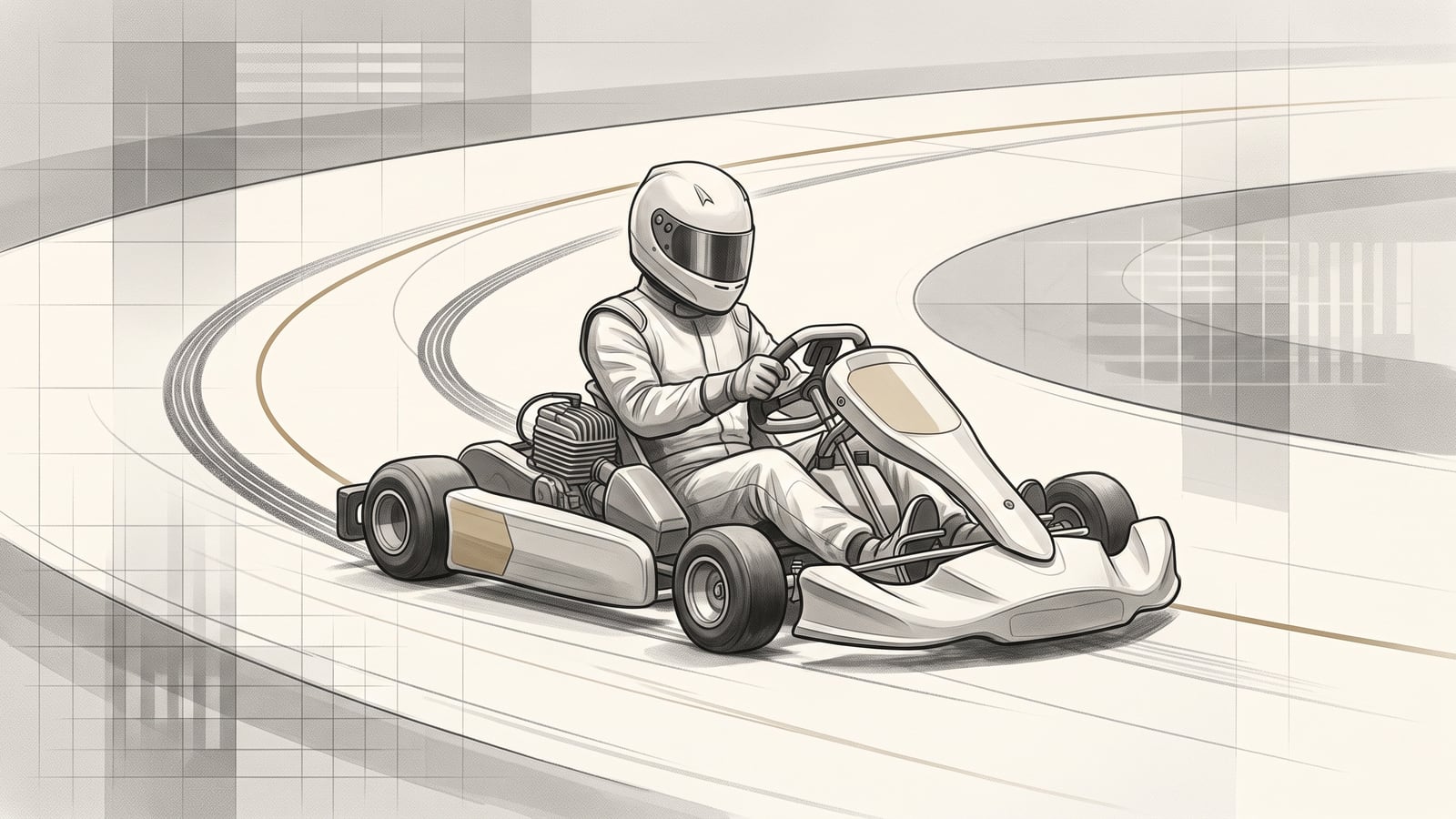
The kart pushed through a corner it usually takes cleanly, or it rotated more than you expected. Your hand is already halfway to the setup notebook. Don't change anything yet.
First, figure out whether it's even safe and allowed to keep driving and observe. If it is, you can make one bounded, deliberate comparison and write down what happens. If it isn't, the right move is to stop and ask someone who can inspect the kart or authorize further running.
Two words are doing a lot of work here, so let's define them plainly. A push (sometimes called understeer) is the sensation that the kart isn't turning as much as you expect. Unwanted rotation (sometimes called oversteer) is the sensation that it's turning more, or earlier, than you expect. Both are things you feel, not things you've proven. Neither one tells you, on its own, whether the cause is your driving, the setup, or something mechanical.
This article walks you through a driver-first checklist, a decision between two paths — keep observing or stop and get help — and a short note you can hand to a coach or mechanic afterward. It won't hand you a diagnosis. Nobody can give you one from a feeling alone.
What the sensation can tell you
Kart response depends on a lot: the chassis, tyres, and setup; the track surface and weather; your speed and the corner itself; and you, the driver. Coaching material for newer racers walks through several of these — chassis, engine, tyres, track surface, weather, and setup — alongside the driver's own effect, without ranking or quantifying how much any one of them contributes. A more technical look at a conventional solid-rear-axle kart adds more variables to that list: centre of gravity, weight transfer, caster, and chassis stiffness on the mechanical side; corner radius, how rubbered-in the track is, and the day's weather on the situational side.
That list matters because it's easy to jump straight to "it's me" or "it's the setup" the moment something feels off. Neither jump is justified by one sensation in one corner.
If you deliberately change one input and the push or the rotation changes with it, that's a genuinely useful clue. It doesn't prove you caused the problem, that the setup is fine, or that the kart is mechanically sound. Treat it as one data point that narrows the conversation.
Stop before testing
Before you try anything, rule out the reasons you shouldn't be testing at all. Stop running if the behaviour feels unexpected or concerning, or if you suspect a problem with the brakes, steering, pedals, tyres, or fasteners, or notice any damaged part. CRG's own manual — for CRG racing karts specifically — is direct on this point: don't start a CRG kart if the braking system is defective or even doubtful. Broader leisure-karting guidance treats brakes, steering, tyres, protections, fasteners, and the fuel system as safety-related areas needing particular care, maintained according to the kart's manual and a periodic plan.
If any of that applies, follow the current manufacturer procedure for your kart, and involve whoever can actually look at it: a mechanic, the venue or track staff, the event organizer, or — if the concern touches competition rules — your ASN or the relevant governing authority. A feeling that something is wrong is reason enough to stop; you don't need certainty first.
Set up one bounded observation
Assuming nothing above applies, here's the method this article recommends. It's Motorsigma's own editorial judgment for organizing what you notice on track — not an established diagnostic protocol, and not a substitute for anyone inspecting the kart. Used well, it can help you organize observations into something a coach or mechanic can act on. It cannot prove cause, and it cannot clear the kart mechanically.
It only works under a specific set of conditions. You need:
- an authorized session, with permission to run the comparison you have in mind
- no suspected safety issue
- an unchanged kart setup
- conditions you can reasonably call similar from one run to the next — same track state, similar weather, comparable traffic
Change more than one thing at once, or compare a wet run to a dry one, and whatever you notice tells you next to nothing.
Whether a given input actually changes the sensation is worth observing, and it depends on the conditions: your kart, your tyres, the track, and the corner in question. That's the honest scope of what one afternoon of driving can show you.
The driver-first checklist
This is the sequence to work through once you've decided it's safe and permitted to observe.
- Record the sensation and where it happens. Is it on the approach, at turn-in, mid-corner, or on exit?
- Establish a baseline. Run a few laps you'd call representative, without touching the setup.
- Pick one observation category. Choose a single thing to pay attention to:
- entry approach
- steering application
- braking and release
- throttle timing and application
- the line you're taking
- posture and body control
- how tightly you hold the steering wheel
- Change only that one input, deliberately. Stay within the session rules and within what you can control at speed.
- Compare broadly similar laps. Note the changed input and what you observed.
- Stop if things go wrong. If it turns abrupt, unfamiliar, inconsistent, or worse, stop right there — don't push through it to finish the comparison.
None of these categories predicts a particular result. Coaching material discusses posture, unintended movement, steering input, and early throttle application as things worth watching in a non-gearbox context. Introductory technique material covers braking, throttle, steering, line, and body position the same way — as things to notice, not as guaranteed causes of a push or a rotation. What each one does in your kart, on your track, on that day, is exactly what you're trying to find out.
Choose between the two paths
Once you know whether the situation is safe to observe, the practical choice comes down to two paths: keep driving and compare, or stop and get help. Continue observing when the behaviour is familiar and repeatable, the kart is believed safe, and the session lets you run a deliberate comparison. Stop when the behaviour is abrupt, unfamiliar, inconsistent, or worsening, or when you have any mechanical doubt at all.
| Controlled driver observation | Stop and seek follow-up | |
|---|---|---|
| When it's suitable | Familiar, repeatable behaviour; kart believed safe; comparison permitted | Doesn't match what you'd expect, or keeps getting worse; any mechanical doubt |
| What it can produce | An input-sensitive pattern and a clearer note for later discussion | Inspection, authorization, or a qualified read on what's going on |
| Immediate tradeoff | Can't isolate cause or confirm the kart is sound; conditions drift between runs | May cost you track time before the cause is known |
| Who's involved | Just you, within the session rules | Possibly a coach, mechanic, manufacturer, venue, organizer, or ASN |
Controlled driver observation
This path suits a corner you know well, where the sensation is repeatable, where nothing about the kart worries you, and where the session allows you to run a deliberate comparison. Done carefully, it can show that the sensation is sensitive to a particular input, which gives you something concrete to raise with a coach or in a setup discussion later. It also avoids changing a driving input and the kart's setup within the same comparison, which would make it impossible to tell which one moved the result.
The catch is that track grip, tyre temperature, and weather — plus your own speed and consistency — can all drift between one run and the next, so the comparison is never as clean as it feels. As above, that's a clue about sensitivity to an input — not proof of anything about the setup or the kart itself.
Picture a driver who feels a repeatable push in the same phase of a corner they know well. Nothing about the kart has raised any concern, and the session allows deliberate comparison laps. They leave the setup untouched, pick one input — say, their braking and release — vary it deliberately, and run a handful of broadly similar laps. If the sensation eases, that's a clue worth writing down. If the kart starts behaving oddly instead, they move to the other path immediately. Either way, they end up with a clearer note to bring to a coach or mechanic.
Stop and seek follow-up
This path suits behaviour that doesn't match what you're used to or that's getting worse, and anything that raises even a shadow of mechanical doubt. Its value is that it keeps a possible safety or component issue from being treated as a driving drill. It routes the question to whoever can inspect the kart, grant permission, or interpret what happened — which a lap comparison can't do on its own.
The obvious cost is lost track time, and possibly no immediate answer. Different concerns call for different people:
- a technique question — a coach
- a mechanical question — a mechanic
- something product-specific — the manufacturer
- anything touching permission or competition rules — the venue, organizer, ASN, or relevant governing authority
Stopping doesn't identify the fault by itself, and it doesn't guarantee a fault will be found — it routes the concern toward inspection, assistance, or authorization from someone equipped to look at it.
Picture a kart that starts rotating in an unfamiliar, inconsistent way after behaving normally all session. The driver doesn't try a string of new inputs to chase it down. They stop and jot a short note: the corner, the phase, the conditions. Then they ask for help before running again — a mechanic, the venue staff, the manufacturer's procedure, whoever the situation calls for. The session ends earlier than planned. That's the cost. The benefit is that an uncertain mechanical question doesn't get answered by guesswork at speed.
Check the applicable requirements
Whichever path you took, check what governs your return to running, because the sources behind this article don't all cover the same ground. Leisure karting guidance is written for leisure karting: it doesn't replace current local law, and it explicitly excludes CIK-FIA- or ASN-controlled competition. If you're driving at that leisure level, follow the venue briefing and track-staff instructions together with current local requirements and any applicable manufacturer procedures for your kart. If you're driving in competition, check the competition-specific requirements for your class, event, and venue for that season, along with your ASN or governing body — leisure guidance won't cover you there. And if the instructions you're following came from a kart manufacturer's manual, remember those apply to that manufacturer's karts specifically, not to karts in general.
Write the handoff note
Whatever you observed, or whatever made you stop, write it down before you forget the details. Five fields are enough:
- Sensation: ___
- Corner and phase: ___
- Broadly comparable conditions: ___
- Single input changed: ___
- Observed result: ___
A coach can use this to talk through technique. A mechanic or the kart's owner gets useful symptom context without you implying the kart has been cleared — that's still their call to make. And if the conversation eventually turns to setup, this note gives you something concrete to bring to it, rather than a vague memory of "it felt off in turn three."
Where to go next
This guide sits in the driving hub, alongside the practical skills that make an observation like this worth trusting in the first place. If you want to be sure two sessions are comparable before you draw any conclusion from them, how to compare karting sessions fairly is the next read. If lap times and sector splits are part of what you're weighing, how to read lap times and sector data without guessing the cause covers that ground carefully. Once you're ready to raise what you found with someone else, turning driver feedback into one bounded decision and how to run a bounded setup test pick up where this article leaves off. Beyond that, the wider karting section covers everything from getting started to race-weekend logistics.
Your next step: before your next safe run, write down the corner and the phase where the sensation shows up.