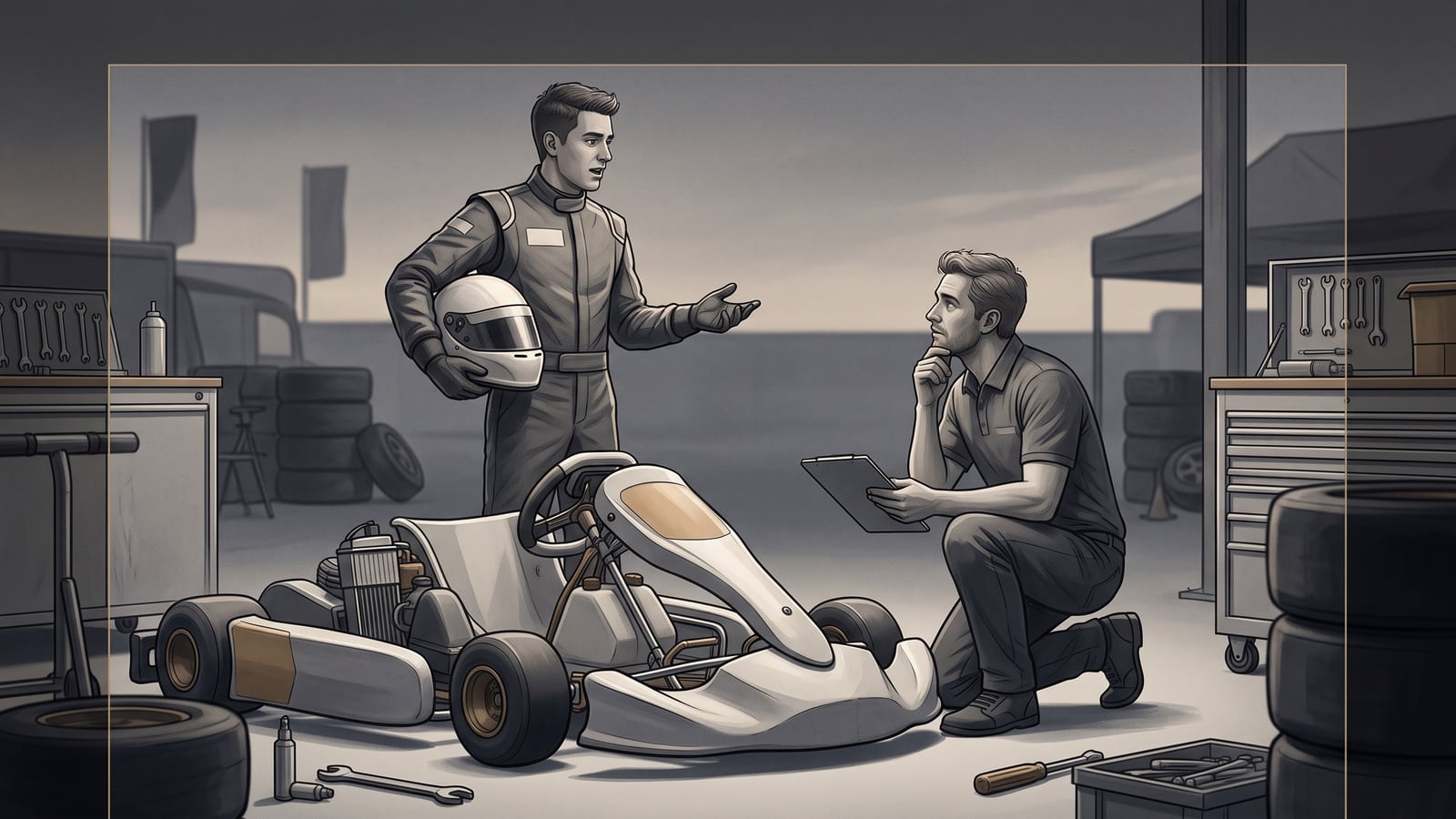
A driver climbs out and says, "it wouldn't turn." That sentence feels like feedback, but it's already two things stitched together: something the driver felt, and a guess about why. The guess might be right. It might also send the mechanic straight to the wrong adjustment.
A better debrief keeps those two things apart. The driver reports where the behaviour showed up, during which part of the corner, how sure they are, and whether it happened more than once. The mechanic listens, asks a question that doesn't hint at an answer, and repeats the account back to check it. From there the pair does one of two things: write down a bounded hypothesis — a possible explanation worth testing, without treating it as a confirmed diagnosis — or decide, on purpose, to leave the baseline alone. A baseline, here, just means the kart and setup state you're comparing everything else against. Neither outcome is a verdict. One gives the next run a question to answer; the other keeps a known reference point until there's more to go on.
Observation comes first
"It wouldn't turn" packs an experience and a diagnosis into one phrase. The experience is real — the kart did something the driver didn't want. The diagnosis, that the kart is somehow deficient in turning, is a guess sitting on top of it, and it might be wrong, or it might be right for a reason nobody's named yet.
A useful account keeps the two apart. It should cover:
- Context — the session context the team already has, such as which run or which baseline setup was on the kart.
- Location — which corner, or which part of the track.
- Phase — entry, the middle of the corner, or exit, without implying which one is at fault.
- What was felt or seen — in the driver's own words, rather than a conclusion about the cause.
- Confidence — how confident the driver is, and whether the behaviour happened once or every lap.
None of that requires the driver to know anything about setup. A driver who says "the back stepped out on the way in, twice, and I'm pretty sure both times" has given the team something to work with, without diagnosing anything. That's the point: useful feedback and correct diagnosis are different skills, and only one of them is the driver's job.
The seven-step debrief
What follows is Motorsigma's proposed debrief: an editorial synthesis of general questioning and reporting practice, not a validated karting procedure and not something any rulebook or manufacturer prescribes. Treat it as a starting checklist you can adjust to the situation, rather than a script to follow word for word.
- Add context. Note which run this was and which baseline setup or configuration was on the kart, using whatever session record the team already keeps.
- Record the location. Name the corner or section of track where the behaviour appeared.
- Name the phase. Say whether it happened on entry, in the middle of the corner, or on exit — without implying which one caused it.
- Write the behaviour in the driver's words. Capture what they felt or saw — save the theory about why for later.
- Record confidence and repetition. Ask how sure they are, and whether it happened once or repeatedly.
- Ask one neutral question, then restate the account. Clarify anything missing, then repeat the account back so the driver can correct it.
- Record the decision. Write down one bounded hypothesis to test, or explicitly decide to retain the baseline.
Steps two through five are the reporting fields; steps six and seven are the conversation that turns them into something the team can act on. Retaining the baseline in step seven is a Motorsigma editorial option — none of the sources behind this process require it. It's simply the honest choice when the account doesn't yet support a test.
Ask without supplying the answer
Start open. "What did you feel?" or "Walk me through that corner" gives the driver room to describe the experience in their own terms, rather than steering them toward an answer the mechanic already suspects. Only once the account is missing something specific does a narrower question make sense: "was that on entry or on exit?" is fine when the driver hasn't said, but "did it push wide because the front was loose?" is not — it hands the driver a diagnosis to agree with.
This is adapted question-form guidance drawn narrowly from a law-enforcement interviewing manual: begin openly, use a specific question only to fill a genuine gap, and avoid wording that suggests the answer. That source covers eyewitness interviews rather than motorsport, and nothing here claims it improves a driver's memory or produces better decisions — it's simply a sound shape for a question, borrowed for a different room.
A short set of neutral prompts covers most gaps:
- "Where on the track was that?"
- "Was that going in, in the middle, or coming out?"
- "Did that happen once, or every lap?"
- "How sure are you that's what happened?"
Each question asks for a fact; the cause comes later.
Restate the shared account
Once the driver has answered, the mechanic repeats the account back — where it happened, what phase, and what was felt. Then comes how often it happened and how confident the driver was, uncertainty included rather than smoothed away. The driver then gets the chance to correct or add to it. This step exists to preserve the driver's uncertainty rather than quietly resolve it, and to make sure the written account matches what was actually said. It's an editorial adaptation of a good habit rather than a claim that restating improves recall or leads to a better decision — it just gives both people one account they've both checked before anyone starts guessing at causes.
Three fictional debriefs
The scenarios below are fictional examples, built to show the process, not fieldwork or a reported result from any real team. Each one ends in a hypothetical decision — something a team might plausibly choose, not something that happened.
A competitive driver and mechanic
A driver comes in and says the kart stepped wide on exit of the same hairpin, twice, and they're fairly confident that's what happened, on the baseline setup that's been on the kart all session. The mechanic asks, "what did you feel, and where?" rather than naming a cause. The driver describes the rear stepping out on the way out of the hairpin. The mechanic restates it: exit of the hairpin, twice, fairly confident. The driver confirms it's accurate, with nothing to add.
If the responsible people on the team can define and approve an appropriate comparison for the next run, they write down one bounded hypothesis — the rear grip might be dropping through that exit — and a plan: run the next heat with nothing else changed, then compare the same corner again. If they can't approve a fair comparison yet, because the track's still evolving, say, they record the observation instead and leave the baseline alone. A precise, repeated account makes a bounded test possible. It doesn't diagnose the kart or authorize anyone to touch it: any consequential change still needs confirmation from the current organizer or governing/class authority, applicable class requirements, manufacturer instructions, and the responsible team member or qualified local support.
An owner-driver in both roles
An owner-driver notices the kart feels different in the fast sweeper on two laps of the same session — a touch of push on one lap, nothing on the other — though other things may have shifted too, such as track grip or fuel load. Because they're both driving and deciding, it helps to write the observation down before reaching for a mechanical explanation: fast sweeper, mid-corner, happened on one of two laps, moderate confidence.
Rereading the note, they ask themselves a neutral question — did anything else change between those two laps? — and add a correction: the second lap followed a spin recovery, so the surface underfoot may have been different. Because the account conflicts with itself and other factors may have moved as well, the hypothetical decision is to retain the baseline — a deliberate no-change decision, an editorial option rather than something any source demands. A later test would still need a stated objective, conditions held as steady as practically possible, and a written record of what happened.
A parent supporting a young driver
A parent's young driver mentions, once, that something felt odd going into a corner, but isn't very sure about it. The parent asks where and when, without suggesting what might be wrong: "which corner, and was that going in or coming out?" The driver says the last hairpin, on the way in, and isn't sure it happened more than once. The parent repeats it back — last hairpin, on entry, once, low confidence — and asks if that's right. The driver agrees, with nothing to change.
The parent doesn't propose an explanation. The hypothetical decision here is to leave the baseline alone: a single, low-confidence, one-off account isn't enough on its own to support a test. The record goes to the responsible mechanic or coach. Any consequential change still needs the current organizer or governing/class authority, applicable class requirements, manufacturer instructions, and the responsible team member or qualified local support. The parent's role is just to help that account travel intact to the people who can weigh those questions.
Choose the next decision
Choose a bounded next test when the observation is specific, it repeated, the driver stated their confidence honestly, and the responsible people can define and approve a fair comparison. Choose a deliberate no-change decision — retain the baseline — when the report is vague, conflicting, low-confidence, unconfirmed, or nobody's in a position to approve a comparison yet. Retaining the baseline is a Motorsigma editorial option for exactly those moments — none of the sources behind this process draw that conclusion.
| Bounded next test | Retain the baseline | |
|---|---|---|
| Best for | A specific observation that repeated and can be honestly qualified | A vague, conflicting, low-confidence, or unconfirmed report |
| Advantages | Gives the next run a defined question; encourages recording the objective, conditions, and result | Keeps a known reference point; avoids treating an unsupported account as a diagnosis |
| Trade-offs | The result stays conditional on the recorded context; changing one thing at a time can't reveal every interaction | The suspected explanation stays unresolved; the team still needs another observation |
| Poor fit when | The report is vague or nobody can approve an appropriate comparison | The team has a specific, repeated report and an approved comparison ready to run |
Two ordinary post-session conversations show the shape of it. In one, the driver's account is sharp enough that the pair writes down a specific question to test in the next session. In the other, the account doesn't quite hold together, so the pair notes what was said and keeps the current setup as the reference. Neither conversation ends in a verdict: one produces another observation to test, and the other simply avoids pretending the account supports more than it does.
Fast note or fuller record
A fast paddock debrief — the location, phase, words, confidence, and decision — is enough to capture the immediate account and move on. It doesn't try to control every condition that might have changed.
A fuller repeat-testing record adds more: baseline details, whether conditions repeated across runs, any other changes made along the way, and the results once they're in. Teams reach for this when they plan to keep comparing sessions over time, rather than capture just one moment. Either record still leaves some confounders unaccounted for. It's a matter of how much detail the comparison you're planning needs.
What one comparison can show
A bounded test works best with an explicit objective, one selected variable to change, and a plan to record what happened and keep the raw information rather than tidy it away before anyone's looked at it. Unplanned changes during the test undercut the comparison, so it helps to hold everything else as steady as practically possible.
Varying one input while holding the others fixed is usually called one-factor-at-a-time testing. It's a reasonable way to bound a single comparison, but one run does not prove the cause: other factors may interact in ways a single change can't reveal, which is exactly why the plan is to record the conditions and result rather than announce a conclusion. Each test adds one more observation to the picture; it doesn't settle the question on its own. Sometimes it supports another test, and sometimes it's a good reason to return to the baseline instead.
Before a consequential change
Everything above is a way to capture and clarify what a driver noticed. None of it advises a specific adjustment, a change to how the kart is operated, a participation decision, or any regulated procedure. And the checklist itself doesn't confirm safety, legality, class eligibility, or compatibility with anything.
Before anyone acts on a hypothesis, it's worth confirming with the current organizer or governing/class authority, applicable class requirements, manufacturer instructions, and the responsible team member or qualified local support. A documented hypothesis is a question worth testing. It isn't permission.
Where to go next
This debrief sits under Motorsigma's racing coverage. If you want to make sense of what a bounded test showed, how to compare karting sessions fairly walks through the confounders that can make two laps look different for reasons that have nothing to do with the kart. If you'd rather build the habit of capturing a full account every time, what to record after every karting session gives a template for that. And once a debrief points toward an actual test, how to run a controlled kart setup test covers how to structure it. All of it sits inside Motorsigma's broader karting coverage.
Your next step: after the next session, record the driver's first observation in their own words with its location, phase, and confidence before discussing a diagnosis or change.