The short answer
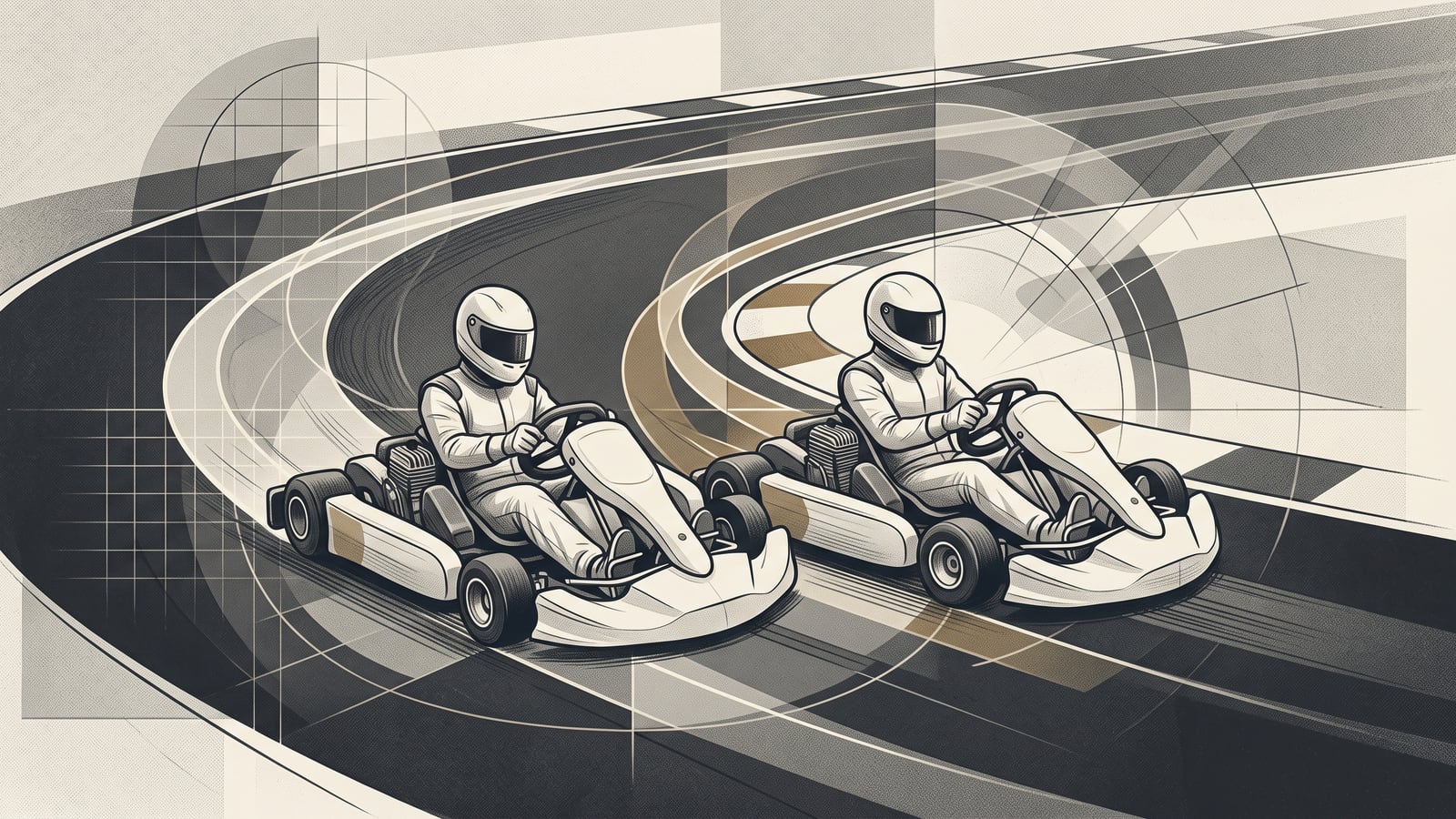
You're behind another kart, a gap opens, and you have to decide whether to push into it or let it close and wait for another chance. That kind of decision is part of what people mean by racecraft.
Here's the conservative version of the answer. A sound choice keeps you in control and gives the driver ahead something predictable to react to. It also stays inside whatever rules apply to that organiser, event, class, and season. If finishing the move depends on contact, on crowding someone off the track, on losing control yourself, or on forcing the other driver to bail out, don't finish it. Let it go instead, and leave the question of who was responsible for anything that happened to the officials who are there to judge it.
A few terms are worth pinning down first, since the rest of this guide leans on them.
In this guide, a defensive move means whatever the driver ahead does to protect their position: choosing a line, covering the inside, holding pace steady. A racing line is the path a driver is taking through the corner at that moment — it isn't a fixed rail, and whose line it "belongs" to depends on the applicable rules for your event. This guide calls the boundary of the usable track surface the track edge; whether a kart has left it, and what follows, is for the applicable rules at your event to decide. And lapping happens when a faster kart is about to pass a slower one that isn't racing it for position — a different situation from two karts fighting wheel to wheel, covered later in this guide.
None of that sets a universal overlap rule, a right-of-way rule, or a legal-pass threshold. Those depend on the applicable current rules and event documents for your event.
Four choices on track
Most encounters come down to one of four choices. None of them is described or ranked here as inherently faster, safer, or more likely to work — the evidence behind this guide doesn't support that kind of comparison.
| Choice | What it means | When it fits | What it costs or limits | Poor fit when |
|---|---|---|---|---|
| Prepare | Watch the kart ahead and the space available, without committing to a move yet | You see a possible opening but haven't confirmed it's controllable and permitted | You may end up declining the attempt entirely | Preparation itself distracts you from controlling the kart |
| Commit | Take the path you've identified, and keep taking it as long as it stays open | A controlled path exists and the move is allowed under the current rules and briefing | The situation can change mid-corner and force a rethink | The move already depends on contact, crowding, or the defending kart leaving the track |
| Abandon | Stop pressing and let the position go | The path has closed, control is doubtful, or continuing needs prohibited conduct | You give up the immediate opportunity | Used as a blanket instinct to yield even when a permitted path is genuinely there |
| Defend predictably | Pick one course and hold it | You're the kart ahead and want to protect the position within the applicable movement rules | May limit which line you can take further into the corner | It needs a second reactive direction change, or crowds the attacking kart past the edge of the track |
Prepare before you commit
Preparation isn't a technique with a proven payoff — it's watching. Before you commit to anything, look at where the kart ahead is, where its driver seems to be aiming, and whether the space you'd need is there or just looks like it might be. Notice whether you can still bail out cleanly if the gap closes. That matters as much as the opening itself: an attempt with no exit isn't preparation, it's a commitment you haven't admitted to yet.
It also means being honest that grip, kart balance, traffic, and the other driver's intentions all vary lap to lap and event to event. Nothing here claims that a particular sequence of moves or a particular corner setup makes a pass more likely or faster. What preparation buys you is time and information: the option to commit, or to quietly let the opportunity pass without anyone noticing you considered it.
Sometimes preparing means concluding, correctly, that there's nothing to commit to yet. That's not a failure — it's the whole point of doing this before the corner instead of in the middle of it.
Motorsigma's editorial decision aid
This is an editorial decision aid, not a legality test or safety guarantee, and it does not predict passing success. It's meant to help you think through an attempt in the moment, conservatively. The current governing-body and organiser rules, together with the supplementary regulations, event notes, and drivers' briefing, decide legality. Officials for the specific event, class, and season decide any incident. This decision aid decides neither.
- Prepare. Can you identify a controlled path that doesn't rely on contact or on the other driver leaving the track?
- Check. Do the conduct rules and briefing for this event permit the movement you're considering?
- Commit. Continue only while the path and the kart stay under control and your move stays predictable to the driver you're racing.
- Abandon. Abandon if the path closes or control is doubtful — do not rely on contact, crowding, or another driver's evasion to make the move work. That includes repeated defensive reaction and pushing.
- Reset. Go back to normal, predictable driving. No retaliation, no immediate second attempt to make a point.
A coach can use these five steps the same way a driver does: as a shared vocabulary for talking through a hypothetical corner rather than as a rule to be taught. Run a driver through the stages against a specific scenario — "would you still be at Commit here, or has the path already closed?" — and treat step two, checking the applicable conduct rules and briefing, as non-negotiable rather than something the framework can answer on its own.
Attack or preserve position
Attacking and defending aren't a better option and a worse one — they're two different jobs with two different obligations, and which one you're doing depends on whether you're behind or ahead.
Attacking means arranging a workable path and keeping an exit available if it disappears. That can mean giving up the immediate opportunity: you set up, the gap closes, and you try again further into the race instead of forcing it. Preserving position asks for something different — an early, predictable choice of line, made and held, with the understanding that the applicable rules may limit how much you can move and may require leaving room near the edge of the track. This guide doesn't rank attacking against preserving position by speed, safety, or success — the evidence behind this guide doesn't support that kind of comparison.
Within this framework, an attacker can keep reassessing right up until the path closes, while a defender is asked to settle on a line before the corner rather than partway through it. This is how the framework treats the two roles. It doesn't claim to describe what most drivers actually do.
Commit, abandon, or defend
Commit only holds while three things stay true together: the path is open, the kart is under control, and the move is permitted. As soon as one of those stops being true, the calculation changes — commit isn't a decision you make once and then forget about.
Abandon gives up the immediate chance, but it isn't an admission of anything, and it doesn't decide who was at fault in whatever happens next. It's the non-escalating option: you keep driving, the position stays contested, and nothing gets settled by contact.
Defending predictably means choosing one course and holding it. It doesn't mean weaving to match where the kart behind moves, or treating the space to your inside as something you're automatically owed. Under the 2026 FIA Karting code, for competitions on the CIK-FIA International Sporting Calendar, more than one defensive direction change and deliberate crowding beyond the track edge are both prohibited, along with other dangerous changes of direction. For Motorsport UK karting under the 2026 rules, a defender cannot make more than one direction change in response to each attempted overtaking manoeuvre, and is separately barred from crowding a kart beyond the track edge or making abnormal direction changes liable to hinder another driver. This guide doesn't treat a defensive move as an automatic right to block, regardless of what your event's rules say.
Two ordinary race situations
The categories above are easier to use once you can picture them. The two situations below are hypothetical: they illustrate how the same choices play out differently depending on which rules govern the encounter.
A Motorsport UK position battle
Picture a club race under Motorsport UK's 2026 rules. Two karts are fighting for position into a corner. The defender has already moved once to cover the inside, and the attacker is still there, looking for a way through.
From here, the attacker has the same choice as always: keep pressing only while a permitted, controlled path remains, or abandon if it's closed. The defender's choice is narrower than it might feel in the moment. For Motorsport UK karting under the 2026 rules, a defender cannot make more than one direction change in response to a single attempted overtaking manoeuvre. If that defender then moves back toward the racing line after defending off it, the rules require at least one kart width when returning toward the racing line — specifically, that much space between the kart and the track edge on the approach to the corner. A second reactive move in response to the same attempt, or closing that space down, turns the question from who won the corner into whether the defence stayed within the rules. That figure and that one-move limit belong to Motorsport UK's cited wording — they aren't a global standard, and other organisers may word it differently, so check what applies to your event.
Position racing and blue flags
Now picture an FIA international event, with two moments in the same session. First, two karts are racing each other directly for position. Under the 2026 FIA Karting code, for competitions on the CIK-FIA International Sporting Calendar, the cited provision allows overtaking on either side according to circumstances. It rules out more than one defensive direction change, deliberate crowding beyond the track edge, and other dangerous changes of direction. It's a position battle like any other: prepare, commit while it's controlled, abandon if it isn't.
Further into the same race, one of those karts is being lapped and sees blue flags. That's a different situation. When being lapped, the slower kart has to let the faster one through at the first possible opportunity — that's a specific duty tied to being lapped, and it is not a general duty to yield a position in an ordinary fight for track position. Treating the two as the same thing leads to the wrong response, which is exactly the distinction this guide exists to keep clear.
Check the rules that apply today
Everything above is a way of thinking about an attempt. It doesn't substitute for finding out what your event requires. Before you use any of it on track, check the current governing-body and organiser rules. Check the supplementary regulations, event notes, and drivers' briefing too. And check with the officials for the specific event, class, and season. That's not a formality — it's what turns general racecraft judgment into an answer for your race.
The two jurisdictions used as examples here stay exactly where they are. Under the 2026 FIA Karting code, the cited conduct provisions apply to competitions on the CIK-FIA International Sporting Calendar — that code also requires drivers to use the track, allows rejoining only when it's safe and doesn't gain an advantage, and lets apparent offences be reported to the stewards. The Motorsport UK wording on direction changes and kart-width space belongs specifically to 2026 Motorsport UK karting and doesn't extend beyond it.
Some events layer several documents on top of each other. The 2026 FIA Karting World Championship – Junior regulations, for instance, require observance of a stack of documents all at once:
- the International Sporting Code
- the driving-conduct code
- general and specific prescriptions
- supplementary regulations
- Race Director Event Notes
- the championship's own regulations
That's one championship's structure, shown here as an example of how the hierarchy can work — other organisers arrange their documents differently, and yours may too. None of the sources behind this guide set a universal overlap rule, a universal contact standard, a universal penalty scale, or a universal right-of-way rule. Wherever this guide has gone quiet on a specific threshold, that's deliberate. The threshold belongs to your event's documents, and a general-interest article like this one isn't positioned to set one.
Where to go next
This guide lives in the karting driving hub, alongside the mechanics of building a path through the corner in the first place. How to build a faster path through a corner covers the racing-line groundwork this framework assumes before you start fighting someone else for it. How to control a kart under braking covers the control side of "keep the kart under you" that abandon decisions depend on, and what karting flag signals require of a driver explains how officials communicate the blue flags and other signals mentioned above. From there, the wider karting section covers everything from getting started to setup and race-weekend logistics.
Your next step: open the current rulebook for your organiser and find out which current supplementary regulations, event notes, or drivers' briefing add to its conduct rules before you use the decision aid.