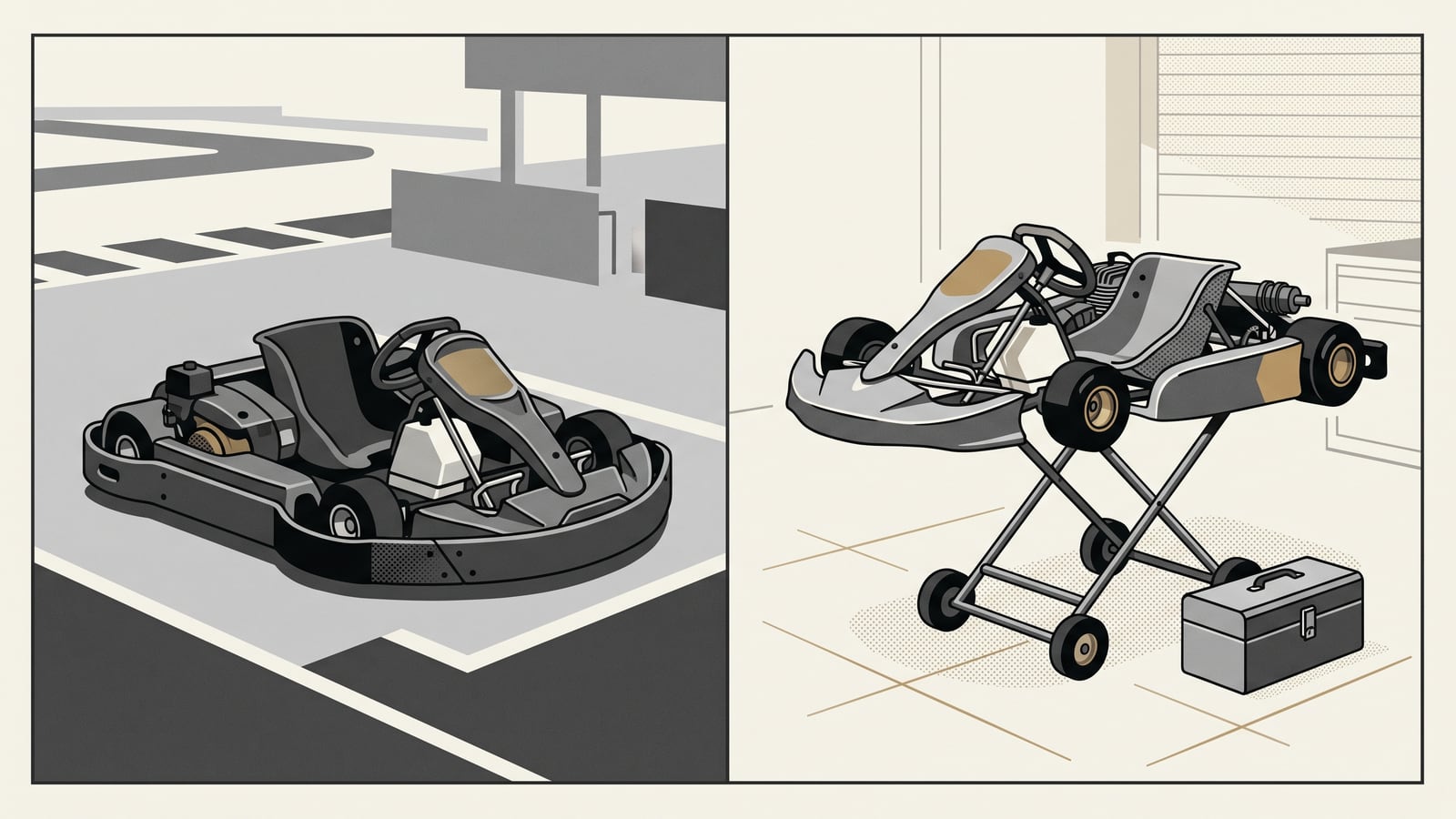
You want to try karting, and you've hit the first real fork in the road: rent, join a supported programme, or buy a kart. Investigate rental karting first if you want limited kart responsibility and a suitable local offer exists. Look at a supported arrive-and-drive programme if you want organized driving or racing with some help around it. Consider ownership if the mechanical and logistical side sounds like part of the fun, or you've already got someone lined up to share that load.
None of these is the universal starting point. Which one is a plausible first route depends on how much involvement you want, how much time and support you actually have, and what exists near you. This guide walks through what each route suits and what it doesn't, then closes with a short list of things worth confirming before you hand over any money.
Who does the work?
The label that matters isn't "owned" versus "not owned." It's who handles the kart, the transport and storage, the prep, and the trackside help.
Rental karting means a track or operator supplies and manages a kart for you to drive, usually for a session or a short series of them. The kart is the operator's problem. Your own obligations — eligibility, personal gear, insurance, whatever the venue asks of you — still depend on that specific venue and event, so check rather than assume.
Supported arrive-and-drive is an editorial umbrella we're using here, not a single fixed package. It covers arrangements where a club, organizer, or team supplies some combination of equipment and operating support. Sometimes that's just the kart; sometimes it includes fuel, tyres, and mechanical help too. Because package contents vary so much from one programme to the next, the only safe approach is to confirm in writing exactly what's included before you sign up for anything.
Owner karting means you own the kart, so equipment responsibility sits with you. That includes maintenance, tools, spares, transport, storage, and technical decisions. That said, owners may buy team support for parts of that job, so responsibilities depend on the arrangement you set up — ownership doesn't automatically mean doing everything yourself.
Budget matters too, though there's no universal figure to hand you. Get current local quotes for each route in your own currency, based on how often you'd race or drive, and check what each quote includes and excludes. Treat anything unmentioned — repairs, tyres, trackside help — as unknown, not free.
Local availability isn't just about distance, either. Weather and seasonal operating schedules can affect whether an option is usable when you can actually attend, so check whether the option you're eyeing runs on the days and in the season that work for you.
The responsibilities at a glance
| Responsibility | Rental | Supported arrive-and-drive | Owner |
|---|---|---|---|
| Kart and equipment | Operator supplies and manages it | Programme supplies some or all — confirm which | You supply it |
| Transport and storage | Handled by the operator; your own logistics still depend on the venue | Depends on the programme; some handle it | Usually yours, unless you arrange support |
| Prep and maintenance | Handled by the operator | Depends on the programme | Usually yours, guided by manuals for your kart |
| Competition support | Depends on the operator and event | Package-specific — confirm what's included | Yours to arrange, or buy in |
| Local availability and cost | Depends on what's nearby and its schedule | Depends on what's nearby and its schedule | Depends on what's nearby and its schedule |
Choose by fit
The three routes answer different questions about involvement, time, and support, and none ranks above the others. Each may suit a different mix of driving interest, competition interest, mechanical appetite, free time, and what's available near you.
Rental karting
Rental can be the simplest first step if you want limited equipment responsibility and a suitable local format exists.
Advantages:
- The operator supplies and manages the kart, so there's nothing to store, transport, or fix between sessions.
- Some formats let you drive, and occasionally race, without ever owning a kart.
- Your involvement stays limited to showing up and driving, within whatever the local venue offers and requires.
Tradeoffs:
- Session formats, equipment, support, eligibility, and terms all vary by operator.
- You're dependent on whatever format the local venue happens to run.
- The available evidence doesn't support comparing rental to the other routes on cost, safety, or progression.
Poor fit: no suitable rental format nearby, a strong wish to manage your own equipment, or an offer that doesn't match the kind of participation you want.
Supported arrive-and-drive
A supported programme can be a good first step for organized driving or racing, when a club, organizer, or team offers a package that fills the gaps you can't fill yourself — provided you can find one locally and get its contents in writing.
In the UK, Motorsport UK says many circuits and teams offer packages that include a kart, fuel, tyres, and mechanical support, though not every package matches that description. The FIA has described a programme in which national sporting authorities work with local tracks or rental providers to run competition on rental equipment; one concrete instance is the 2026 FIA Karting Arrive & Drive European Championship – Junior, whose current regulations specify a turnkey package including a kart, trolley, fuel, slick tyres, and awning rental. The clearest illustration of responsibility transfer, though, is Rotax's separate club model: the club, not the driver, handles storage, transport, and setup — the provider describes its own programme, but it shows a supported arrangement can remove a substantial amount of off-track work when that's what it's built to do.
Advantages:
- A programme may supply the kart and selected consumables or infrastructure.
- Some models move storage, transport, setup, or trackside work onto a club or team.
- Support can make racing realistic for someone without a home workshop or family mechanical help.
Tradeoffs:
- There's no fixed package — you have to verify the specific offer rather than assume it matches another one you've heard about.
- Repairs, personal gear, transport, consumables, and trackside help all need checking programme by programme.
- Availability, eligibility, and value can't be inferred from any single example, including the ones named above.
Poor fit: you can't get a clear written package description, no suitable local programme exists, or you want to own and develop your own equipment.
Owner karting
Ownership can be the right first step if you want equipment and mechanical involvement and can arrange the logistics — or you've lined up support for the parts you can't cover yourself.
Rotax describes several considerations for owners: maintenance, tools, and spares; transport or team space; technical responsibility; and local regulatory checks. It also shows owners may buy team support for storage, technical work, or transport, so owning a kart doesn't mean doing every task alone.
Advantages:
- You choose which duties to keep and which to buy as support.
- It suits someone who wants prep and maintenance to feel like part of the hobby rather than a chore.
- Team support can absorb storage, transport, or technical work under an arrangement you set up.
Tradeoffs:
- Maintenance, tools, spares, transport, storage, and technical responsibility may fall to the owner, depending on the support arrangement.
- Procedures and intervals depend on the exact kart and components you own. The ROTAX 125 MAX DD2 evo manual, for instance, documents recurring maintenance and transport or preservation tasks specific to that engine — always work from the current manufacturer manuals for your exact kart and components rather than a general rule.
- Owning the equipment doesn't by itself mean lower cost, better performance, or faster progress.
Poor fit: no storage or transport and no verified support arrangement, mechanical and logistical work that would make it unsustainable, or you're not yet ready to check manuals, local rules, and who does what.
Three ordinary situations
These are hypothetical situations meant to show the practical contrast, not real cases we observed.
A parent's child wants to try karting, but the family has no kart transport, no storage space, and no maintenance experience. A local rental session puts the kart supply entirely with the operator, which may make it the simplest route to check first. If the child later wants organized competition, a supported programme could become plausible — but only if its written package covers the logistics the family is missing. Buying a kart here would just shift that same problem onto the family without solving it.
An adult hobbyist has storage and transport sorted, enjoys mechanical work, but only has a few free weekends a month. Owner karting fits the interest in wrenching, but it adds prep and maintenance on top of driving time. Rental may leave more of those limited weekends for driving itself. A supported arrangement could split the difference, if a local provider handles the parts of the job that eat the most time.
A new driver wants organized competition but has neither a workshop nor a family member able to prep a kart. A club, organizer, or team-supported programme may bridge that gap. But the driver still has to verify exactly what's included before assuming transport, repairs, tyres, or trackside help come with it. Local rental competition might exist too. Buying a kart wouldn't close the support gap on its own unless the driver also lines up transport, storage, and maintenance help.
What these situations share is the same first question: who does the work around the driving.
What to verify
Once you've narrowed things down, confirm the details before committing money. Requirements and offers can vary by venue, operator, organizer, club, governing authority, class, age, and season. So check current local requirements with the venue or operator, the organizer or club, and the relevant governing authority — don't assume one of them speaks for the others.
Before you sign up or hand over a deposit, ask for or check:
- A current written description of exactly what's included and excluded for equipment: kart, fuel, tyres, transport, and storage.
- The same for operations: preparation, maintenance, tools, spares, repairs, and trackside support.
- Eligibility, age, and licensing requirements for the class and event.
- Personal equipment and insurance requirements.
- Event-day rules and format.
- If you're taking on maintenance or transport yourself, the current manufacturer manuals for your exact kart, engine, and components — procedures and intervals are product-specific and shouldn't be generalized from another kart.
- Current local quotes for your likely level of participation, in your own currency, treating anything unquoted as unknown rather than free.
Where to go next
This article sits in the getting-started hub, alongside guidance on choosing a class and club that fits how you want to participate, on building a local first-season budget before you buy anything, and on what to check before buying a used kart. From there, the wider karting section covers driving, setup, maintenance, and racing once you've picked a route.
Your next step: For the route you currently favour, get a written statement of what the provider supplies and what you'll need to arrange yourself.